 | ||
 | ||
|
PICTURES HERBS GEMS PICTURE WHAT YOU SEE IN YOUR MINDS EYE! 
| ||
|

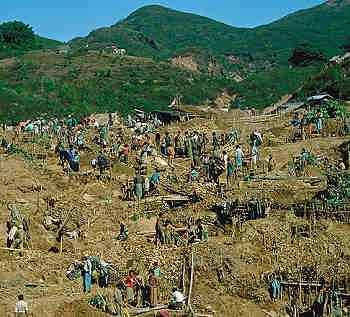
Just outside this arid boomtown, a dozen mini buses called "bush taxis" ply a landscape of red rock formations, grasslands and huge craters left by thousands of miners looking for the "Big Big."
The "Big Big" is a large sapphire stone that can fetch up to $2,700, or the equivalent of 10 years of work for the average Malagasy, whose per capita annual income is $260.
Although there are no official figures, observers say hundreds of thousands of dollars in profits from the gem trade changes hands every day in the town. With that kind of money to be made in one of the world's poorest nations, 100, 000 fortune hunters gripped with "blue fever" have migrated to this once remote southern village since the first sapphire was discovered two years ago.
At that time, Ilakaka was a cattle-herding hamlet of just 30 inhabitants. Now it is an African version of a Klondike gold rush town with 20,000 huts, nightclubs, brothels and gamblers. And more people keep coming.
On most days, overcrowded buses on National Route 7, one of Madagascar's few paved highways, bring newcomers who arrive with all their worldly possessions piled high atop the bus. The pavement ends at the bus station, which is also the best place to buy overpriced mining equipment, rum, clothes, and sporting goods with the Chicago Bulls logo.
At the mines, bare-chested diggers work from dawn to dusk in human chains, passing dirt in 33-pound bags from the bottom of the pit to the surface, where it is panned for gems. Children, most of whom have dropped out of school, help their parents sift through red clay looking for the precious stones.
Augustin -- most Malagasy are known by their first name -- was a retired Lutheran pastor before coming to Ilakaka. The 64-year-old former clergyman uprooted hisfamily of eight from the nearby coastal town of Tulear to help him look for sapphires. "It is for their future," he said.
Augustin is a patron, or boss, who employs three or four younger men to dig.
Fano is another patron, whose employees dig without ropes or any other safety equipment. In 1999, 216 men died from mining accidents, the majority from cave- ins and falls, according to local miners.
Fano boasts that his crew once found 300 grams of gems -- worth $50 to $200 a gram depending on quality -- in a single day.
But for every get-rich-quick story, there are dozens of tales of failure. Rene Fernand is the president of a fokontany, or village assembly. He has yet to find anything other than the tiniest of stones. Most men wind up digging for $2 a day plus food and sodas if the boss is "generous." With any luck, they can become a patron or a middleman, taking a cut for deals between the miners and the buyers. The diggers are largely Malagasy who typically sell gems below market value to Asian and European buyers.
The real winners are the foreigners -- Thais, Sri Lankans, French, Swiss, even some Americans. Some are gem company buyers with plenty of cash; others are gem cutters or owners of bulldozers and hauling trucks. Some fly in by private plane several times a week to buy sapphires, communicating with their firms by satellite phone.
A stroll through Ilakaka's "Big Boss" neighborhoods shows a two-tier economy: This is where most foreigners live, buy and sell sapphires behind enclosed brick compounds protected by security guards.
Those with sapphire gems often look for Malagasy women who stroll the main drag or frequent bars and restaurants in platform heels and gold jewelry. At the Mahahera nightclub, which is little more than a fenced-in dirt circle with a generator that runs a sound system, the party goes on until the town lights are shut off at 10 p.m. Afterward, it often continues at one of Ilakaka's two hotels or behind the walls of a trader's compound.
In contrast, most miners live in thatched huts crammed together on paved streets, with no sanitation or running water. At Bepeha, a village that has the look of a refugee camp, 5,000 residents live in triangular homes no more than three feet high, six feet across and 10 feet long. They use the nearby Ilakaka River, which gave the town its name, for drinking water, washing clothes and bathing. It is a "cholera epidemic waiting to happen," according to a recent guidebook.
At a time when the government is battling a nationwide cholera outbreak, only the charity group Catholic Relief Services has stepped in to stop the spread of the disease in Ilakaka. More than 1,200 people have died from cholera in Madagascar since the first outbreak past year. "The most difficult thing has been changing the mentality (of many Malagasy about hygiene)," said one CRS worker.
More locals have died from gunbattles over gems and money than from contaminated water. In a page out of the Wild West, men saunter down the streets with guns at their hips. In the last year, at least 15 locals have been killed, and many miners bury their gems in their huts to protect them from robbers. Poorly paid police officers would rather dig for sapphires than restore law and order.
The violence has also spilled into Isalo National Park, which begins at the edge of town. When park guards tried to stop some 1,000 prospectors from breaking through a fence last year, they were forced to retreat from a hail of rocks. Within hours, the miners had claimed more than 50 acres of land in a park known for its Arizona-like sandstone canyons, natural pools, rare plant species and a population of ring-tailed lemurs. The miners were eventually evicted by authorities, but environmentalists are angry that concessions have been granted to mining companies in a six-mile stretch of protected land around the park.
Meanwhile, some Ilakaka residents who left their poverty stricken origins in hopes of striking it rich are returning.
Rollande Rosie Razananirina, a young mother who wears the traditional sarong called a lamboana, left her job as a radio journalist six months ago to run a shack bar. Her mother had urged her to seek her fortune despite the area's reputation for violence, disease and empty dreams. Razananirina says she will soon return to her native city of Fort Dauphin so her young son can start school. Her husband, however, will keep mining.
"So far, we have only found the smallest sapphires," she said. "We are waiting for the Big Big."
|
If you have come to this page from an outside location click here to get back to mindfully.org |
STAY AWHILE RELAX IN THE SUN DRINK SOME STRONG COFFEE FIRST TO INTERNALIZE YOUR SUN-SKREEN
AND STAY AWAKE NOT TO BURN!
 HEAVEY METAL WORKING PAGE
  100 TRANSLATOR-bultra.com
HEAVY METAL WORKSHOP ALL ALLOYS
TOOLS AND DATABASES FOR ODD JOBS
HISTORY OF GOLD AND MONEY AND RESULTING CAOS
 THE UNTOLDSTORY
 BOOKS ON GEMSTONES JEWELRY MAKING AND RELATED ARTS AND LINKS!
 MINERALS DATABASE
HARD ROCK MININGGOLD
GEM STONE JASPER CHERT JADE JADITEDISCRIPTIONS
SOAP MANUFACTURERS NO MISTAKE LYE TO OIL LYE CALCULATOR GET RATIO'S RIGHT FIRST TIMEMINERALS IDENTIFICATION GEM - GEM,MINERAL.WORLDS
MINERALS DATABASE
ROCKHOUND-GEM-CLASSIFIED ADDS -
A Compendium of On-Line Soil Survey Information Chemistry,Satalite Maping!
-MINERALS ON LAND,MOUNTAIN DISTRIBUTION OF NUTRIENTS
ACTIVE GOLD MINEAUSTRAILIA
GOLD-CHERT-ASSAYPROSPECTOR MINER INFORMATIONS
MINES AND LAND RESOURCE EXPERTS & DATABASES> -NORTHERN RESOURCES LINKSGEOPHYSICS TOOLS AND PROGRAMS FOR RESEARCH OF PLATES,FIELDS,MINERALOGY
SILVER DIRECTORY SILVER INFO AND CONTACTS
SMELTERS AND METALS DIRECTORY http://www.asarco.comSILVER INFO AND CONTACTS
http://www.engelhard.com/eibprices METALS AND MINERALSPRICE DATABASE
BUSINESS DATABASES> - BUSINESS CONTACTS
2FREE CLASSIFIEDS SELL ONLINEBUY SELL CONTACTS -http://www.sell.com
3FREE CLASSIFIEDS SELL ONLINEBUY SELL CONTACTS-http://www.hoobly.com/
THESE OLD HERBALISTS ARE STILL IN THE TOP RANKS OF MEDICINAL CURE DEALERS
THEIR CURES ARE FINE AND THEY UNDERSTOOD WE AND OUR ENVIROMENT
SYMBIOTIC CO-HABITANTS OF A MULTIDIMENTIONAL HELIOCENTRIC INTERGALACTIC OPERATION OF SOME SORT!
 The Eclectic Materia HERBS Medica,eg: Ribes rubrum, red currant
 ANOTHER EASY TO READ HERBAL PLANT LIST=ETC
http://www.swsbm.com/FelterMM/Inula-Felter.jpg
ANOTHER EASY TO READ HERBAL PLANT LIST=ETC
http://www.swsbm.com/FelterMM/Inula-Felter.jpg
 ANOTHER EASY 10 MB FREE MAIL!http://WWW.FASTMAIL.FMBETTER AND MORE FOR LESS THE SAPPHIREPLANET WAY"AND YOU CAN KNOW THE TRUTH AND GET FREE!"
 A SMALL FINE ASSORTMENT OF HERBAL HEALING,MINERALS AND METALS AND WORLD TRADE DATABASES WORKING ON THE PRINCIPALFREE TRADE AND GARDENING IS WORTH IT CAUSE YOU AND YOUR KIDS DISERVER THE BEST AND CAN GROW IT IN THE BACK YARD!
 BIG TIME METALS LINKS,DEALERS AND PLATERS
PLUS AN ANTI INVASION VIRUS SCANNER FOR YOUR COMPUTER!
BIG TIME METALS LINKS,DEALERS AND PLATERS
PLUS AN ANTI INVASION VIRUS SCANNER FOR YOUR COMPUTER!
MINERALS AND MINES WORLDWIDE ExcaliburMineral.PEEKSKILL NY
http://www.searchenginecolossus.com
 OVER 93 WORLD WIDE COUNTRY BASE SEARCH ENGINES HERE AT
 MINERALS FORUM EXCHANGE WITH EXPERTS AND AMATURES ALIKE.
GOLD BLOOM AND THE CERTAIN KNOWLEDGE AND HOW PROSPECTORS GET TO THAT POINT! EGZAMPLE! RANDOM COMPANY PROFILE WITH REFFERENCES-NOT AN ENDORSEMENT.-FOR GEO EDU.
http://www.shabait.com/articles/publish/article_337.html Nevsun Resources is doing gold and base metal exploration works in Eritrea. Exploration involves several steps of work. The first step is acquiring permits and ground to work followed by initial prospecting surveys which include examination of previous data, maps, topographic maps, landsat images, air photos and setting up logistics etc. These activities are supported through ground controls over the license area. The first step also involves inquiring with the local people and administrations regarding the past history of the prospect area, any history of current or old gold panning activities in the area etc. All plausible steps are taken to get acquainted with the prospect area. After these initial surveys a work program and budget is developed. Activities in the work program include examination of outcrops and rock chip sampling, soil and stream sediment sampling, mapping at an appropriate scale and so forth. Each of these activities is guided by a specific orientation survey results. The above is possible under a government permit called “Prospecting License” which allows an area of 100 sq. km. and lasts for one year. After a satisfactory completion of the prospecting survey requirements another higher up license called “Exploration License” is issued. It has an elevated commitment of works and budgets to be carried out over a period of three years. Currently, Nevsun Resources is working under exploration license over the Bisha area. Exploration drilling has already been underway, what are the developments? Recently we have completed airborne and ground geophysical surveys and mechanical trenching. The geophysical surveys (EM and Gravity) were used to locate conductors buried deep in the ground and the trenching is used to expose anomalous ground covered by soil or sand. At the moment we are conducting a diamond-drilling program pursuing conductors located through the geophysical surveys. To date we have drilled 53 holes, and we have been successful in locating the conductors. Each hole could go up to 200m deep depending on the outcome of the drilling, and it is the geologist on site who decides how deep to go. Results (rock chemical data) for the first 24 holes are in and they are very encouraging. Results for the remainder of the holes are forthcoming. The current drilling program will cover 6500m of core drilling. What do you mean by ‘encouraging results’? In this case encouraging results means high-grade gold and base metals continue to be discovered as we keep drilling. In technical terms, at Bisha we have discovered a synclinal (concave upward) rock structure that hosts a significant sulfide (metallic mineral) body capped by a gold enriched oxide iron horizon followed by a supergene (enriched) copper horizon. The oxide gold horizon appears to be up to 35m thick while the underlying supergene copper horizon is 30-35 meters thick. All of the above is underlain by primary massive sulfides. We have drill tested 900m of strike length of similar structures. More extension and drill testing of the structure is to come in the next drilling program. The Bisha deposit is now labeled as a Volcanogenic Massive sulfide (VMS) deposit with a high grade gold cap. What does ‘high-grade’ mean in simple terms? High grade means above average concentration of ore mineral in a given bulk material. Bisha is high grade but we still have to figure out the tonnage, metallurgical feasibility and other infrastructure and logistical matters before considering it for production.AMID WORMWOOD,MUGWART AND TEA OF HORSECHESTNUT LEAVES ASHWAGANDA
 ENRICH YOUR LIFE WITH THE STUDY OF
 METAL CASTING TUTORIALS FOR CREATORS AND THE CURIOUS!
CLICK ALEXANDERSA WILD CELERY LIKE ANGELICA
WITH ESTROGEN RICH
ROOTSTOCKS THAT COOK
WELL-BIANNUAL SYSTEM
 HANDY search space for when the glorious pages don't fly!


E-MAIL WITH ENCRYPTION SECURITY FREE <>/H3
THAT AIN'T A STAR UP THERE-SATURNS-DAY-NIGHT-LIVE!
-Barclays in The Caribbean - Anguilla
A COUPLE OF OFSHORE BANKS TO LET YOU CHECK THE IDEA BEFORE YOULOOK THEM UP ON THE SEARCH ENGINES.
 Caribbean Development Bank
www.caribank.org
AUSTRAILIAN GEMS ONLINE!
universe-city.2ya.com <IMG src="http://www.geocities.com/eagal14u/Photo8.jpg" height=79width=55alt= ALIGN=bottom VSPACE=12 BORDER=2></A>
>
KNOW HOW ENCYCLOPEDIA
Household_Cyclopedia_of_General_Information/
 MATURES TEAS A SITE TO RESEARCH FLOWERING PLANTS FOR THE HOMESTEAD
 SOUTH WEST NORTH AMERICAN MINERALS
 MINERALS FORUM EXCHANGE WITH EXPERTS AND AMATURES ALIKE.
  SOUTH WEST NORTH AMERICAN MINERALS
TI-FOR THE TILLUEL-MAN
CHEEP TEAS AND HERBS
 http.2020siteorg-assayASSAY TECH FROM 1800'S
http://www.2020site.org/trees/hornbeam.html
 http.2020org-SERIOUS HOW TO'ZASSAY TECH FROM 1800'S AND OTHER HOW TO'Z
2020site.org
 http.2020org-SERIOUS HOW TO'ZASSAY TECH FROM 1800'S AND OTHER HOW TO'Z
electronic_publications
 http://intranet.essinfosst.ess.nrcan.gc.ca/esic/electronic_publications_e.htmlELECTRONIC ROCK AND MINERALS GOVERNMENT DATABASES FOR PUBLIC USE.
Publicbookshelf.com-General_Information/
Read aboutPARASITE SELF DEFENSE!Trichinae informationHousehold_Cyclopedia_of_General_Information/
SAPHIREROAD JOBS AND CONECTIVE SEARCHENGINES
 back to top of page
 MINERAL DA
TA
Gemstones of the Bible reprinted all acknowlegements to the Author(s).
MINERAL DA
TA
Gemstones of the Bible reprinted all acknowlegements to the Author(s).
 |
Gemstones of the Bible The 12 stones of the Foundation of the New Temple of Jerusalem, as mentioned in Revelations A summary by J. Michael Howard IT IS INTERESTING to note that although the ancients were not well versed in the science of mineralogy, they did know and have names for the many commonly used minerals and stones of their day. A number of these can be directly traced back to the mineral, gem, or type of stone they used. However, some are clouded, now and forever, by the veil of time. Lack of specific information about the characteristics, particularly color, is not available. So you will find much speculation in the literature. The translation of the original Hebrew language by the early Greeks and then translation by later writers from the ancient Grecian language has added to the confusion. The 12 stones mentioned in Revelations actually are earlier mentioned in Isaiah as three types in the verses:
It is perhaps easier to understand why 12 stones are mentioned in Revelations as 12 is an important number in the Bible. The 12 tribes of Israel. The 12 apostles. The 12 stones of the foundation of the New Temple of Jerusalem. Our best knowledge of the characteristics of these 12 stones come by considering the 12 stones of the Breastplate of the High Priest of Israel, each representing a tribe of Israel. One of the earliest writers to associate with the apostles the symbolism of the 12 gems as given in Revelations is Andreas, bishop of Caesurae. For a long time, he was thought to have lived in the 5th century AD, but is now known to have lived in the last half of the 10th century AD. He gives a brief description of the 12 stones, which is recounted in George F. Kunz's book The Curious Lore of Precious Stones (1913). Please note: the names given below are the names as in Revelations, not necessarily what the stone would be called today:
On pages 289 - 301 of Kunz's book, we find information concerning the ancient names of the stones and what they are named today. In the following list, the ancient or biblical name is given, followed by the modern name in parentheses. They are: Sardius (Carnelian), Topaz (Peridot), Chalcedony (Emerald), Emerald (Almandine garnet), Sapphire (Lapis Lazuli), Sardonyx (Onyx), Jacinth (Agate), Amethystos (Amethyst), Chrysoprase (Citrine), Agate(Agate), Jasper (Jasper), and Onyx (Turquoise). Also in this book, we find the following information about each of these stones (the original Hebrew name is given in italics): Sardius or Carnelian: Hebrew name of Odem. Carnelian is a translucent hard fine-grained variety of orangish red quartz, that has often been used for ring stones and wax seals. Topaz or Peridot: Hebrew name of Pitdah. The Hebrew word appears derived from a Sanscrit word meaning yellow. Some theologians think it could have been serpentine. But the topazius of ancient writers almost always signified the gem variety of olivine called peridot. Chalcedony or Emerald: Hebrew name of Bareketh. There is some confusion concerning this stone due to the fact that chalcedony is a milk-white fine-grained variety of quartz and the non-gem form of emerald (beryl) is typically a sea-green to grayish to white hard mineral that forms six sided elongate crystals. All emeralds are relatively uncommon in occurrence, whereas chalcedony is fairly common. Both minerals are relatively resistant to weathering and might be found in river gravels or on the surface of the ground. It is known that there were active emerald mines during this time providing this stone to Egypt. Emerald or Garnet: Hebrew name of Nophek. The literal translation of the ancient Hebrew name means glowing coal. So this could not be the green stone we call emerald, but instead is thought to be a bright red variety of garnet: almandine. Sapphire or Lapis Lazuli: The Hebrew name of Sappir. The sacred character of this stone was attested by the tradition that the Law given to Moses on the Mount was engraved on tablets of sapphire. This is not the blue sapphire we think of as the faceted gemstone, but instead the rich blue stone now relatively popular in jewelry known as lapis or lapis lazuli. It was well known and often used by the ancients as a blue paint pigment when ground to a powder. Much of what is now sold comes from Afghanistan. Sardonyx or Onyx: Hebrew name of Yahalom. The traditional interpretation is onyx. Some Greek writers considered it to mean diamond as the translation of the Hebrew word means to smite or cut. But their is no evidence that the Hebrews knew of diamond. However, onyx was a well known stone which was carved into seals and used with wax. So the term to smite may mean to strike as with a seal on hot wax. Onyx is a fairly common soft stone, composed of calcium carbonate and deposited in caves. Much banded onyx today is cut and polished as inexpensive novelty items. Jacinth or Agate: Hebrew name of Lesham. The name signifies the tribe of Joseph. Scholars have great disagreement on this stone as we have no good guide to know what it was for certain. Some think it could be amber. Others suggest a brown variety of sapphire. However, brown agate is known to have been commonly worn by the Hebrews during their early history and, therefore, would seem to have greater significance as one of the New Temple's foundation stones. Amethyst: Hebrew name of Ahlamah. The Hebrew word is directly translated as amethyst. Abundant supplies of this violet to purple variety of crystalline quartz were available from both Arabia and Syria. Chrysoprase or Citrine: Hebrew name of Tarshish. The original stone of the Hebrews came from Phoenician mines in what is now Spain. Black quartz crystal was heated until it turned a pale golden brown color. The Hebrew word literally means golden stone and was given to the region that produced it : Tartessus. Agate: Hebrew name of Shebo. A banded variety of agate, commonly used by Egyptians, had distinctive gray and white alternating bands which would have contrasted well with the other varieties of fine-grained quartz. Jasper: The ancient Hebrew name was Yashpheh. A translucent stone of green hue. Jasper has been known from early times as a fine-grained variety of quartz. It occurs in many different colors and hues, but green was particularly valued. An early variety discovered in India and still mined there today is called bloodstone. It is dark to medium green with small spots of red scattered throughout. It has been said that it originated when Christ's blood fell to the ground and was scattered on the rocks under the Cross, which is a nice story but was used and prized in India long before Christ's birth. However, many early Christians wore it to remind them of Christ's sacrifice. Onyx or Turquoise: Hebrew name of Shoham. The Catholic translation is onyx, whereas the earlier translators considered this stone beryl. However, there is little to guide us. Some theologians have suggest this stone might have been malachite, a green stone well known to the Egyptians. However, the discovery of ancient turquoise mines on the Sinai Peninsula, which were worked by the Egyptians reveal the distinct possibility this stone was actually pale green or pastel blue turquoise. There is another interesting reference source, a book by Max Bauer, originally published in German, translated into English entitled Precious Stones (1904, republished in 1968). The following information pertaining to possible sources of these stones was located in Bauer's book. Carnelian would have come from India, where it is recovered as both river gravels and pebbles and from encrusting masses at the sites of its formation. Since it is a variety of quartz, it is relatively hard. Its color is due to the amount of iron present, strongly colored natural stones considered to be "masculine"whereas paler stones were thought to be "feminine". Carnelian is still recovered today from India. Almost all are heat treated to cause a more pronounced color as most are pale when mined or collected. Peridot is the gem variety of olivine, a mineral that is commonly present in basaltic volcanic rocks. To be considered a gemstone, the mineral must be perfectly pure, clear, and transparent, and free of all flaws. Egypt is considered a possible source, especially Upper Egypt, east of Esneh between the Red Sea and the Nile. The source of emerald was with no doubt mines which are located in Upper Egypt, not far from the coast of the Red Sea and south of Kosseir. These mines were extensively developed both as surface and underground excavations. Emeralds from here graced Cleopatra and other rulers of her time. The excavations were lost and forgotten for centuries, thought to be simply another legend. But excavations at Pompeii and Herculaneum uncovered emeralds from this source. They were re-discovered by Cailliaud, who with official permission, reopened them for mining in 1819. His mining attempt ended in failure, for at a later date, baskets of emerald-bearing rock were recovered where his miners left them. The site is 15 miles west of the Wadi Chamal, with 2 groupings of mines about 10 miles apart. There are 100s of shafts driven into the hill, which stands some 600 to 700 feet above the surrounding plain. Some of the individual mines are large enough to have held 400 men working at a time. Obviously, this was a type of labor relegated to slaves and/or criminals. The rock is a dark mica schist (metamorphic) and the average emeralds are of poor quality, but the mines probably produced some high quality stones, which went to the Egyptian rulers. Almandine is a deep red variety of garnet with was called carbuncle by the ancients. The closest known source of any significance is India, where almandine has been produced from earliest times. Almandine is a mineral of metamorphic rocks, and it may be that ancient, now unknown, mines in Upper Egypt existed. No mention of any source closer than India is given in Bauer's book. Lapis lazuli used by the ancient Egyptians is almost certainly from the early mines at Badakshan in the northeast corner of Afghanistan on the upper reaches of the River Oxus. Marco Polo first described this and nearby ruby localities as early as 1271 AD, but these mines had been worked for centuries before that. Their product reaching most of the early civilized world by well establish trade routes. The region is sill very remote. Mining still takes place by primitive methods. The "sapphire" that was carved into scarabs by Egyptian craftsmen were obviously lapis. Onyx is a fairly soft stone, composed of calcium carbonate. It composes much of the common decorations in caves as the various types of formations. Onyx-alabaster is well known from the caves of Egypt and has been worked since ancient times. Cave-formation onyx has distinctive banding and is often pale yellowish tan in color. Agate (brown) is a variety of fine-grained quartz. Brown agate owes its color to traces of oxidized iron scattered throughout the stone. It is not uncommon and stream pebbles of this stone would become translucent by contact with the skin, where they would pick up oils that would penetrate the stone. Agate is a common stone, filling the gas cavities (amygdules) in lava flows by the circulation of late silica-rich waters. India has tremendous sources of agate from the Deccan traps, a series of layered lava flows across 100s of square miles. I don't know of lava flows in Egypt or other countries in the Middle East, but there are likely some present which could have been the source of the brown agate of the Israelites. Amethyst is a purple variety of crystalline quartz, very similar to our own colorless rock crystal. Amethyst commonly forms as linings and fillings of gas cavities in igneous rock in a manner similar to agate, but as crystals, not as coatings of silica. Again, I can find no source in the immediate area of the Middle East, but amethyst is occasionally recovered from India, but is not a particularly common mineral there. Citrine is a yellow variety of crystalline quartz, similar to amethyst and rock crystal. The natural color may vary from brownish yellow to golden yellow to honey yellow to pale almost colorless yellow. However, it has been known from early times that by heating poorly colored or pale amethyst, you can produce golden to orange citrine. Natural crystals of citrine are truly uncommon. It is a mineral which again is sometimes encountered as infillings or crystals in gas cavities in lava flows. I could find no local source in the Middle East. Agate (banded) may or may not exhibit banding, depending on the conditions of its formation. Banded agate is formed by periodic chemical changes in the water that is depositing it, resulting in color differences in each band. Often the layers appear to be like the growth rings of a tree, except forming from the cavity wall inward. Some cyclical banding, with repetitious pastel coloring is reminiscent of seasonal fluctuations or changes, perhaps of local ground-water conditions. Banding may also be related to fluctuations in hot springs systems. The nearest deposits appear to be India, being associated with basaltic lava flows. Jasper today is usually considered to be an opaque stone, but translucent varieties of variously colored fine-grained quartz were probably also considered jasper in Biblical times. Jasper forms under many different conditions and has a wide variety of colors, patterns, and varietal names. A few varieties named for color include red jasper, blue jasper, yellow jasper, green jasper, and brown jasper. The strong coloration is due to a great amount of impurities incorporated into the stone during its formation. It is not uncommon in metal ore bodies, where the host rock is replaced by silica. Jasper is extremely common and was probably available from several local Middle Eastern sites. Turquoise is a secondary mineral that forms where copper minerals have weathered. It is fine-grained, opaque, harder than many of the common copper minerals, and the best varieties have a beautiful robin's egg blue color. It was mined as a gemstone in ancient times on the Sinai Peninsula, the mines having been rediscovered in the 19th century. The most important mines for turquoise in the world are located in ancient Persia (presently Turkey). The mines have yielded high quality blue cutting material for over 2,000 years. The last item to consider about the 12 stones is the significance of color. All have either strong color or are well patterned. The colors or patterns are, as recounted by Andreas (the 10th century bishop, remember?): green, blue, red, translucent tan, orange, golden, sky blue, purple. The colors of the stones have their own Christian symbolic meaning, as noted by Bauer (p. 273-274): Green: Canonical color for use on Sunday. Hope, joy, and the bright promises of youth. One also thinks of constancy of the evergreen's foliage. Blue and Sky Blue: An emblem of the Celestial regions and Celestial virtues. Not employed in the decoration of Churches normally. However, in Christian art, the Virgin, Saints, and Angels are often depicted in blue robes. Red: This color is used in ceremonies concerned with the Pentecost, and at various religious feasts. It suggests and symbolizes suffering and martyrdom for the faith, and the supreme sacrifice of Christ upon the Cross. Divine love and majesty are also typified by this color. Dull yellow or tan: The color has a connotation of treachery and envy. Hence Judas was dressed in a dull yellow or tan clothing. Heretics were required to wear clothing of this hue when they were condemned to the stake in Medieval times. Orange and golden yellow: This color is emblematic of God's goodness and of faith and good works. The color of the sun from the beginning of man's recognition of things spiritual has had major significance. Violet: A canonical color which is appropriate for use during Lent, and on Advent Sunday, along with Septuagesima and Quinquagesima Sundays. The chastening and purifying effects of suffering find expression in this color. Two commonly encountered colors in stones are obvious in their absence from the 12 stones of the Foundation. They are white and black. White symbolizes purity, of the Virgin, of saints, of the angels, and of innocence, faith, light, and life. No wonder it is the color for Easter and Christmas. Black is a canonical color and symbolizes death, mourning, and sorrow inspired by death. It is only appropriate in Church on Good Friday, when it symbolizes the sorrow and despair of the Christian community at Christ's death. As important, common, and symbolically significant as these colors are, I am surprised that they are not colors of any of the stones mentioned in Revelations. Because the stones were chosen for the 12 tribes of Israel before the birth of Christ, I can understand no Christian significance. However, because white is strongly associated with purity and righteousness and black being the opposite, perhaps these colors were intentionally left out so that no tribe of Israel would be considered of greater consequence than any other. MINERALS CRYSTALIZE THOUGHTS GOD LOVES YOU
|


