
 |
 |
 |
 |
 |
 |
 |
 |
 |
 |
|
|
 |
 |
|
|
 |
|
Dyeing process has been undergoing drastic changes.
Today, latest technology is making the dyeing process faster along with
being economical and most importantly conforming to the exact
environmental specifications. Discussed here are such path breaking
Dyeing processes. |
|
|
What is Dye »
New Dyeing Concepts
With the passage of time new researches have led to
newer ways to dye that is fast, involves less expenditure, dyeing of
blended fibers and conforms to the environmental guidelines. In the
pages two of very recent developments have been described here. One is
the latest state-of-the art Dyeing with supercritical fluids, second is
Union Dyeing and the third is the Pigment Precursor.
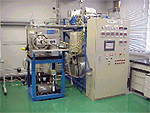
Dyeing and the allied industries have often been in
the scanner of the environmental watch dogs for large scale pollution of
the environment. In fact it has assumed the status of a global problem.
Considerable researches has been done in this field to come out with
technologies that are environmentally much cleaner. One of the
technologies that has evolved is the use of supercritical carbon dioxide
as the dye solvent, instead of water.
The diagram above shows an apparatus for dyeing, using supercritical carbon dioxide. The machine consists of the following:
The dyeing system using supercritical carbon dioxide
is composed of a three-component/three-phase system. The key components
are gas, dyestuff and a substrate like fiber polymer. While in the solid
state, dyestuff and polymer are present in three separate phases along
with the supercritical mixture. The dyestuff is first dissolved in the
supercritical fluid, and is then transferred to, the fiber. Which gets
subsequently absorbed and diffused into the fiber. The process of
supercritical dyeing is shown in the following diagram. 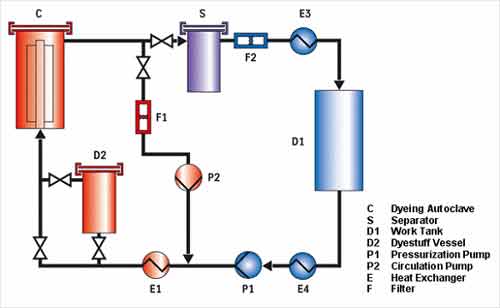
Dyers have found a new way of dyeing that will make
cotton chemically more similar to wool. This will help to dye the fabric
blend of the two. In a process, called Union Dyeing, which dyes fibers
having different dye affinities and still achieve an uniform appearance
and a homogenous colour.   Actually, dyeing a blend of cotton/wool is difficult as the two fibers have a completely different set of chemical makeups. Wool, that is made up of sheep hair, is an animal proteins, while cotton is essentially cellulose, a plant product. What happens is that if wool and cotton are blended together, there is a need for two separate dye baths as it is the wool that takes up most of the dye. In a new innovation, Union dyeing, a single-bath dyeing procedure was developed. This process goes a long way in helping textile producers to overcome a significant "technological bottleneck"- dyeing of all the blends that has the depth of same shade just in a single step. How does Union dyeing work In this new concept of Union Dyeing there is reversal of the chemical charge of cotton. The change is done before dyeing from negative to positive. Now wool is already positive beforehand. This is done by using cationic fixatives, a set of positively charged ions. By using the fixatives before the actual dyeing is able to give both the components of the fiber a positive charge. As the dye is negatively charged. And it is a chemical phenomenon that positive changes attract negative. As a result the cotton and wool is dyed to a uniform shade for the simple reason of the dye being attracted equally to both the fibers. Thus Union-dyeing process makes use of just one dye in a single bath, normally under a single set of conditions.
In the recent years there has been much development
in the field of inkjet printings. There has been a new technology that
utilizes a method in which a water soluble pigment precursor is
able to penetrate the surface of the print medium and then the pigment
is released. This particular method is able to combine the properties of
a dye based ink like high gloss and resistance to abrasion along with
displaying properties of the conventional pigment based ink like
superior light stability. The The following table gives a comparison of the imagesobtained from dyes, conventional pigments and pigment precursor:
A Microscopic view of the comparative images obtained
by synthesizing a quinacridone type water soluble pigment precusor, with
conventional pigment and dyes are shown in the image here. As can be seen in the images, though dye images provide features like high gloss and fairly good resistance to surface abrasion, but they suffer from insufficient light stability. 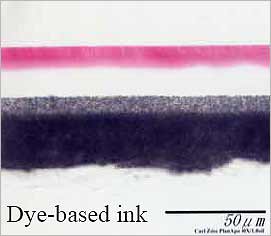 Image obtained for a Conventional Pigment Pigments provide a high light stability, however the problem lies on the surface of the medium. The average size of the pigment particle is in the range of 100-150 nm. The pigment particle is prevented from penetrating the surface. The results are rough surfaces, limitation in gloss and succeptibility towards abrasion. 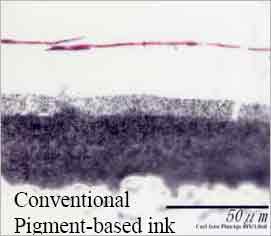 Image obtained for a Pigment Precursor Lastly the pigment precursor deposit the pigments below the surface of the medium. This action give rise to a kind of dual advantage.
 |


 Dyeing
with supercritical fluids
Dyeing
with supercritical fluids