 |
 |
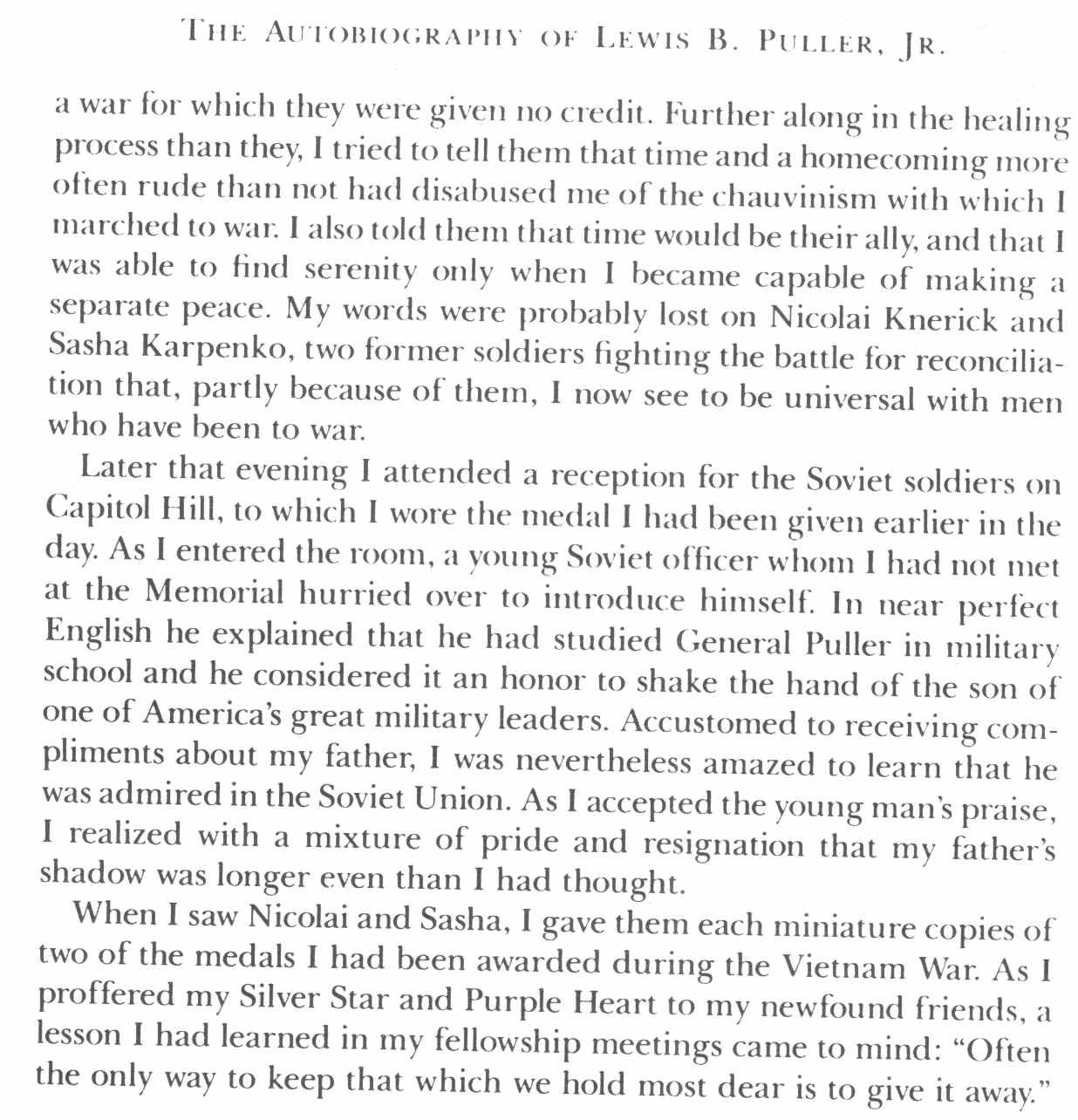
| I'm putting up this page May 24, 2003 both as a Memorial Day tribute and as a remembrance of my father, who died on the day Lewis Puller, Jr. writes about below. This is the Epilogue of Puller's 1991 autobiography Fortunate Son. Puller uses some of the lyrics from Creedence Clearwater Revival's song of that same name as the epigraph (and the title, of course) at the beginning of his book. Daddy went into surgery, for liver cancer, early in the morning on May 24, 1989, and died early in the evening from severe hemorrhaging. The story of Lewis Puller goes beyond what I've included here, mainly in the context of how he came to step on the land mine that wounded him so severely. The U.S. military was aware that the M-16's issued to soldiers during the early years of the Vietnam War were defective when combined with the type of ammunition being issued. The guns often jammed during the heaviest fighting. But neither the contract for the manufacture of the guns nor the use of too heavily-loaded cartridges was changed, due to the unwillingness of the military or civilian managers to take responsiblity for the mistake. (They claimed the soldiers weren't cleaning the guns properly.) It was a situation that came to characterize the war, which was started on the basis of false information (the Gulf of Tonkin incident) and went on far longer than it should have, mainly because no one in a position of power was willing to admit things were not going as planned. High-level careers were at stake. Puller stepped on a land mine--or triggered one rigged to a trip wire--as he was attempting to retreat to safety after his gun jammed. |
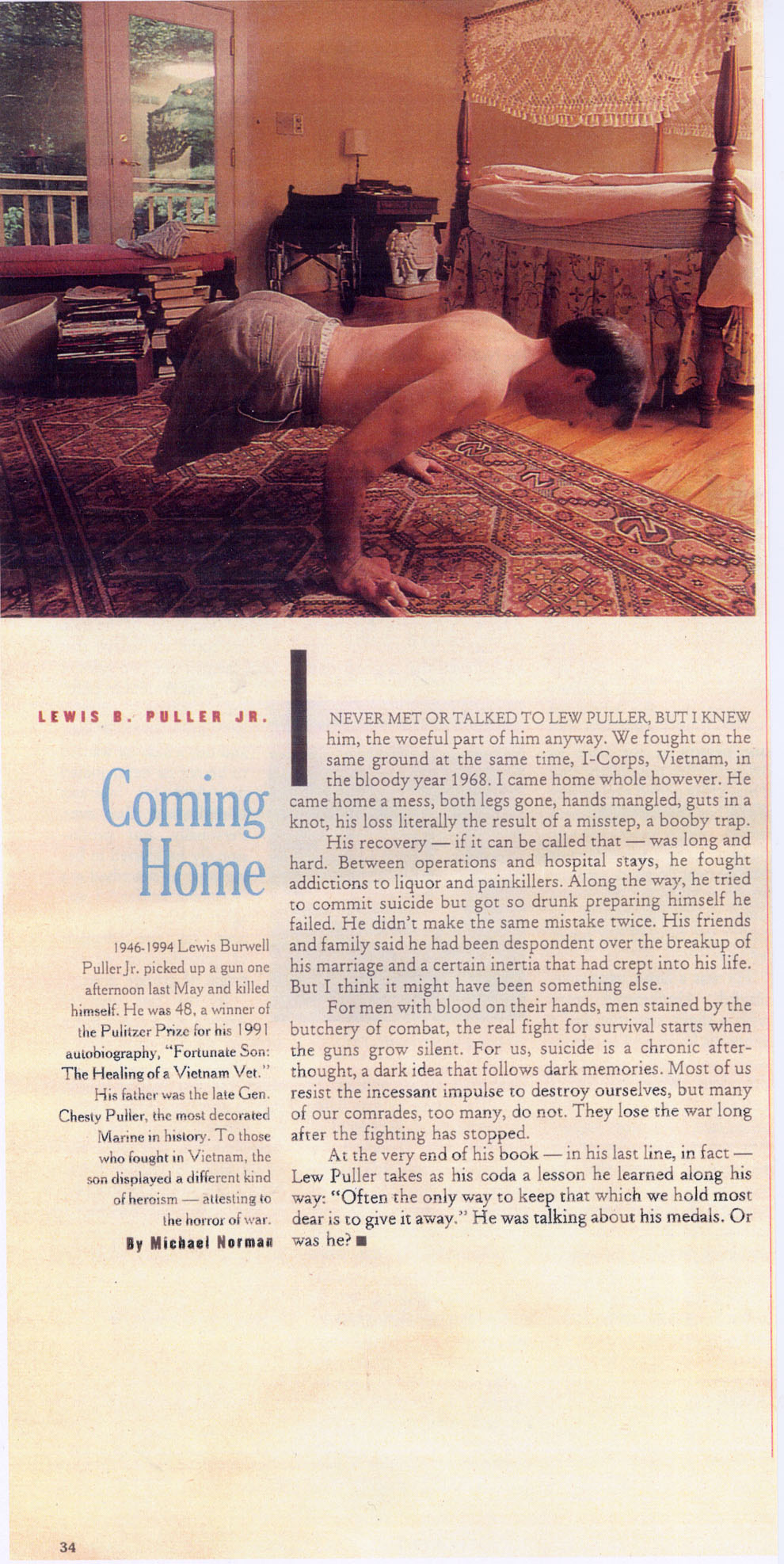
| Copyright 1995 The New York Times. From "Lives Well Lived" (about some of the people who died in 1994), which appeared in the NYT magazine January 1, 1995. A few others who were profiled in that issue, and the year of birth: Jacqueline Kennedy Onassis (1929), Richard Nixon (1913), Kurt Cobain (1967), Linus Pauling (1901), Cab Callaway (1907), Nicky Hopkins (1944; see Circa '69 collage). |
| And here's a recent example of the mentality of military management at the highest levels, similar to what occurred with the M-16 in the early years of the Vietnam war: The A-10 Warthog may have been cancelled by now, but the fact that it fires armor-piercing shells made of depleted uranium metal (DU) makes or made it even more controversial. DU isn't highly radioactive but is radioactive, and is thus dangerous mainly if ingested as small particles, especially if it's inhaled. Being part of an exploding shell makes it likely to be inhaled or to be otherwise ingested or deposited on the skin as small particles. So, DU!, why use it in exploding shells? Well, uranium metal is very dense stuff, very heavy, and for armor-piercing shells that's what is needed--and uranium from used nuclear reactor rods is much more plentiful than osmium, the densest of naturally occuring elements. Some U.S. Army tanks and maybe other military weapons also use DU armor piercing shells, so the controversy won't end with the A-10 cancellation. And the A-10 could be used without it's DU shells. "Depleted," by the way, refers to the use of U238 rather than it's explosive sibling U235. The separation of these two isotopes was what the huge gaseous diffusion plants at Oak Ridge, TN were built for during WWII, and what high-speed centrifuges are used for these days. Enriched uranium has more U235 than natural uranium, which is less than one percent U235. See this link for more info on nucular weapons, etc, and I recommend a Web search under "depleted uranium" if you want to find out the dirt on DU, from both its defenders and opponents. |
 |