(1/03)
(5/01)
"Students work with Hollywood pros on movie set in Lincoln area"
By Jeff Korbelik / Lincoln Journal Star
ASHLAND — With his black shirt, black pants and white collar, Ryan Kathman looks just like a priest.
“I need to take a picture and send it to my mom,” the Lincoln actor said while waiting to shoot a movie scene Monday in Ashland. “That would make her day.”
Kathman, a University of Nebraska-Lincoln graduate student, is one of around 120 UNL students who are working on a short film, “Vipers in the Grass.” He plays a priest.
The 25-minute movie, filmed from Zamacona’s 27-page script, is about a young girl who has gone missing in a small Nebraska town and how the community comes together to solve the case.
The filmmakers shot Monday’s scene in front of the Lutton Law Office in downtown Ashland.
In addition to Zamacona, who’s also producing, the film features a Hollywood director (Alex Zakrzewski), stars (Harley Jane Kozak and Dean Winters) and several other industry professionals.
Many of them are here because of Sandy Veneziano, a longtime Hollywood production designer who now teaches at UNL.
The project is being funded through a Hixson-Lied College of Fine and Performing Arts grant and the Johnny Carson Theatre and Film Endowment. Many of the professionals are volunteering their time or working at reduced rates.
The movie crew will spend a week at locations in Lincoln, Ashland, Roca and Wahoo, working closely with the students, who are handling all aspects of movie-making, from camera operation to editing to location scouting to costume and scene design.
It’s an opportunity Zamacona, whose credits include “Oz” and “Homicide: Life on the Street,” would have welcomed when he was in film school at California State University-Northridge.
“We had professionals come in and lecture for a day,” he said during a break in filming. “We never had anybody walk us through an entire production.”
The students are making the most of the project, right down to working 18-hour days.
“My feet start to hurt from standing all day,” said undergraduate Lacey Hanna, one of the assistant directors. “But I’ve gained so much insight into how a film is made. I love it.”
The professionals have been impressed with the students and their willingness to take it all in and ask questions.
“It’s been a good time with the kids,” actor Winters said. “I’ve been pleasantly surprised by how talented they are. They are so eager to learn.”
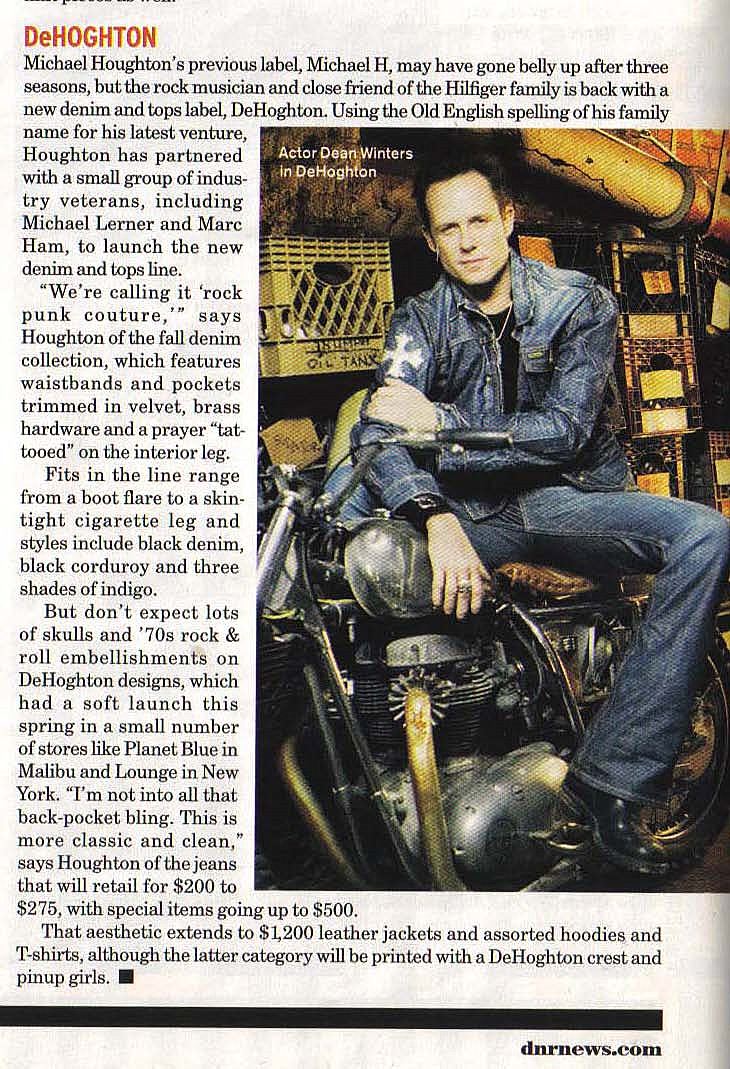
"DeHoughton Line"
(Click picture to open)
"Inner Tube"
FX has ordered a fourth season of Denis Leary's critically acclaimed drama "Rescue Me,"; which he produces with Peter Tolan and Jim Serpico. The entire cast, including Andrea Roth, Dean Winters, John Scurti and Callie Thorne, have been locked in, too. Production on the new season begins early next year and will start airing in the second quarter of 2007. ...
Top
"Undercover Brother"
Dean Winters rises through the ranks on Rescue Me.
By Sean Burns
JOHNNY ON THE SPOT Winters rises to the occasion as Rescue Me's acerbic Detective Gavin.
"I had no idea it was coming," Dean Winters says of the plot twist that recently increased the size of his role as NYPD detective Johnny Gavin on FX's irreverent Rescue Me. The actor is calling from his cell phone while pacing the streets of midtown Manhattan, which is only appropriate: During the series' first two seasons, Winters remained primarily a cellular presence, always glimpsed in split screens, talking tough into the receiver and pounding the pavement. Johnny was typically bailing his reckless, alcoholic firefighter brother Tommy (head writer and star Denis Leary) out of one jam after another, trying to be the voice of reason-until the two men would inevitably get angry and hang up on one another.
That changed when the season three premiere on May 30 dropped the bombshell that Johnny's carrying on a secret affair with Tommy's estranged wife, thereby promoting Winters to the kind of juicy role he hadn't had since his days as Oz sociopath Ryan O'Reily came to an end in 2003. "Yeah, when I got those first couple scripts, I was ecstatic," he laughs. "It's fun to get dirty. There's a lot of room to run. I find the darker it gets, the more fun it gets…and this is pretty fucking dark."
Such darkness is a hallmark of this jagged, aggressive comedic drama, which prides itself on veering from lowbrow locker-room high jinks to stark tragedy-often within a single scene. Created by Leary and Peter Tolan, the show is a gritty, painfully funny, warts-and-all portrait of firehouse culture which never shies away from the toll that occupational exposure to trauma can take on a human soul. Everybody drinks, smokes, swears and screws too much, behavior that-considering their circumstances-feels oddly reasonable.
But the series is at its best when wrestling with the increasing irrelevance of alpha masculinity in our more sensitive age. "You're right," Winters admits when asked about the subject. "It's a show about men trying to figure out what the fuck is going on. I'm a forty-year-old male. I'm Irish, I'm from New York and I definitely have issues. The best thing an actor can bring to a role is himself-that's no secret. I'll even go so far as to say it's semi therapeutic to watch Denis and all these guys work out their shit.…"
He pauses for a moment. "Marisa Tomei is on the show, and the other day she said to me, 'If anyone is curious where all the men are on TV right now, they're all here on Rescue Me.' It was a nice compliment.…Hey, does this make any fuckin' sense at all?"
Actually, yes. But premiering in the long shadow of 9/11 couldn't have been easy for a program that dares to depict NYC firemen and cops as deeply imperfect people, rather than the plaster saints that have dogged most media representations of New York's Finest. "It was almost like a taboo subject," Winters concedes. "But I think the way Denis and Peter have handled it is remarkable. Denis's character is a hero, but he's a hero with a lot of flaws. It's extremely truthful. Again, I'm Irish and from New York, so I've known a lot of cops and firefighters my whole life.…They've taken me aside and said: 'You guys are really getting it'-which is a tribute to everybody involved."
Without naming any series in particular (for the record, he spent half a season on Law & Order: SVU and has appeared twice on CSI: Miami), Winters displays little affection for other TV depictions of the world of law enforcement. "If I see one more forensics show, I'm gonna throw up," says the actor. "People are lazy, and they want their fast food via the television. To sit down and watch something like Rescue Me, for anyone who has a modicum of taste or intelligence…it's a gift. But the odds are against us; it's still a numbers game, all about ratings. The day I'm running a black light over someone's bedroom sheets is the day I quit acting."
Rescue Me airs Tuesdays at 10pm on FX.
Top
"More Screen Time for 'Rescue Me' Brother"
Actor Dean Winters says he is happy to have more screen time on Rescue Me-- even if it means his character must lock horns with star Denis Leary.
In the third season of the acclaimed FX series, Leary's firefighter Tommy Gavin is furious to discover his estranged wife, Janet, played by Andrea Roth has been sleeping with his cop brother, Johnny.
It's definitely taking a little bit of a darker twist, Winters told UPI of the blood feud between Tommy and Johnny. As an actor, I tend to enjoy going to the dark side. I guess that's due to my six-year stint on (the HBO prison drama) 'Oz.' But I am enjoying the arc this season and Denis has found a rhythm, which is captivating.
Last week's episode ended with Tommy thrashing Johnny at a family birthday party.
It's the longest scene I ever had to shoot, Winters said, noting he did 80 percent of the stunts himself. A few bruises came out of that one.
Asked if the expanded role was worth it, Winters quipped: It seems my theme this season is suffering. ... It's always good to mix it up. Don't get me wrong, I'm having a great time.
Top
"Profiles in Oz: Part Three - Menace: Redefined Dean Winters"
by David R. Guarino
DEAN WINTERS (A. K. A. PRISONER # 97 P 904- "RYAN O'REILY")
If there is one positive thing that can be said about Em City Prisoner # 97P904 in Tom Fontana's fictional world of OZ, it is that Ryan O'Reily is a survivor in every sense of the word. In fact, it is precisely his uncanny ability to survive just about anything that makes the subtly savage character of O'Reily at once powerfully arresting yet disturbingly fascinating. Make no mistake; this is one prisoner who definitely knows how to take care of himself.
Bringing to life one of Em City's most infamous and resilient residents, actor Dean Winters consistently delivers a chilling performance as the sexy, wily sociopath Ryan O'Reily, who somehow always manages to beat the odds against injury and/or death amidst the unending nightmare that has become his daily existence. Among the obstacles that Ryan manages to overcome are: surviving breast cancer in a male-dominated society where anything perceived as weakness can bring about one's premature demise; living through the anguish of the unrequited "love" he feels for prison doctor Gloria Nathan (Lauren Velez)-an obsession than eventually prompts him to have his brother Cyril kill Nathan's husband, thwarting blackmail attempts by Corrections Officer Claire Howell (Kristin Rohde) after a brief affair between the two cools off; feeling the anger and pain of his brother Cyril's rape by Aryan leader Vern Schillinger and against whom O'Reily vows revenge.
Throughout all of this and more, O'Reily manages to dodge numerous betrayals and threats on his life yet spends a great deal of time looking out for his brain-damaged brother Cyril. (Flawlessly played by Dean's real-life brother, Scott William Winters). Despite his apparent amorality, Ryan's devotion to the sibling he helped put behind bars is unwavering and intense.
Resourceful, streetwise, and ostensibly fearless, O'Reily survives as he simultaneously spreads around his signature brand of deceit, premeditated retribution and violence, including murder, which eventually lands him an additional 77 years in OZ.
In actor Dean Winters' hands the core of O'Reily's disarming malevolence is not only explored but also expanded upon with apparent ease. Winters has clearly made this character his own in every way, and he knows exactly when to pull in the reigns on O'Reily's sinister machinations. Undoubtedly the instincts and talents of the New York-born Winters have enabled him to both master this complex character and also capture the inexplicable appeal of the shockingly mercenary O'Reily and his crafty survival skills. A master at playing both sides against the middle, O'Reily can neither trust nor be trusted. As the body count rises and tensions grow, Ryan manages to keep his hands clean as he does whatever is necessary to ensure that he will see the light of the next day. Capable of the most insidious acts, such as hatching a plan to feed ground glass to an enemy mob leader and later shift suspicion for the crime to another inmate, O'Reily invariably manages to deflect responsibility for his depravity and manages to come out smelling like a rose. Obviously what makes O'Reily so compelling is also what makes him dangerous. There are few limits to what Ryan will do; besides having his brother Cyril kill Gloria Nathan's husband, he later murders Nathan's rapist with a set of barbells in a psychotic fit of jealous rage. Another example of O'Reily's subtle treachery is pointed up in the OZ boxing matches, in which Cyril O'Reily has a distinct advantage in match after match since Ryan has drugged the water jugs of his brother's opponents. Occasionally O'Reily gets caught, but is never totally shut down.
Winters digs deep to find the humanity within the sociopathic personality of O'Reily. O'Reily seduces and repels, evokes revulsion but also empathy. We want to despise him, but find ourselves admiring his unwavering resiliency, empathizing with his misguided need for affection and love, instinctively understanding and relating to his paternal need to protect the weaker, more vulnerable sibling for whom he feels responsible.
This is a strong, powerful, multidimensional portrayal of a man who is indeed a prisoner, not only of the penal system but also of his own inner demons.
Winters said the role of O'Reily was actually written for him by Tom Fontana. Candid and open, the 38-year-old readily acknowledges a crossover of his real-life survival instincts from his "pre-OZ" days into his on-target portrayal of O'Reily. Says Winters, "I have the survival instincts. You know, I was a bartender for eight years in the city, and when you're a bartender in New York City you have to be a real hustler."
After those bartender years, OZ creator Tom Fontana (one of Dean's frequent customers), took an interest in him, and Winters soon found himself signed for the role of Tom Morans on three episodes of Fontana's popular series, Homicide: Life On the Street.
The son of an Irish middle-class family, Winters traveled and lived throughout the West Coast, Hong Kong, Europe (Paris, Milan) and Florida before settling in Manhattan. He majored in English at Colorado College.
Winters considers his role as O'Reily to have been his first challenging acting assignment, and in 1997 he debuted as a member of the original cast, becoming Prisoner # 97P904, receiving a sentence of life imprisonment for two counts of vehicular manslaughter, five counts of reckless endangerment, illegal possession of drugs, criminal possession of a weapon and parole violation.
Readers might recognize Winters from his many TV guest appearances including his thoughtful portrayal of good guy Detective Bryan Cassidy in Law and Order: Special Victims Unit, in 1999. Prior to that, Dean appeared as Sara Jessica Parker's neighbor John Mc Fadden (a.k.a. "The Fuck Buddy") in a 1999 episode from the second season of HBO's Sex and the City. Other roles include: "Larry" on NYPD Blue in 1996 and a part in 1999's Payback. Dean briefly appeared in Conspiracy Theory, and had the lead opposite Yasmine Bleeth in the lighthearted Undercover Angel. Winters also had the lead role of "Trevor" in the sixth installment of Clive Barker's Hellraiser series, Hellraiser: Hellseeker, and in the 1997 films, Firehouse and Lifebreath. Dean also had parts on Millennium, both in 1997 and in 1999.
In 2001, Dean starred in the action thriller, Snipes, set in Philadelphia, billed as an expose of the dark side of the rap music industry. The film spotlights the underworld of music industry hustlers, thieves and killers, who will do just about anything to stay on top of the business. Winters plays a slithery hip-hop record mogul named Bobby Starr opposite rapper Nelly.
DG: What would you say is the biggest difference between you and O'Reily?
DW: Well, that's kind of a tricky question; it's a good question. It's tricky only in the sense that this character was written for me. I didn't read for this character; I had worked for Tom (Fontana) a few times beforehand … I gotta be honest, there's not a whole lot of difference between the basic structure of (Ryan) O'Reily and me. I have the deep love for my family; I have the survival instincts. You know, I was a bartender for eight years in the city ... . So I think I was able to bring all that (into the character). Obviously I don't have the killer instinct do you know; I don't have that in me.
DG: Tell me more about the survival instinct.
DW: The survival instinct is probably what we (Dean Winters and Ryan O'Reily) have the most in common. Besides the love I have for my brother (Scott) which kind of goes without saying. When Tom Fontana met me I was going through a very difficult period in my life. Without sounding too dramatic or too corny, there was a certain amount of survival (instinct) that I was relying on at the time. I think he saw that.
DG: I have always felt your character is one of the most amazing on the show, because you are able to elicit empathy from the viewer. I often find myself sympathizing with your character and yet your character carries out some of the most horrific deeds.
DW: Crazy, right? It's not something that I consciously think about. I think if actors constantly started thinking about that (gaining empathy), they'd get in trouble. I've never once thought, "OK, how can I get empathy from the audience?" Or sympathy, or whatever you want to call it. I think that there are a lot of bad actors out there who do that, and I just think that it's so obvious. You know, in this show I literally just show up to work, and I do the lines the way Tom wants me to do them, and that's it. I mean, the writing is so clear and so understandable. I'm lucky, I haven't been in a position where I've had to deal with bad writing yet. Maybe when you're in that position then you do have to start figuring, "Now how can I make this person more likable?" I detest that in actors and I see it all the time. I think that the audience is really dialed in to what you just touched on, David, which is basically understanding the survival instinct. There's definitely some kind of twinkle in the character's eye, but it's never something that I've consciously set out to achieve.
I think one of the reasons that people do like the character is that Ryan is able to get away with a lot of stuff that people would secretly like to get away with. I mean, who wouldn't want to grind up glass and put it in their worst enemies' food, you know? Yeah, I think the fact that I'm able to do (things like) that and get away with it … I think that everyone's got a dark side, and they see me getting away with this stuff and they can't help but get a little bit of a grin ...
DG: I've seen some of the work you've done on other shows, and I think it's quite good. I did see Undercover Angel, in which you costarred with Yasmine Bleeth … (Dean chuckles) That was really a different kind of movie for you, wasn't it?
DW: Oh, Jeez! That was strictly a need to make some money. (We both laugh) The truth is, I've had a lot of people who really like that movie for some reason. I thought it was kind of corny and cheesy, but for me, that was obviously as different from Ryan O'Reily as you could possibly get. So, in that respect I kind of enjoyed doing that film. It's Michael Jackson's favorite movie!
DG: Then there's this new movie you're in with rapper Nelly, called Snipes, set in Philadelphia. You play a sleazy hip-hop mogul named Bobby Starr.
DW: Snipes opened in NY in October and it closed about two weeks later. It's coming out in DVD, I think, Feb. 22nd. Let's see, I think it'll be great on DVD on a small screen. It had a good young cast, and Nelly was quite able. It was his first movie and he did a good job.
DG: Did you like playing this scumbag?
DW: I did. I had a good time with him. Again, this is not a nice person but in a different ilk than Ryan O'Reily. Bobby Starr is a straight-up asshole and the owner of this hip-hop label. It was fun. Once again, it was a learning experience. Most of the films I've done to date have been learning lessons. I'm really looking forward to doing a film where I can just be real proud of the finished product and go to the movie theater and see it.
I would never rely on any performance to insure a career, but I'll tell you that if I don't get any work out of this next season of OZ, then there's something wrong with the world. Basically my whole story line is with Scott this year. It's just absolutely beautiful. People are literally just going to get emotionally and physically ill from the scenes.
DG: The two of you work beautifully together …
DW: Yeah. Absolutely. And I think that Scott, hands down, has the hardest job on the show (OZ). And after that, he's equally as good an actor as anyone if not one of the better actors on the show. I think everyone on that show gets a chance to walk the walk and talk the talk and there's posing going on. Everyone's macho and the testosterone is through the roof, but Scott really has to play this little kid. You're talking about a complex character; Scott does a lot of work on this show. I get a little sad because I really don't think he gets any recognition and he deserves more recognition than anyone does. He's incredible.
This year, man, I'm telling you he takes it to another level! People are going to have to turn their TV's off. They're going to be physically sick. And not by rapes or anything like that, but just by what goes on with his character. And the way he portrays it. There were a few times when we were shooting these scenes and in between takes at one point I walked off the set and I threw up. I was so emotionally spent.
DG: It was emotionally draining?
DW: Draining. I couldn't take it. I actually couldn't take it. I'm looking forward to the (upcoming) season of OZ; too bad it's the last one, but that's just the way it has to go. It'll be the highest watched season because last year was the highest watched. It's good to go out on top. But it's tough also, because there's just so much crap on television and there's not a lot of good work out there.
DG: Of all of the evil things you've been asked to do on OZ, was there one thing that was really rough for you to do?
DW: No. Some of the most evil stuff that I did I came up with. I guess there were some rough things. I'm not a big fan of walking around in the nude in front of 50 people. (Dean laughs) I never had to deal with rape or being raped. Actually I think I was the only person on the show that got to have sex with four or five women. I know that that was not easy for some of the guys, especially the guy who played (Peter) Schibetta. He had a hard time with that (being raped). Let's put it this way, I never got a script that made me think, "I've gotta talk to Tom. I can't do that." That was the great thing about this cast. If Tom would ask an actor to do something, he/she was happy to do it. There are not many casts like that. If someone didn't want to do something, there were two instances where he (Fontana) just literally got rid of the actor. It wasn't fair to the rest of us who had to do things we didn't necessarily like doing.
DG: Did you have a problem playing a cancer victim?
DW: No, I didn't have a problem with that, but it was difficult and that was in the second season and that was when Tom was really starting to kind of trust me and write for me and he gave me a difficult story line. I lost a lot of weight for that and I shaved my head. And I actually got awakened to the whole world of male breast cancer. [And his character gets this] in an environment where it's all men, with everyone trying to be the strongest. And (with Ryan) not really wanting anyone to know what had happened… It was tough. The other guys on the show made it tough, as they should have; by the way they made fun of me, etc. I think emotionally the toughest one is coming up.
DG: How would you have felt if your character, Ryan O'Reily, was scripted as having been raped or written as having a homosexual encounter while he was serving time in OZ?
DW: I'd do anything for Tom, you know? I mean, seriously. And most of us felt that way. Because we'd all known Tom before OZ; we'd all worked for him. When he was doing the show and he came to us and he said, "Look, this is not going to be an easy show," we said, "Bring it." I'm not saying I would do that on any show. But on OZ I would have done it for Tom. I think you need to be careful in doing that stuff; it's easy for it to become stupid and crass. What's that show called, "Queer as Folk?" I think that's just embarrassing. I'm very in tune with the gay world in New York; I've got a lot of really good friends who are gay, and I've worked in the clubs for a long time. I'm very comfortable around them. I know that most of them think that show is just crap. So like I said, I wouldn't do it for just any show. For Tom I would do it because I'd know that there was a reason why I was doing it. And I would know that the writing would be there.
DG: As a native New Yorker, what's been the hardest part of dealing with the Sept. 11, 2001 attacks for you?
DW: Well, at the time my girlfriend's uncle died, he was in one of the towers, and I live around the corner from one of the first fire stations that was on the scene. Twelve guys died and I probably knew eight of them. And I live downtown so everytime I walk out of my building, those towers aren't there anymore so it's always going to be difficult ... I was born and raised in New York City. It's not something that anyone in New York City, especially native New Yorkers, is ever going to get over. It emotes sadness. But at the same time this city really has bounced back and it makes you proud to be here.
DG: At one time, you described yourself as a "street chameleon."
DW: Well you know I grew up in a good family, middle-class, but there's really not a situation I can't adapt to. I think that's one of the things I got from my father, because my father basically grew up in an Irish ghetto. I think the thing I got from my Dad was my street smarts, and that's also something that New York gives you. I've always felt like a real chameleon in that whether I'm in a street situation, in a bad situation or at some tuxedo function at The Plaza, New York has provided me with the ability to be a real chameleon, to blend in. When I was 14 we moved to Arizona for a while. It was out there that I realized how lucky I was to have been from New York. Most of the people that I know here (in NY) have that kind of survival instinct. I haven't seen that in a lot of other places. I've lived in Paris, Milan, Hong Kong, Los Angeles, Miami … I've never seen it.
DG: New York is your first love …
DW: Ah, yeah, definitely. The fact that I love New York is probably going to be hard on my career, and I'm kind of resigned to that. I will not live in Los Angeles.
DG: What would your castmates say is the most difficut working with you?
DW: (Dean laughs) You might have to ask them that. I think for method actors, and thank God we don't have any of them on OZ, I don't take things very seriously in between takes. Or in between scenes. I like to keep it light. Because it's a serious show. So sometimes I might drive everyone a little bit crazy … (We laugh) You know, we're all such good friends. There's really not a bad bone in the bunch. And (regarding) the few people who came in and it didn't work out; Tom (Fontana) simply had them killed. (I laugh) Tom knew who fit in there and who didn't ...
DG: What is "Project Innocence" and the OZ soundtrack that came out of that. I heard Method Man and Nate Dog got together to do that.
DW: Yeah, they did. Also Lord Jamar of the Brand Nubians. But it was really Barry Scheck, who was one of O.J.'s lawyers who started the whole thing. He has this group, a legal clinic called "Project Innocence." The group raises money to afford DNA testing for guys in jail. Because this DNA testing now is releasing everybody, but there are a lot of these guys who can't afford it. So "Project Innocence" raises money to help fund the DNA testing. Method Man and all these guys got together to do the OZ soundtrack, but Barry Scheck started it all.
DG: You've had a lot of famous directors come through OZ. Do you have a favorite?
DW: Probably Steve Buscemi. He was terrific. We had Kathy Bates and Chazz Palminteri. Matt Dillon, Brian Cox. But there was something about Steve's way that was just real soothing. Kathy was great too. I've got to tell you, that's a tough call. They were all great.
DG: I would think it would be really hard for a woman to come onto a set like OZ that's made up primarily of men …
DW: Yeah, but have you ever met Kathy Bates? She's a tough chick, man. She owned that set. I won't mention the name, but we did have one woman come on the set and she shouldn't have been there. She was too fragile. The sheer volume of men and the content matter … it got to be a little too much for her. I will say that that also happened with a few guys. OZ is a weird animal, you know?
DG: What have you learned from portraying Ryan O'Reily, Dean?
DW: As an actor I've learned everything I possibly could. I mean, I don't even remember going to acting school after doing this show. I've learned that it's going to be very difficult for me to get work. The writing was so good on this show. We wrapped in August, and most of the scripts I've read are unacceptable. Most actors will tell you that with a script you don't love, acting just becomes tedious! I was a real wild child and I did get into my fair share of trouble. And I've come to learn how lucky I am. Because I know I don't ever want to wind up in prison.
DG: How long do you think you'd last in prison?
DW: (Dean smiles and laughs) Not a day! For info on "Project Innocence" go to www.innocenceproject.org
Top
"Early release -- At the height of its popularity, 'Oz' begins its final season"
By VIRGINIA ROHAN, STAFF WRITER
A few weeks before the notorious Oswald State Correctional Facility was to close forever, the inmates were moping around the joint.
"It's funny, 'cause we're all going to get paroled and none of us wants to leave," Dean Winters, an original cast member of Tom Fontana's "Oz," said on the HBO drama's Bayonne set. "I respect Tom's decision. I don't think a lot of people would pull the plug on their own show, but at the same time, it was the best job any of us have had."
"Oz" begins its sixth and final season at 9 tonight --- on the heels of its most watched season ever.
"The realization I came to was this: There's been a core group of actors who really have been the heart and soul of the show, and I felt like, with most of them, I had gotten to the end of their story," says Fontana, a onetime playwright who has never much followed the typical TV path. "I knew I had this season in me. I didn't know if I had a season beyond that. I think there's times that a TV show should end with a its head held high, as opposed to being chased out of town with a broom.
"I still think it's the right decision, but it doesn't make it any less sad," says Fontana, who admits that when he was writing this season's eighth and final episode (a 100-minute finale that's slated to air Feb. 23), he got "very emotional" but struggled to keep those feelings out of "Oz."
"This is not a show where you're going to get weepy and sentimental," Fontana says. "What I don't want to do is to end this in a kind of nostalgic way. That's not the way the series was. Not that nice things don't happen in the last episode. There's a balance between redemption and retribution in the last episode. And some things will be left on edge."
Oz always was a bleak, dark, and edgy place. Prisoners murdered and maimed other prisoners, even guards, in every way imaginable. Rape was commonplace, often graphic.
The morality in Oz was as gray as the walls. Even the most hardened criminals sometimes showed a spark of humanity or decency, while the most likable inmates did unspeakable things to stay alive.
As the final season begins, Tobias Beecher (Lee Tergesen) -- the show's most complicated, compelling character - finally has a good shot at parole. Once a successful attorney who killed a child while driving drunk, Beecher initially was the average viewer's eyes into the horrific world of Oz's experimental Emerald City unit.
Immediately branded and raped by neo-Nazi inmate Vern Schillinger (JK Simmons) - -his nemesis throughout the series - -Beecher suffered humiliations, injuries, and tragedies, and learned to inflict pain in return.
Now, Beecher's attorney father (Edward Herrmann) is working hard, if reluctantly, on an appeal to get his son's great prison love, Chris Keller (Christopher Meloni), off death row. For the Beechers, the Job-like trials are far from over.
Ryan O'Reily (Dean Winters) also is desperately trying to spring his brain-damaged brother from death row. (Cyril is played by Scott Winters, Dean's real-life brother.) "This year [for Ryan], it's about trying to do the right thing instead of the wrong thing. My character really grows up," Dean Winters says.
Ryan O'Reily's mom (Betty Buckley) is back at Oz teaching music, and now staging "Macbeth," a story line with comical moments.
Father Mukada (B.D. Wong) is wrongly accused of sexual assault by another death row inmate, and Bob Rebadow (George Morfogen) makes a surprising connection with the prison's intriguing new librarian (Patti LuPone).
Burr Redding (Anthony Chisholm), a Vietnam combat veteran and convicted cop killer, starts a new business venture in Oz, but is still mourning the death of fellow inmate Augustus Hill (Harold Perrineau). Hill, the son of one of Redding's dead Vietnam buddies, was stabbed in the season finale - -a shocking development, because he's also the show's narrator -- but he still appears.
"Harold is in every episode," Fontana says, explaining that he was covering his bases, because Perrineau was commuting to Australia last summer to make two "Matrix" sequels. "I won't say whether he's dead or alive."
Hill is one of dozens who have died and reappeared since the series began in 1997.
The show's relentless darkness was, in fact, the likely reason why "Oz," HBO's first dramatic series, never won an Emmy Award, despite its quirky, often astounding, writing, directing, and acting. (Even the eclectic array of guest stars was fascinating: stars like Uta Hagen and KISS drummer Peter Criss have appeared, and Joel Grey will play an inmate this season.)
Fontana improbably cast Oscar winner Rita Moreno as a nun (Sister Peter Marie, the prison counselor), and launched the television career of Edie Falco, who played a prison guard when the series began before moving on to-"The Sopranos."
Overlooked by awards committees, "Oz" often was lavishly praised by critics - -and clearly cherished by its own.
"This is the least elitist environment in the film business that I've ever been in, and that's an extraordinary thing," says Morfogen, who has known Fontana since his playwright days at Williamstown, Mass.
His Rebadow character was a good example of the humanity and humor Fontana brought to Oz. Rebadow looks like a harmless, beaten-down old man you might see on a park bench, and yet he's been in Oz for decades. After committing a murder that cut short his promising career in architecture, Rebadow was to have been executed in the Sixties, but a major blackout stayed the electrocution. And so his sentence, for humanitarian reasons, was commuted to life in prison, where he soldiers on.
"Oz" wasn't just complicated characters, great writing, and fascinating moral dilemmas. It also could be a big, juicy soap opera, in which viewers sometimes confused actor and character.
"There's a woman who works the token booth at my [subway] stop at 116th Street and she talks to me like I'm in character," says the actor-poet muMs, who plays the inmate Poet. "She'll be watching it the night before, and then she'll see me and say, 'Why'd you do that? What's wrong with you?'-"
Co-star Chisholm has heard buzz that "Oz" may keep going on the big screen, and he hopes it happens.
But Fontana isn't high on that idea.
"About the second year, I got inquiries from a couple of studios to do a feature version of the show," he says. "I went to these meetings, and what I began to understand is, I would not have as much freedom doing 'Oz' as a feature. .-.-. They started to talk about an NC-17 [movie rating], and say, 'We need a likable prison hero.' It started to sound like somebody else's prison movie."
And so, after "Oz" filmed its last scene in mid-July, Fontana had the Emerald City set dismantled, though he continues to lease the warehouse at a former military base in Bayonne. "The rest is fairly generic office spaces and things that you could turn into something else without much trouble," says Fontana, who has several new projects in development.
Looking back on "Oz," he says he's most proud of his "extraordinary, generous, and courageous" cast, and that he may have afflicted the comfortable.
"I think that we have told as much of the truth about prison life as possible," Fontana says. "When you put it through the lens of a television camera, it's not going to be exactly the way it really is in a prison. But I think we've given people a taste of what it's like."
As for the value of doing so, Fontana explains that best in an on-air promo now running: "If we make people think for a second, wow, these are real people, not faceless, nameless detritis that you throw away, I will consider this show a success."
Top
"The Caroline Rhea Show"
transcript
CR: Our next guests play two of the cutest prison inmates on television in the hit series from HBO `Oz', please welcome adorable Dean and Scott Winters.
(Cheers and applause. the band plays the OZ theme)
CR: You cut your hair?
Scott: Yes. I got it chopped, which you will see in the upcoming season.
CR: I don't want to know why it gets cut.
Dean: I shaved his head. It was fun.
CR: You're not twins are you?
Scott: Irish twins, we're a year apart.
CR: Irish twins, I like that. Are you similar at all?
Dean: Actually--
CR: I feel like I'm on the dating game. Winters brother number 2?
Dean: We're actually a lot different we're best friends, but like, night and day.
CR: You're a Leo and you're a cancer?
Dean: I'm a cancer and he's a Leo.
CR: That's so weird, You're personalities are the exact opposite.
Scott: I think it's easier being a little different. Dean watched television, I went fishing. Dean would not do the dishes, I would be cleaning the kitchen. It made good for friendship.
CR: I love your hairdo.
Dean: Thank you.
CR: That's very spiky.
Dean: Yes.
(audience cheers and applauds Dean's haircut)
Dean: It's called, like, the Monday morning blues.
CR: Have you even bee up this early in your life?
Dean: Never.
CR: You guys were Bartenders in tandem?
Dean: Yes, we worked in 15 bars together as brothers. It was kind of like a gimmick. That's how we got our break. The executive producer of OZ met us, took us out of the bar world. (points to the hot chocolate Caroline is drinking) Is that good?
CR: It is, but I realize I don't have enough for you and I`m not sharing. Although, I have a slave for the week though who will run out and get anything.
Dean: That'd be great, actually.
Chris: I'll be back then.
CR: Go. Get me something pretty. He thought the Raiders were going to win, did you?
Scott: No, not from the get-go. I was excited for Tampa Bay.
CR: You were?
Scott: Yes.
(Cheers for the Bucs)
CR: It was exciting. Did you guys ever date the same girl?
Dean: We did once. What was her name?
Scott: Jenny Smith.
CR: That's right, out the poor girl, go ahead, give a name. Where is she living now?
Scott: She was in Arizona last time we checked.
CR: Really?
Scott: Yes.
CR: It's bizarre, I feel like it's the same face with different hair.
Scott: We have another brother who is one of the writers on the show.
Dean: He's a third twin. The three of us walk around together and people get confused.
CR: What's with the Winters brothers in prison?
Dean: I don't know.
CR: I think Oz is one of the most brilliant shows they have had. It puts a face on these people whose lives are immediately discounted because they're in prison.
Dean: It's a part of the society that you want to give justice to even though it's a injustice. You know what I'm saying? You want to portray them in an honest light. Which is why the show is very rough. It's not for everyone. I think it's one of the most honest shows in the history of television.
(Chris comes back with hot chocolate for Scott and Dean)
Dean: Thank you very much.
CR: Chris.
Chris: Would there be anything else?
CR: You know what? If that's not cold or hot enough for you Chris will go right back and fix that. I call him Goldilocks.
Chris: Can I get you something to nibble on?
CR: Chris, not till your spoken to.
Dean: We have Caroline, we're set.
CR: All right. Now boys, you must be killer on girls. How many hearts have you broken collectively?
Dean and Scott: None, No, no no.
CR: Look at you, 'no no no'. You're trying to count.
Scott: I'm actually engaged right now.
CR: You are? Congratulations.
Scott: Yes.
CR: Congratulations. You're engaged, and you continue to date everyone in America.
Dean: I continue to date everyone in America, so.
(Audience cheers)
Dean: Mom!
CR: Where is your fiance?
Scott: My fiancee is sitting right in front of that sound gentleman.
CR: Hello, lucky girl. All right, don't go away. We will be back with Dean and Scott Winters. And we're gonna find out how well the know each other.
(Commercials )
(Back from Commercials, they play a scene from OZ right after Cyril`s first electro shock session)
(Audience cheers)
CR: Great actors.
Dean: A nice cheery Monday morning.
Scott: A light drama.
CR: Yes, Betty Buckley is great, though.
Scott: She is great.
Dean: She's Awesome.
(Applause.)
CR: We wanted to see how well you know each other. We're doing a newlywed thing with brothers. Dean.
Dean: Yes.
CR: What is your brother's most annoying habit? Who did we ask? What do you think Scott will say is your most annoying habit? No, I'm wrong. Dean what is your brother's most annoying habit?
Dean: What's Scott's most annoying habit? Always correcting me.
CR: Is that what you thought it was?
Scott: Let's see. I put `being late'.
Dean: Yes, he's always late.
Scott: That's exciting.
(Audience cheers)
Dean: Pump it up.
CR: It would help if I read it correctly. Scott, what was Dean's most ridiculous Halloween costume?
Scott: Huh. I would say when we were five Dean dressed up like Batman. It was really ridiculous.
(Dean holds up his little board thing that says `Batman'. Everyone cheers.)
Scott: Nice.
Dean: Nice.
CR: We're playing a child-like game with the men from the prison show. Dean, what posters did Scott have on the wall when you were kids?
Dean: Scott had-- You had Bruce Lee and Jimmy Hendrix, right?
Scott: No.
CR: Scott, you're underplaying this. You have to hold it up.
Scott: I had Rocky and Cheryl Ladd.
CR: Don't you remember?
Dean: I had an idea.
CR: Where is your fiancee? He's very sassy this one, you're in big trouble.
Scott: Jennifer.
CR: That's her name?
Scott: Jennifer (last name omitted by transcriber. I know, I know, he said it on national TV, but I don't trust us internet types *g*)
CR: How did you propose?
Scott: We were in Sequoia Nation Park when standing next to a river, and I didn't have a ring, but I just kind of got filled with inspiration, kind of took advantage of the moment and purposed. I got her a ring a week later.
CR: That's so nice.
(Cheers and applause)
Scott: Can I just add something to that?
CR: Yes, you can add something you sassy pants. Go ahead.
Scott: Our brother Brad, he's engaged, he's getting married in April and our sister Blair is also engaged, and she's getting married in May.
Dean: I never have to get married now. I'm off the hook.
Scott: He's single for life.
CR: What month are you guys getting married?
Scott: Late March.
CR: March, April, May weddings for the Winters family?
Scott: Mom's gonna have a stroke.
Scott: Yes.
CR: Are your parents having breakdowns?
Scott: Yes.
CR: Who are you dating now, Dean? Just give the Top 10.
Dean: Top ten. Caroline Rhea, Caroline Rhea, Caroline Rhea, Caroline Rhea.
CR: Dean! Quickly, Scott, what was the most trouble Dean got in as a teenager.
Scott: Wow. He got caught in a phone booth with a girl, it was a scandal.
CR: Is that what you put down?
Dean: No, I got busted for stealing a Penthouse magazine.
CR: I love these two.
Dean: It was a boring childhood.
CR: OZ airs Sunday nights on HBO where you will see both of these amazing actors.
Dean: Thank you.
Top
"The Men Behind the Curtain"
Three actors from "Oz" talk about surviving the slammer, prison politics and the brutish force of the most overlooked show on television.
by Ian Rothkerch
Despite a celebrated creator, addictive story lines and a crackling ensemble cast, OZ remains the bitch of network television. It's a little unfair. Writer Tom Fontana's violent, realistic drama debuted five years ago and uninitiated viewers still dismissively call it "that prison show on HBO."
Yet like this season's "24" and the prematurely defunct "Homicide: Life on the Street" (another Fontana creation), "Oz" has managed to fly low on the Nielsen radar while attracting an unshakably faithful audience attracted to the sheer ballsiness and uncompromising sophistication of the material.
Set in the fictional Oswald State Correctional Facility, "Oz" is a testosterone-drenched male soap opera centering around the inmates of "Emerald City" -- an experimental, maximum-security unit of Oswald. With its glass-enclosed cells and suffocating architecture, Em City looks and functions like a human ant farm, playing home to such motley residents as a gay serial killer, a homicidal skinhead, a Muslim writer-turned-arsonist, a junkie basketball player, a slut lawyer and an evangelical preacher played by Luke Perry.
Fontana and his writers have fashioned this merry-less land of Oz as a microcosm of humanity, using the fishbowl as a way to comment on universal politics and interpersonal protocol. Ultimately, all that really separates these convicts from the rest of us is their aptitude for murder, mind games and manipulation. That is "Oz's" singular triumph: its ability to make audiences care about the fate of people more deserving of our contempt than our compassion.
Salon recently spoke via conference call with Kirk Acevedo (who plays the psychotic, suicidal gang leader Miguel Alvarez), Harold Perrineau (the savvy, wheelchair-bound narrator Augustus Hill) and Dean Winters (crafty schemer and resident troublemaker Ryan O'Reily). "Oz" airs Sunday nights at 10 on HBO.
Tom Fontana is the driving force behind the series and has long been considered one of the best TV writers. What do you admire most about his writing?
Kirk Acevedo: What I enjoy about Tom's writing is that it's very accessible for the actors emotionally. He allows them to go certain places that you wouldn't normally be able to go on some other TV shows.
Harold Perrineau: I like Tom's writing for its simplicity and therefore its complexity. It's really, really simple writing, but profound in the sense that it speaks to everybody. Tom will deal with issues that I think a lot of writers on TV or anywhere don't want to deal with -- things that everyday people of all races and economic backgrounds have to deal with. Tom finds a way to put them all in. Even in the world of Oz, it's pretty fantastic that he can touch so many people.
Dean Winters: I like Tom's writing because it's fearless. He doesn't write the obvious material. He doesn't write the obvious endings. He doesn't write what he thinks is going to be commercially acceptable. Which is probably the one reason why he's kind of stayed in the background as far as winning awards and all that. He takes the unpopular route. I think that people who are really dialed into this business have the utmost respect for him.
Does it bother you that "Oz" doesn't receive the same recognition as fellow HBO programs like "The Sopranos" and "Sex and the City"?
Winters: I think that we all feel the same way. For any of us to say that it doesn't bother us would kinda be a lie. It does bother us. I don't think the actors are necessarily looking for awards, but it would be really nice if Tom got the respect he deserves. Unfortunately, in the Hollywood way, respect comes in the form of a trophy a lot of the time.
Perrineau: If we were more recognizable, really, we wouldn't feel as cool as we do. [Everyone laughs] We actually feel like we're doing something that's worthy of being done. I don't know about anybody else, but I don't feel in any way like I'm selling out to some sort of corporate television thing for the masses. You know ... I'm representin'. [Laughs]
Winters: No doubt "Sex and The City" and "The Sopranos" are great shows ... but it's been done before. I think people are a little bit frightened of us and there might be a little hesitation to give awards. Also, because we only do eight episodes a year, we fall into a very weird category.
Did you do any kind of research in preparation for your roles? What kind of feedback have you received from the penal system?
Winters: I went out and robbed a few delis and I arsoned a couple of buildings. [Laugh] That was my research -- I can't speak for the others.
So you're a method actor then? [Everyone laughs]
Winters: It's kinda hard to research these roles, you know.
Did you hang out in any prisons at all?
Perrineau: I went with Eamonn Walker [who plays Kareem Said] over to Riker's [Island], which is not like a regular state penitentiary but a holding cell. I actually do have a cousin who's upstate, so I would talk to him a bit. There are a few people I know who've been in and out and that's kinda all the research I did.
If you had a chance to play any other character on "Oz", who would it be and why?
Winters: Honestly, I'm not envious, but I love watching Harold in the box. I just think there's something very cool about being the "Our Town" narrator and giving people a checkup every 15 minutes to let them know what they're going through.
Acevedo: I'll have to second that. If I could switch roles, I'd probably wanna switch with that.
Winters: Because you get to sit down all day. [Laughs]
Acevedo: There's something about the solitude of Harold's character, because we have a lot of scenes where there's like two to 20 people in one scene interacting.
Since everybody envies you, Harold, what's your choice?
Perrineau: I don't know. There's so many really interesting roles. One of the things about delivering the monologues and stuff is that it actually gets a little lonely. Sometimes I look for the interaction with the other actors. I almost wish I was playing Lee [Tergeson's] role or Christopher Meloni's because they always have each other. I'd almost do any one of them. I'd love to be O'Reily because of all the stuff he gets to do with Dr. Nathan (Lauren Velez).
While "Oz" is ostensibly a prison drama, it tackles much larger societal themes like racism, capital punishment and a corrupt political system. Has working on the show influenced the way you once thought about these subjects?
Perrineau: Absolutely not.
Winters: Think twice before you cop heroin on the street. [Laugh] Oz is in a fictional city because Tom doesn't have to follow any federal guidelines. I can't speak for these guys, but it definitely made me more aware of the penal system. A lot of that comes from the fact that we get stopped many times during the week by people that have either been in prison or who have had family in prison. They really make you aware of how horrific a place it is.
Acevedo: You would have to say that Tom's views about the penal system definitely weigh toward the left and so do mine. I think there's a theme about rehabilitation throughout the whole thing. I definitely think that in the right facility with the right programs inmates can be rehabilitated to live a normal life in society. I think Tom just leans toward that without knocking you over the head with it.
What influence does the bleak prison setting have on your work atmosphere? How would you describe the usual mood on set?
Winters: Because we moved our set we're in this abandoned military base in the middle of nowhere. In the previous four years that we shot, we really weren't forced to spend time together outside the scene work and now we're completely forced to spend time together. There's no such thing as a trailer -- it's like working with a bare bones theater company. But the actual set itself is so realistic. The second you walk through those doors you really feel like you're in a prison. No exaggeration. Really the only star of the show is the prison. This year it comes glaringly through; it adds to the claustrophobia and tension.
"Oz" is fascinating in its exploration of prison politics and the social hierarchy among inmates. What's the most surprising thing you've learned about life behind bars in a maximum-security facility?
Perrineau: I would have to say that behind bars is no different than in front of bars. People still respond the way that people respond because of love or hate or loyalties. I used to think somehow that if you're in jail you would look different than human, but you're not.
Have any of you become more active in the area of prison reform?
Winters: I've definitely become more aware of the penal system and more aware of what life could be like inside a prison. But as far as becoming proactive in the community, I personally have not done anything. It's tough. What are you gonna do, you know?
Perrineau: I actually met someone who is an organizer for a group who are trying to get the Rockefeller Laws repealed. I haven't started working with them yet, but we've been in contact over the past year. So I've been looking at different groups like that because there's so many things to be done.
Winters: Barry Scheck, O.J.'s lawyer, has an organization (Project Innocence) for death row inmates who couldn't afford to go through the new DNA testing, which is freeing so many people. Basically, a bunch of rappers like Method Man and Nate Dogg got together to make an "Oz" soundtrack and all the money went to Barry Scheck's organization.
Despite the amoral nature of your characters, there's something decidedly likable about them. What's the biggest challenge in breathing humanity into these guys and making them empathetic to audiences?
Winters: I never go into a scene -- ever, ever, ever -- thinking, I have to make myself more empathetic toward the audience. Once you start doing that, you get into really dangerous territory. I think you start to become kind of untrue to the character.
Dean, you work opposite your real-life brother Scott [Cyril O'Reily]. You two have had some gut-wrenching scenes together, particularly when Cyril felt the ill effects of that experimental aging drug. Does the intensity and grimness of the material ever bleed over into your real life?
Winters: If anything, it's almost therapeutic -- it's almost like we get to work this shit out. Our relationship has gotten so much better in the last four years. We're at much different places in our lives. I mean, I've been in scenes with my brother where I've been absolutely emotionally terrified to go somewhere. But because he's my brother I feel safe.
Basically, your brother is playing someone with severe brain damage -- is it tough seeing him that way day in and day out?
Winters: Brutal. There have been numerous times that Tom Fontana will tell you where I've broken down -- where I shouldn't have -- just because I'm looking at him [Scott]. It makes me sick to my stomach. You really inhabit that character. There have been times where I almost got physically sick.
Harold, in many ways Augustus Hill is the conscience of the show. He's the one person we can count on to make sense of this senseless world called Oz. Can you identify with Augustus' disillusionment and cynicism toward society?
Perrineau: I don't know that it's always disillusionment. Sometimes there is, but sometimes it's just calling it the way it is. In order to say a lot of it I really have to get in there and figure what it is he's saying. Most of it I really get and I understand. I have a part of me, and I try not to live in that part all the time, that cynical part of me that sees the world like that and wants to always call it. Augustus' role is to say something about it and then what I do in my life is to try to find things to do about it.
As the show's narrator, you get a chance to recite some really juicy dialogue. Of all the monologues you've delivered, is there any one that still sticks with you?
Perrineau: They're all really, really great monologues. I don't remember the monologue exactly, but there was one that talked about pets and people wondering about whether their pets are gonna go to heaven. It says, "Why are we wondering about our pets when pets don't do the same things that humans do? Pets don't wallow around in lies ... they just live in the truth. How amazing would that be to just live every moment in the truth?" It's really struck me in my life. I really have to look at myself all the time now and go, "Oh, I'm lying. I'm bullshittin'."
How long did it take to adjust to being in a wheelchair for so many hours? Does it ever get frustrating not being able to move around? Do you feel it inhibits your acting style at all?
Perrineau: No, I think it makes me really have to be creative. I used to be a dancer many years ago, so it's a weird poetic justice that I get one of the biggest roles of my life and I can't move the bottom half of my body. I never really get frustrated with it. You can't imagine how much I love going to work -- seriously.
Kirk, Miguel Alvarez is an extremely complex and emotionally layered individual. How do you inhabit a character who's constantly being put through the psychological ringer?
Acevedo: I have to admit, it was fun for the first two or three seasons. Then it got really difficult trying to go to that same place over and over just because the first three seasons he was put into situations that were beyond his control. As an actor, I would say those are the scenes I love to do the most because they're more challenging and I'm able to show the sympathetic side.
In one episode, your character brutally gouges the eyes of a security officer. Does the violence get to you?
Acevedo: I have to go back to what Dean said. It's totally therapeutic to let out a primal howl, an angst, through someone's writing.
How do you all respond to people who accuse "Oz" of furthering negative stereotypes about minorities?
Acevedo: We're talking about a specific group of people who have committed crimes -- whether they be white, black or Hispanic. We're not singling any groups out. In the second season, for instance, Luis Guzman tells my character he's "too white" to be part of the gang. For me personally, it's happened throughout a large part of my childhood where I went to school, in East Harlem, and everyone thought I was white when I'm Hispanic. We incorporated that into the show. But I don't really think it perpetuates stereotypes. I've never had an experience where someone accused something about the show that they thought was racism.
Perrineau: I actually had one where a black man said, "You need to stop what you're doing". And I asked him to really watch the show. Listen, it's a fact that there are a lot of minorities [in prison]. We're not making anybody bigger or smaller or anything. There's a lot of truth-telling in it. There are good people and there are bad people of all races. In "Oz", one moment you think Ryan O'Reily is the biggest dick, and the next moment you're crying your eyes out cause you see how much he loves his brother.
Who's the one inmate in Oz you don't want near you when you drop the soap? [Everyone laughs]
Perrineau: He's gone. [Simon] Adebisi!
Winters: There hasn't really been a stand-out rapist since he left.
Perrineau: Him or [Christopher] Meloni (playing serial killer Chris Keller).
Winters: Yeah, I wouldn't wanna be in the shower with Meloni. [Laugh]
What was going through your mind the first time you had to do a nude scene? [Everyone laughs]
Winters: The first time I did the nude scene, I was, like, "Man, it's cold in here", I made sure that the second nude scene I did the temperature was turned up.
Perrineau: This is a really weird thing. I read it and read it and read it [the nude scene] and didn't realize until the day I was shooting it and had to sign a waiver that I was supposed to be nude. I got that I was in the bed with my girl and I then jump out the window, and it still didn't occur to me that I have no clothes on!
Winters: Did you run out on top of the building naked?
Perrineau: I ran out on top of the building, so there were people across the way looking at the building screaming, "Whoooo"! It was a little bizarre. I went out and got thoroughly trashed that night. I was a little freaked out.
So, what do we have to look forward to on the new season of "Oz"?
Winters: I think we can say that one of the more popular cast members who left comes back. As far as my story line goes, something really horrific happens to Cyril and so I kind of spend the second half of the season taking care of my brother, and it goes horribly wrong.
What survival advice do you have for any Salon reader out there who might be on his way to the big house?
Winters: Keep your mouth shut. [Laughs] Or work out and get big enough before you go in.
On a scale of one to 10, how do you rate your chances of lasting in a place like Oz for one year?
Winters: Zero.
Perrineau: I'd have to go with the old zero, too.
Acevedo: I would have to say a "1" just because I think I'd be someone's cupcake.
Top
"Someplace Like Home - Actors settle into the new 'Oz' set"
by Virginia Rohan, Staff writer
Something about the bright day, and the raucous laughter, brings to mind summer camp.
On this balmy mid-April morning, a half dozen actors from "Oz" are hanging out in and around their trailers -- parked directly outside the massive Bayonne warehouse that encloses the HBO prison drama's new set.
Inside the building, where "Oz" is filming, there's a strictly-enforced code of silence. But these actors are on a break, and giddily killing time.
They chat, joke, play video games, and admire a cast member's shiny Rolls Royce. A week and a half after their arrival at Bayonne's Military Ocean Terminal, they're also cautiously dropping some hints about the next season of "Oz," and candidly giving opinions of their new "prison"home.
"In one respect, it's cool being out here, because you actually feel like you're on a Hollywood lot," says Dean Winters, who plays inmate Ryan O'Reily.
And what about Bayonne?
"I haven't even seen Bayonne. I've been on the base," says Scott Winters, brother of Dean, who plays his TV brother as well, the brain-damaged Cyril O'Reily. "Dean and I actually borrowed [actor] Harold Perrineau's car and we took a little drive down to the end of the base -- about a mile away -- and it was really cool actually to see the view of Manhattan."
The downside? It's a long way from Manhattan and the old "Oz" set, which occupied the sixth floor of Chelsea Market.
"It's just not as convenient, obviously," says Dean Winters, a New Yorker. "If I had a seven o'clock call, I would wake up at quarter of seven. I would get on my bike, and I'd be at the studio in 10 minutes."
Now, he has to get up at 5:30 or 6 and hop one of the vans that chauffeur the majority of the actors, in groups, through the Holland Tunnel.
"It took me an hour to get home last night," Winters says. "On the other hand, we're back doing what we love. We all love doing the show, and you can just see these guys -- it's like being in summer camp."
The "Oz" actors and production team are, in a sense, pioneers -- the first regular players from the entertainment industry to set up camp on this 437-acre onetime military base, which closed in September 1999 and is now administered by Bayonne. The city, along with the New Jersey Film Commission, hopes that it will someday become a film and television production mecca.
In two nearby warehouses, Ron Howard is shooting interior scenes for his feature film, "A Beautiful Mind," which stars Russell Crowe.
But the "Oz" crew is the first regular "permanent" show business tenant, and so, its assessments could portend potential wrinkles in the Hollywood East plan.
"I think what they should do is put a ferry service in that takes us to Battery Park," Dean Winters says.
According to the Bayonne Local Redevelopment Authority -- which plans to convert the property for residential and commercial use, on the order of Battery Park City -- a marina and ferry service are indeed part of the long-term redevelopment plan.
Rita Moreno, who plays Sister Peter Marie, would also be happy to hear that the Bayonne shopping district is within walking distance.
"There's no place to go when you have two or three hours between scenes, like I did last week," Moreno gripes. "Nothing to do with Bayonne itself. It's the fact that we are so isolated from everything. I heard there's a mall across the waterway. I will never see it." (Jersey City's Newport Mall is a 15-minute ride by car.)
Moreno concedes that the isolation, and the no-flyover zone overhead (a remnant from the area's military days) have one big advantage.
"There's so little outside noise," she says. "Even more than that, there's no cars honking. We used to have huge problems at the Chelsea Market. People yelling at each other, and there was an enormous amount of traffic there. Every single time a bus or truck went by, we had to stop and do it again."
Most of the actors say that they're still acclimating.
Though individual areas of the prison, such as the Emerald City unit, look the same, room dimensions vary enough to be disorienting, and the relative locations of prison areas, such as the cafeteria and the infirmary, are different from New York.
"I still get faked out," Scott Winters says. "I come out of Emerald City, and I'll expect to be at the craft service table, where the food is, and I'll be in a construction zone."
Lee Tergesen, who plays long-suffering inmate Tobias Beecher, has also had some navigational problems.
"Last night, I was heading out and I couldn't get my bearings," Tergesen says. "There's one area, right behind the gym, where it looks like there's three ways to get into the common room. I keep getting stuck. It's like I'm a rat in a maze. It's very disorienting. Even things that look the same are different now."
Although the camera probably won't pick up these discrepancies when the series' fifth season launches early next year, "Oz" creator Tom Fontana has covered his bases. He intentionally ended the fourth season with an explosion. A guard lit a match near a gas stove that Ryan O'Reily had left on.
"It's almost like the explosion blew everything up," says Harold Perrineau, who plays inmate-narrator Augustus Hill.
Word from the set is that the blast also miraculously saved Luke Perry's character -- who was presumed dead -- by freeing him from the wall into which he'd been bricked by other inmates.
During the hiatus, Eamonn Walker, the British actor who plays Muslim inmate Kareem Said, admits to having agonized over the move to the new set.
"My main concern before I arrived in Bayonne was, maybe we would lose the magic that was `Oz' -- some intangible thing," says Walker, adding with a chuckle. "But my first scene, I was naked in the `hole' [solitary], and I was like, `Yeah, I've been here before. I've been naked.' It doesn't matter whether I'm in Bayonne or I'm Manhattan. The hole is the hole, and everything just clicked."
His fears completely dissipated once the gang came back to Emerald City, Walker says.
"What you have to understand is that we're a family," Walker says. "It's an ensemble family, and there's a tightness and a loyalty and togetherness that helps create that magic that comes across on the screen."
On this day, actor Rob Morrow ("Northern Exposure") has temporarily joined the family, on the other side of the camera. He's directing this episode, working on a scene in which Moreno's Sister Pete informs Tergesen's Beecher that his sadistic former lover, Chris Keller (Chris Meloni), a charismatic sexual predator, will be returning to Em City.
Keller had been transferred to another prison after confessing to the murder of Hank Schillinger, son of neo-Nazi inmate Vern Schillinger (J. K. Simmons). In an uncharacteristically selfless act, Keller did that to protect Beecher from the elder Schillinger's revenge.
"It turns out, in the scene I do with Tobias today, that Keller has been exonerated of that one," Moreno explains, during the lunch break that follows this rehearsal. "I'm telling Tobias the news that the predator is coming back. We were rehearsing it before, and Lee's reaction is just to flop into a chair in his cell and look mind-blown."
At a nearby table, Tergesen shares other tidbits.
"Sister Pete has started having Said [Walker] and [Vern] Schillinger and I in interactions, trying to straighten out the trouble," Tergesen says while eating lunch in the complex's mess hall. It's in a nearby administration building on the base -- and would never be mistaken for the Four Seasons.
"I think the location works well for the story, because you can't get closer to a prison. We really are locked up here," says Michael Wright, who plays inmate Omar White, and who owns that buzzed-about Rolls.
"I drove here today for the first time, and it was a snap," he says. "The traffic was coming the other way. And I've found some shortcuts to get to the Lincoln Tunnel."
Tergesen, meanwhile, has been riding his motorcycle to work.
"It hasn't been that bad, really. Maybe about a half-hour. Nice ride. It used to be like a two-minute ride to Chelsea," he says, adding impishly, "But actually, it's better for the motorcycle to take a longer ride."
Complimented on his remarkably positive attitude, Tergesen comes clean.
"You should have seen me the first week. I wasn't so positive. It was raining, so we were coming out here in the van with like 30 guys," he says. "But I'm getting used to it. I knew I would. I'm like Beecher. He assimilates."
Top
"Dean Winters: Rollin' with the Homies"
Any old celebrity can hang around in his trailer, but only "Oz" star Dean Winters can do it with a couple of reefer-toking homeless guys. After an evening filming his upcoming hip-hop flick, Snipes, Winters tells us, he returned to his "honey wagon" on the mean streets of Philadelphia only to find a pair of uninvited guests. "These two homeless guys were sitting in my trailer smoking pot and drinking forties," Winters recalls. "They were just like, 'Hope you don't mind.' " Of course, the known party boy didn't bat a lid. "I told them, 'Hey, no problem,' and ended up hanging out with these guys for, like, two hours." Snipes also gave Winters the opportunity to chill with rap sensation Nelly as well as past master Schooly D, his two co-stars. While Winters enjoyed working with the hip-hoppers, there was one problem: "You know these fucking rappers," he says. "They're always late. We'd be having lunch, and I'd say, 'Yo, Schooly, we've got to get back to the set.' But when we'd get back late, everyone would yell at me." Guess the white guy always has to take the rap.
Top
"Behind the scenes of HBO's grim prison drama series `Oz'"
by Marc D. Allan
NEW YORK _ Take the slow, rickety elevator to the sixth floor of the nondescript office building at 15th Street and Ninth Avenue, and you'll be in the only prison where you actually might want to spend time.
This is Oswald State Correctional Facility - Oz - home to some of the most violent offenders ever to appear on your TV screen.
Simon Adebisi infected a fellow prisoner with AIDS-tainted blood and spiked an inmate's food with ground glass, causing the internal bleeding that slowly killed him. Ryan O'Reily instructed his brain-damaged brother to kill the prison doctor's husband after she rejected his advances. Kareem Said, head of the black Muslims, instigated a riot that left several people dead. And so on.
For three seasons (the fourth begins July 12), HBO has put this brutality on display in "Oz," easily the best, most intense drama on television. "Oz" is ugly, frightening, an unflinching demonstration of the evil men do.
On a glorious day back in mid-March, I visited the "Oz" set, where the cast was shooting a scene that neatly summarizes the series' dark brilliance.
A new inmate has been buying large amounts of drugs. The prisoners suspect he may be an undercover cop, so they put him to the test by forcing him to snort heroin _ something an undercover cop wouldn't be allowed to do.
They lay out four lines on the floor of the weight room. After each line goes up his nose, he looks up to hear an ominous command from the prisoners who surround him: "More." It's like a Greek chorus of doom.
The scene is shot over and over _ for more than an hour, from perhaps a dozen angles _ to capture the terror of the suspected officer and the satisfied glee of his antagonists. When it's wrapped up, there are smiles and laughter all around.
If anything is jarring about being on this set, it's not the size of the glass-and-chrome "Emerald City" area, which looks more spacious on TV. No, it's the abrupt way the atmosphere changes. Prisoners who inflict the worst physical and psychological damage on each other one minute revert to what they are _ actors who like each other and appreciate the chance to work with great material.
"It's a dream role," says Dean Winters, who plays the conniving O'Reily, standing on the roof of the building for a cigarette break, speaking with the same nervous energy of his character. "Every day I come to work, I get to be so nasty and I get to really exorcise my dark demons.
"I was talking to someone the other day and they said, `Do you find yourself starting to act like Ryan O'Reily in real life?' First of all, if I did that, I'd be in a lot of trouble. But I said no, it's just the opposite. I get to come here and be (a jerk) and get my ya-ya's out. Then, when I leave the set, I'm like the nicest person in the world."
That doesn't stop people from being scared. Winters tells the story of being recognized on a subway early this year. He says the woman who saw him started whimpering. His response: "I was like, `Relax, it's just a TV show, lady.""
But "Oz" has that effect. The show isn't real, but it feels that way. Every cast member has a story about viewers who've forgotten they're watching scripted drama.
Lee Tergesen plays Tobias Beecher, an alcoholic lawyer sentenced to Oz after he killed a little girl in a drunken-driving accident. Beecher is Everyman in prison _ small, scared and vulnerable. Over three seasons, he has been raped, branded with a Swastika tattoo and had his arms and legs broken.
He also has learned to survive.
Tergesen was in a New York pizza place when a man walked up and said he hated Beecher.
"What he hated," Tergesen says, "was the things I did. When Beecher would be abused, the crew guys were always, `Why don't you just kick his ass?' And I was like, `It's a scene.""
He surmises that people who watch "Oz" put themselves in the characters' places and wonder whether they could survive. "They want to believe that they would, and that they would kick ass," Tergesen says. "But in their heart, they know that sometimes you do what's pragmatic."
In prison, pragmatism equals survival. The characters on "Oz" do whatever they must to get through the day. We may look at them as evil, but the actors don't.
"The rules that apply on the outside don't apply in here," says Eamonn Walker, the British actor who plays the powerful, focused and distinctly American Minister Said (pronounced SI-eed). "The strongest survive, or the smartest. Those are the rules. So when you call somebody evil because they did something or they do something or they manipulate to get their way, they don't really have any other options."
Consider the scene where the inmates force heroin on the suspected undercover cop. Walker has been watching on a monitor in the prison cafeteria (which is directly outside the prison gym/basketball court) as the prisoners impose their will.
"In jail, there are all sorts of tests that you can put somebody through to see where they stand," he says. "That's a test. It's not evil. They don't have any other way of knowing. If they're wrong, he's got a bit of a problem and they'll get him off it. If they make a big mistake, they've got so much too lose."
Adewale Akinnuoye-Agbaje agrees. He plays Adebisi, perhaps the toughest prisoner in Oz and one of the ones commanding "more."
"I see him as a guy who's just doing his daily business, trying to survive before they knock him off," says Akinnuoye-Agbaje, who knows something about people like the one he plays. He grew up in London and Lagos, Nigeria, which he describes as "more vibrant, more energetic, more ruthless than any city I've ever come across."
A trained lawyer, model, actor and musician, he came to the United States seven years ago with the intention of making music inspired by his heroes, the great African musician Fela Kuti and the father of reggae, Bob Marley.
Instead, he ended up in a Mary J. Blige music video and movies including "Ace Ventura: When Nature Calls."
Sitting in his dressing room, Adewale _ pronounced Ad-eh-wah-lay _ picks up a trumpet and blows a short, soulful solo. This is not what anyone would expect from Adebisi, who'd be more likely to use the instrument to crush someone's skull.
Casting against type is something that appeals to Oz creator/executive producer Tom Fontana, which is why he hired venerable actress Rita Moreno _ the first person to win an Oscar, Tony, Emmy and Grammy _ to play Sister Peter Marie. She calls it "Tom's perverse notion of casting."
As "Sister Pete," Moreno plays a small but meaty role trying to counsel the prisoners. Having made her fame as Anita in "West Side Story," she's acquainted with theatrical violence. But Oz goes places the Sharks and Jets would have never talked about. Sometimes, that makes Moreno cringe.
"I think some of it's excessive, I really do," she says. "Very likely, Tom may think so, too. But that's what he wants. I don't know what demons he's trying to exorcise, but I can't help feeling there's something that's very personal about the way he writes."
That said, she finds his writing "innovative and bold in the best sense." Moreno tells what she calls a "delicious" story about Fontana calling her with an idea about how to stage the prison riot that ended "Oz's" first season.
She said Fontana wanted to put on "West Side Story" with Beecher in drag as Anita. The simulated violence in the play would turn real, and the riot would be on.
Unfortunately, Moreno says with a laugh, the rights to the play were unavailable. But that bit of mischief gives some insight into how Fontana thinks.
Ernie Hudson, who plays warden Leo Glynn, says: "I don't know how people get through the stuff that goes on in Tom Fontana's head. And I hope to never find out."
Hudson's career has included roles in everything from "Roots: The Next Generation" to "Ghostbusters," and he smiles when he talks about the demons Fontana lets out through "Oz." He also marvels at Fontana's ability to take the audience to prison, a place they don't necessarily want to go, and explore subjects they'd rather not face.
"When I was a kid," Hudson says, "we thought the military was a place to grow up. With my sons, college was the place to grow up. It's that space between being a kid at home and being an adult on your own. ... But unfortunately for a lot of young African-Americans, prison becomes that initiation period. I hate to think what that implies."
While "Oz" deals with a heightened version of daily prison life, its subplots have gone to other corners of society _ male breast cancer, old people in prison, notorious inmates selling their belongings through computer auction services.
And, this being a show about prison, "Oz" has delved into homosexual relationships. Among the more intriguing and talked-about storylines is the ongoing relationship between Beecher and Chris Keller (played by Chris Meloni).
"When it started, we were really nervous about it," says Tergesen, who takes on the subject with characteristic good humor. "Obviously, just because it was something we hadn't really dealt with, especially at work. Because let's face it, it wasn't like I hadn't kissed men before. But it was weird when we first got that script because we talked about it and we really wanted to go towards it rather than shy away from it. And I think it paid off."
Before "Oz," Tergesen's best-known role may have been as Terry, one of Wayne and Garth's headbanging friends in the "Wayne's World" movies. "I was the guy who said, `I love you, Wayne. I love you, Garth.' Now when I say `I love you' to men, it's a little different," he jokes. "But basically, the love theme is there in all my work."
Tergesen also has a serious psychological take on what has happened to Beecher. "The greatest thing humans can do is assimilate," he says. "The abused child can see the abuse as love. So it's the same sort of thing _ you start to interpret things in a way that keeps you from losing your mind."
Exactly right, says Winters, whose Ryan O'Reily keeps his sanity (and the breath in his body) by playing his fellow prisoners against one another.
Winters grew up in New York City, which gives him a leg up on survival instincts. Seven years ago, he and his brother Scott (who plays his brother Cyril on "Oz") met Fontana when they were bartending. Both made appearances on Fontana's acclaimed NBC show, "Homicide: Life on the Street," before getting their roles on "Oz."
In the spring, Winters thought "Oz" would finish its 11 weeks of taping and he'd be out looking for work. But HBO ordered eight more episodes, which gave the cast and crew double the work. The second batch of episodes will begin airing in January, leading up to the next season of HBO's "The Sopranos."
The stories of Tony Soprano and the New Jersey mob have garnered their share of acclaim _ and then some. "Oz" hasn't gotten nearly that amount of recognition, and cast members speculate it's because of the grimness.
"People know it's quality TV," Walker says. "They just wish it wasn't so real. When you explain that it has to be that harsh, it has to be that real, the violence has to be that bad because we're used to Westerns where people go bang, bang, bang and John Wayne gets up again two seconds later and you watch him in the second matinee.
"We've become conditioned to think that it's all right to watch all that violence and, therefore, we can watch it over and over again. The whole point of `Oz' is, yeah, it's harsh. Don't go outside and play with this stuff. You bleed. You die."
Top
Gritty HBO prison drama crucible of good acting
What if they made a soap opera and all of the characters were villains? HBO calls it Oz. A brilliant but brutal prison drama overseen by Tom Fontana and Barry Levinson, the show begins its third season Wednesday.
Set in an experimental unit ("Emerald City") of a fictional slammer (Oswald State Pen), the series is a crucible of high-intensity acting, razor-sharp writing and imaginative staging. No surprise there, given the setting and prior career highlights compiled by executive producers Fontana (Homicide: Life on the Street) and Levinson (Rain Man, Diner, The Natural).
Two members of the Oz cast have Valley references on their bios. Dean and Scott Winters, who play doomed brothers Ryan and Cyril O'Reily, both attended Brophy College Preparatory Academy. Another Winters brother, Brad, is one of the series' writers.
Although New York natives, the acting Winterses each spent critical adolescent years in the Valley during the 1970s, thanks to carefree grandparents. The New York branch of the family visited the Valley often and eventually decided to relocate. "We felt such a kindred spirit with the desert, and we were all so rocked by the beauty, we just decided to move out there," Scott said in a recent telephone interview. "My dad took a lesser-paying job, and we all piled in the station wagon and drove out West."
The move was difficult for the boys. "Quite frankly, it was a nightmare," Dean said in a separate interview. "It was a cultural blast coming from cement to the desert. I had a tough time adjusting." Dean, who's a year older than Scott, spent his freshman year at Chaparral High School. The next year, both boys attended Brophy, a long haul from the family's Scottsdale home. "Freshman year was definitely tough," Scott said of his Brophy years. "I didn't really dig it too much. Sophomore year was kind of the same."
"I really love Arizona, and I did end up loving Brophy, too. There were a lot of cool teachers, and pretty rigorous academic environment. You were definitely around a lot of stimulating people." Scott went on to Northwestern University, where he majored in economics. He briefly worked on Wall Street after graduation. "I wore a suit for a couple of years," he said.
Dean majored in English at Colorado College, sort of. "Mostly, I majored in trying to get the hell out of school," he said. "School and I never seemed to walk hand in hand." After college, Dean kicked around the West Coast, Hong Kong (where he got cast in a couple of commercials) and Europe before settling again in New York.
Scott caught the show-biz bug first and talked Dean into attending acting class. Both worked as bartenders before catching their big break." "The brother-bartenders were kind of like a gimmick around town," Dean said. "We had a pretty big following back in that day." "Whenever we got hired, we'd pack the house with our friends. Business would look great, then the bar owners would catch on that we were giving away the bar, and we'd get fired. This literally happened at seven or eight places."
About that big break: Fontana was one of the brother bartenders' regular customers. (Something to do with the free drinks, maybe?) Each eventually got acting jobs as guest stars on Homicide. Dean was first to get cast on Oz. Now, both have joined what he calls " The Royal Fontana Company"--a group of distinctive actors the writer-producer frequently employs. J.K. Simmons (who plays Oz's evil White supremacist Vernon Schillinger) and Zeljko Ivanek (equally evil Gov. James Devlin) both made indelible impressions on Homicide. "It's like going to a great experimental theater company every day," said Dean, who's recently been cast in NBC's new-for-fall Law & Order spinoff.
Oz is shot in New York City. That fact of geography, matched with the gritty, claustrophobic set on which the actors work, contribute to the series' grinding atmosphere. "Going to work is like going to prison," Scott said. (A prison populated by extremely creative cons, to be sure: Matt Dillon, Chazz Palminteri and Steve Buscemi each directed episodes of the coming eight-episode season.) Added Dean, "Most of us walk to work or take a subway to the show. People say, 'How do you prepare for the show?' I say, 'I don't. I just walk to work.'" "It can be a wear-and-tear show, but in a good way. I get home and I'm physically exhausted. But that's why I do this."
Top
Moderator: It's my pleasure to welcome again to the stage of the Museum, Tom Fontana.applause
Tom Fontana: "Oz" came about, about, because about four different reasons. One was because Rob Keneally who was an executive at Reeves Entertainment at the time we started doing "Homicide", he and I started having a conversation about doing a show about a prison. And, we would talk about it off and on over the years, and then Rob went off to Rysher and I kept doing "Homicide."
In the interim, HBO was producing these incredible documentaries about prison and , uh, and getting evidentally a good response for those. And, Rob was in a meeting with Chris Albrecht, and,uh, Rob said, you know I'd love to do a drama series here. And, Chris said, we're kind of thinking maybe about a "prison thing". And Rob said, "Don't get up. I'll be right back". And, he went to the phone and called me and said "I think we found the people stupid enough to let you do a prison show."
At that point, it was a totally unformed idea. And over about a two-year period when we would troop off, Bridget Potter and I would troop off to prisons and she would get whistled at, which kind of bothered me. She would get all the whistles, I never got any whistles. ( audience laughter)
And while we would go and talk to prisoners, talk to Correctional Officers in various and sundry places, we would, we were also developing this idea which changed over the course of time, twelve, uh, we had about four different versions. And, finally we all found something that we were very excited about. And, then they said go and write it. And, I said, well okay, are there any rules here at HBO? I'm a commercial television guy, I had been working at NBC a long time. And, basically the mandate was, I don't care, we don't care if the characters are likeable as long as they're compelling.
And that was like saying to a herion addict, go for it.(laughter) I mean I was the happiest little Italian boy in New York that day. And, I went off and started writing and lo and behold we got to "Oz"applause
Here's one of our director's. The wonderfully talented and very bald Nick Gomez.(applause)
Nick Gomez: Shall we begin now?
TF: That would be lovely.
NG: (speaking very rapidly) What the director has to do is get together with it and try make some sort of sense of it and try to pull it together. Sort of like try to discover the themes that aren't necessarily there yet. It's a collaborative effort, you know. So you have the Production Designer,and you have, you know, the Wardrobe Supervisors, and the Special Effects people. All the people that you, you have the D.P. and all the people that you have to deal with on the episode and you get together with them and you sort of talk about your ideas.
And, interestingly enough, the whole idea of shooting everything in one location, for a lot of people, for production purposes, this is a godsend. There's like "Ahh, we don't have all these company moves". But, at the same time, in a funny way, visually it can be sometimes, it can be a bit of a limitation. You have the same sort of big room that you're shooting in. So you have to find ways to shoot it in a way that's always different. And, you're not doing something in a way the other ep, the other director has done. You're doing something thats also a little bit individual to you.
So that's some of the challenge with a piece like this is trying to find this big room that you're in. And, trying to find, trying to find a way to create moods and tone in the settings that are somehow evocative or somehow complement the mood that you're trying to create with your characters.
See, it's sort of interesting that you see a person for the first time. You're seeing someone come in. I mean I had some really horrendous crimes committed by the individuals that are incarcerated in this place. And, then the job is, is to find them somehow compelling, to find a way for the audience to somehow have access to them. Where, I mean sometimes it's hard, when you have someone who's committed a very heinous murder, or double murder in my case. The challenge for me was to try to find some way into that character in a way so that I could sort of see that character in a way that the audience could also see that character. So, it's a little bit of a challenge. Personally that is.
And, so there's a pre-prodcution period where you kind of bring all these things together. You have a couple of conversations with Tom about the script. He says no to all of your ideas 'cause he's always right. And you begin shooting.
TF: Okay (laughter) Now, you know what it is to work with Nick Gomez. Just keep ducking. Um, I think we should hear from some of the actors. As delightful as you've been.
Kirk, why don't you talk a little about the set in terms of the claustophobia of it both as a character and as an actor. I mean the fact, for example, that you are there and would be, you know, 7 o'clock in the morning and the sun was shining and you would leave...
Kirk Acevedo: Yeah, it's kind of wild.
TF: You have no idea what time it was...
KA: Yeah we were talking about that today. Yeah, it's like time flies by so fast. And, it's like thhis giant warehouse. And, you'd leave and it's was like you were there about 12 or 14 hours and whatever. It's like 7 o'clock in the morning eating breakfast and it's like 10 o'clock at night, 1 o'clock at night. Kinda, freaky.
TF: Alright Terry.( laughs) Let's talk a little about the clothes. Only because your character, in particular, we decided that he would go through a transformation over the course of the eight episodes. And one of the things I wanted to talk about was the, how you, I pretty much stayed out of it. How you and the costume people came up with where you started with the glasses and the tie and where you ended up.
Terry Kinney: What we tried to track over the arc of eight episodes was the unraveling of this character. So, little by little, I got to loosen the tie, then take it off, then open the shirt, then just the t-shirt, then just sweat. Shaved my head and I became very like these guys.
TF: Edie and Terry, um, I want to talk a little about in this show, we kind of flash to the very famous love scene that you had. It's easy for a guy liek me to sit down and write. "Oh, they take off their clothes and they fuck in the jail cell." I mean that doesn't take any just to write (pantomines writing and audience laughs).
Um, what it take [for] the two of you to approach that scene. What kind of... I'm always, one of the things I love about the cast of this show is that they'll pretty much do what's on the page. And, I admire that because it takes alot of letting yourself be exposed. And um, so that particular scene. That was a tough scene and why don't you talk about it for a second.
Edie Falco:Well, um, I remember when you came into the dressing room to tell me you had this idea that you thought this would happen, we get together when we had this scene in the cell. And, I think I got the script and it said they undress and came and talked to you about it and you said, "well, is that a problem". "Well, I'm not thrilled with the idea." "You don't want to be naked?""Nooo." And, you said okay.
TF: What was interesting was that I was naked at the time. ( laughter) I just want to go on record as saying that.
EF: That's an important detail yes. Um, so I felt pretty safe with that. Well so we had numerous conversations with the director with each other.
TK: I got very nervous based on the number of converstions. And so, we drank about a quart and a half of Everclear. But, um, when we got there in the cell, we really didn't touch did we?
EF: No. I don't think that we did.
TK: We really didn't touch. Not once. There wasn't a kiss. There wasn't any body contact.
TF: Wasn't there?
TK: No. We weren't actually touching there.
TF: She was...
TK: I was against the, I was against the wall and the camera was over my shoulder, you notice. So,she was against it here and it looked like I was up against her but no. No we weren't...And, there was a shot.(laughter) True?
TF: I think the day they shot it I was nowhere to be found.
TK: I had to pretend that the face of the camera was, was Edie. I had to hold onto this metal thing and go ( re-enacts making love to camera). It was cut right out. And then there was a shot where Edie's was with bicycle pants...Do you mind me saying this?
EF: You just did...
TK: She had bicycle pants. And the camera was here motions near the floor and I had to put my face down in the camera and kind of (moves head around as if giving cunnilingus) move my head around down by the camera (laughter). Then, cut! Out!
TF: Well, I still have the film. ( laughter) I watch it every night. Now, speaking of actually somebody who saw in the script that he had to be naked and didn't come whining to me like Edie did ( laughter) is , um, Dean Winters who had this scene where he was put in the Hole, the very famous Hole, and he has to spend. How long were you there a month?
Dean Winters: A month yeah.
TF: The segment lasted 30 seconds or so.
DW: Felt like a month...
TF: In which he had to be completely nude and also coming off of a drug addiction so it seemed easy enough to me. But, how easy was it for you to be nude and going through detox.
DW: A joy. ( He looks down and swivels back and forth in chair) Actually, it wasn't in the script, it wasn't written in the script that I was nude. plays with something on chair seat And, uh, the Technical Advisor we had on the show was a prisoner named Richard Stratton...
TF: Ex-prisoner
DW: Ex-prisoner
TF: No lawsuits please.
DW: Who, yeah, who came up to me about two hours before we did the scene and said to me. You know if you get busted with drugs in prison, they throw you into solitary confinement, they throw you in the hole naked. And so it wasn't written in the script that I was going to go into the hole naked. So, he put this idea into my head and um, I mean personally I hate being naked, I hate my body and the whole thing. I think I had seen Baywatch that morning and so I was so self-conscious (laughter).
I went to the directors and I said listen you know, you know when you're playing someone who's as much of a scumbag as Ryan O'Reily is, I wanna play it as truthfully as possible. So I came to them and I said listen I really, I think it would be really important if I did this naked. Not gratuitously because anyone who saw it knows it wasn't a very pleasant sight, but um, and they were very cool about it. And I was very happy to do it, it came out okay. It was really cold in that room in case any of you are wondering. (laughter)
TF: And, um, Bridget why don't you talk a little about um, because you were kind of the overseer of all of this for me.
Bridget Potter: Yeah, I mean it's really, the interesting thing is what you just said is the very very *very* important thing about the project. Because what it is is very very real.Tom and I went very early on to Faretown, NJ which is someplace so far away. Through tomato fields and other things...
TF: It's a long drive.
BP: To a federal prison that has an experimental unit that was built in an experimental architectual idea of a triangle with glss that looks very similar to the prison that Oz is. And, we were taken around by a woman who was the assistant warden of the prison who was an extraordinary woman. And we saw faces and had experiences there that were very simliar to what you guys have created in the series. Including what Tom said at the beginning, I wore a skirt. Don't wear a skirt to visit a prison becasue there's stairs and you go up and it's like you don't want to go there. But there were also the best looking men. Didn't I say this to you? (laughter) Because...
TF: I could barely get her back in the car.
BP: I was wild.
TF: She was the happiest woman I'd ever seen in my life. (laughter)
BP: They, they, I, because they're good. All they do, I mean a lot of them take very good care of themselves.(laughter)
DW:( plays with something on the floor) I really enjoyed playing Ryan O'Reily as in the very beginning I found, I mean even though I think I was responsible for pretty much every death and (laughter) in one way or another and ultimately the riot, hah. And, this might sound really crazy to you, but I think in each of the prisoners, I think the reason that they come off so well is I think each actor found a certain nobility in each of the characters. I'm not saying that these guys are good guys but if you consider where they come from and where they are, they're just basically doing what they had to do.
And, I was lucky enough to be able to stay just a step or two ahead of everybody, um, and I love doing that. Eamonn Walker, who plays Said, one day at lunch we were sitting there, I think it was about the third episode. And he just clapped his hands and said ( in British accent) I got it. You're fucking Iago. And that was it and (laughter) that's all I needed to know for the rest of the journey (laughter). But, you know, it's fun to be able to get inside the head of someone who's just trying to survive. And I think everyone, anyone can identify with that. you don't have to be from the streets or be a drug dealer or a murderer to identify with survival. I think there's a real nobility in that. So... ( clicks his teeth) it was fun.
EF:Um, I don't know, I don't really think of Diane as unlikeable. I mean, well, maybe she is. ( giggles) She's a downer, I mean she's not the happiest woman around which got to be a drag after a while. Um, and well in the claustrophobic space, I did find it claustrophobic by the end of the day, I couldn't find out why I was so depressed. So, I would kind of walk home, all of a block away.
But I think she uh, one of the things I like about her is that she doesn't try as hard as I do to be liked. She does what she has to do, she is not as concerned with the reprecussions of her actions. She's doing her job, she could be at a factory. The fact that these are people walking around is incidental I think. and this takes a great, it's fun to play a character like that, it's just not as much work. She kind of just doesn't give a shit. So, I kind of like her actually.
Ernie Hudson: I think that uh, for me to uh, to play the warden at this stage in my life. I still think of myself as nineteen. And I've been in some ways I've been, not irresponsible, but I admire people who take on the responsibility of a job like that because I wouldn't take the job.(laughter)
But there's some part of it that was really fascinating about the character and I wanted to play him right down to the wardrobe with thos ehosrt sleeved shirts, you know. The dress shirts that you know those guys that I've seen who are like that and that part of me that must be somewhat like that. And, the interesting thing for me though was the first day on the set Tom said uh now that we're working together, once I get to know you I'll write for you. And, at the end of the eight shows, I kept thinking what does he think about me? (laughter) But uh, I do like , I do like this man, like Tom, I do like the characters that I play. There's something about, very special about him that I'm still finding out and I'm looking forward to doing more.
KA: When I was first auditioning and I saw the other guys coming in to audition and you know you hear through a door how they are auditioning. A lot of them are yelling you know, or one or two guys went in there and they were yelling this scene. The first episode wasn't done yet just that one scene. And, I was like, you know, yeah I don't wanna yell because that's how everyone usually pictures Latinos in film and tv. You know they have a gun and they have a switchblade, they're yelling and they're like "Yo, wassup" (laughter).
It's like, you know, it's like we got red blood just like white people, black people, same feelings, same heart, you know and it's good to have a character or to play a character that's just like a regular person in prison just a regular guy in prison... and he's Latino. TK: One of the interesting things about um, about the pre-production at least in the case of my character was that Tom was really interested. He told me what he had in mind for the character's arc and then I just, uh, I threw a lot of stuff at him.
TF: He means physically.
TK: (laughs)
TF: Chairs
TK: I threw a can, yeah. Um, but, no I uh, was talking to you from a great long distance and had all these ideas for a metamorphosis, the guy to get more and more psychotic basically as the show went on and it all showed up. And, that was the kind of amazing thing because you usually don't have people write for you specifically at all and in terms of your ideas for a storyline, you get humored alot as an actor. Tom actually wants the ideas and that's why the cast, there's so much by-play because everybody has input.
Nobody is kind of stiff because they have input, they feel like they're all part of a creative team.
TF: When you know an actor, you can write for them and that's a lot of fun. And when you're discovering who an actor is and getting their voice in your head, it's equally fun and challenging. And, what we tried to do was to, when they were shooting it, I tried to be there as much as I could, but also it was very important for me to leave them alone to a certain extent. And, it's an odd balance because obviously you write this stuff and you go, oh well you know this is as good as it's going to get.
And, uh, I was telling this story this afternoon about how there's three kinds of actors: a good actor who will do the scene exactly the way you had it in your head and you're very happy. And, then there's a bad actor who's an actor who you watch the scene and you go, oh, "He sucks, he destroyed my scene." And then there's a great actor who you watch the scene and you go, "I'm the best writer there is." (laughter) I'm just so good. And, I'm pretty lucky because most of these guys are in the great category.
Moderator: I, unfortunately, have to end this session but I think that you are dealing with very daring material. And, you are saying things that are very provocative and showing things, uh, that we really haven't seen on television before. But, there's a confidence in it, you don't get the sense that you're taking risks. You get the sense that you are really giving us what you intend to and it's really quite outstanding. Thank you for being here.applause
Top
from the Betty Buckley official website (excerpt)
Buckley has covered the waterfront as an actress, from feature films (Tender Mercies) to TV sitcoms ("Eight is Enough"). But a current project came about in a curious way, which prompts another story, a textbook example of an actor not waiting around for work to come her way.
"I'm shooting the new season of �Oz,' " Buckley said, referring to the gritty, sometimes grisly HBO prison drama. "And this time, my character is in seven of the eight episodes. I'm Suzanne Fitzgerald, the mother of Ryan O'Reilly, who's played by Dean Winters."
"Do you know how I got the part? It's so funny -- I basically made up my part myself. "It wouldn't have happened, except that Tom Fontana, who produces and writes �Oz,' really likes and respects actors. "Anyway, I watched this show and just loved it -- all the good actors, and it's beautifully shot. There's a lot of brutality, but it's really good, and I thought, �Boy, I wish I could be on this show.' Of course, it's men in prison, and for me to get on, it's just not happening. "But I called Tom Fontana anyway and said, �Can I take you to dinner and pitch you on my doing �Oz'? So we go out and he said, �What do you see yourself doing on the show?' And I said, �Oh, maybe an attorney, a judge', and he said, �I don't see you doing that.' "So Dean Winters joins us for dinner, and we both have the same kind of cheekbones. I'm really kind of smitten with him, and I said, �I could play his mother!' "But Tom said, �No, it's already been established that his mother is dead.' "And I said, �No, I'm his real mother. I've been in hiding.' "Tom says, �Why?' And I said, �Uhh, I was a terrorist.' " "Three months later, Tom comes up with this storyline that I've been on the lam for 32 years, hooked up with this militant terrorist, abandoned my son, and now I've turned myself in. I did some short scenes and was barely in the last episode, but what's happened is the courts give her probation and she does community service in Oz! "They film now at this old warehouse in Bayonne, New Jersey, with all these extremely talented actors who, you know, look like the parts they play, but they're actually lovely guys. It's a dream for a girl."
Top
"Interview with Tom Fontana"(excerpt)
by Joe Dirosa
Who on the shows was particularly great to work with?
I've been particularly lucky on all the shows that I've worked with that the cast tended to be very ensemble and really took the word ensemble seriously . Again it's hard to say on OZ Dean Winters and Lee Turgesen were wonderful because in a very subtle way they were the leaders of the cast. I don't want to say leaders of the show because they we're really an ensemble but they really when a new actor cam onto the show they really took care of them and they had to past Dean and Lee's mustard. It was interesting to see that happen. They we're protective of the show and the other actors, and that was very exciting for me.
You worked with Dean Winters on a previous show?
I worked with both of them on Homicide as guest star parts. I also directed Lee in a play years ago. I know them both and wrote the parts with them in mind. The show became a huge part of them and they felt responsible for the show and the other actors. It wasn't to piss on the other actors on OZ because we had a great group of people. Vernie and Terry and Rita and Damon was a gift from the gods.
Top
contact administrator