
Dr V Sivasubramanian

Reader, Plant Biology and Plant Biotechnology, RKM Vivekananda College, Chennai 600004, India, and Director, Vivekananda Institute of Algal Technology (VIAT), Ramakrishna Mission Vidyapith, Chennai 600004, India. Ph: 091-044-24813960; Mobile: +91 9444003960: +91 9381487310
research on bio-diesel from algae

Micro algae are very efficient convertors of solar energy. Being photosynthetic, algae utilize atmospheric carbon di oxide to produce oil. The productivity is much higher when compared to land crops. Water requirement is also very low when compared to other agricultural crops.
Algal technology will not compete with the existing technologies and will not encroach upon agricultural land and precious freshwater. Algae being very simple organisms have the ability to adapt to any hostile conditions and still maintain the productivity.
Research work carried out:
Several marine micro algae isolated from sea were screened for growth, productivity, pigments and biochemical constituents like protein, carbohydrate and lipids. Experiments to optimize parameters to obtain higher growth rates associated with enhanced oil production were conducted.
Laboratory Studies

  1. to enhance photosynthetic rate
  2. to increase biomass yield and lipid production
  3. to minimize the cost of nutrients by switching over to cheaper sources like industrial effluents and wastewaters
  4. to minimize cost on drying algae before lipid extraction through other physical and chemical methods
  5. to grow micro algae in open raceway ponds without contamination During the pilot plant trials valuable data on growth, physiology , nutrient requirement and oil production were collected which will be helpful when scaling up.

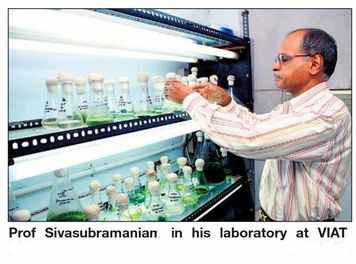
siva in viat lab

WORLD'S FIRST PHYCOREMEDIATION PLANT

Dr V Sivasubramanian and his team have set up the First Phycoremediation plant at SNAP Industry. Algal remediation technology helps in pH correction of the acidic effluent and complete reduction of sludge formation. SNAP is now a zero disposal company. The phycoremediation plant has been in operation from September 2006. The effluent generated by the industry is highly acidic and of very high TDS ( 25000 mg/L). The entire effluent is evaporated using slope tank. The algal biomass produced is used in Biofertilizer preparation and sold by the Company. The amount of CO2 removed during phycoremediation process is being calculated to claim carbon credits......more ....., CLICK HERE FOR NEWS ITEM IN DECCAN CHRONICLE ON EFFLUENT TREATMENT

Hosted by www.Geocities.ws

1