


|
PADIYIL VINOD SIVADASAN |
|
|
BREEDS OF DOGS
WORKING GROUP
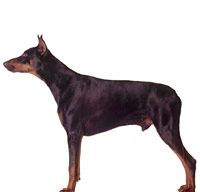 DOBERMAN
| Family | mastiff |
| Area of Origin | Germany |
| Date of Origin | 1800s |
| Original Function | guardian | |
| Today's Function | security, police, military, schutzhund | |
| Size of male | Height: 26-28 | Weight: 65-90 |
| Size of Female | Height: 24-26 | Weight: 65-90 |
History
Few people can claim to have had
so great an impact upon the dog world as Louis Dobermann of Thuringen, Germany.
Dobermann was a door-to-door tax collector who needed a watchful guard dog to
accompany him on his rounds. In the late 1800s he set about to create an alert
streamlined guard dog, most likely by crossing the old German shepherd and
German pinscher, with later crosses of the black and tan Manchester terrier,
greyhound and Weimaraner. He soon obtained the prototype of the breed that now
bears his name. The original Dobermans were still somewhat heavy-boned and
round-headed; subsequent breeders selected for a more racy-looking dog. The
breed evolved in remarkable time; by 1899 the first breed club was formed. The
breed continued to attract acclaim, and the first Doberman arrived in America in
1908. It soon found favor throughout Europe and America as a police and guard
dog, and later as a war dog. Its prowess in these areas soon brought more
admirers, and the Doberman quickly became a valued family protector. Its
chiseled silhouette and fearless alert demeanor has made the Doberman a top
contender as a show dog. As its fame grew, many families grew to appreciate the
breed as a family pet, and the Doberman eventually rose to be the second-most
popular breed in America in 1977. During this same period, a new challenge arose
for the breed — the emergence of the albinistic white Doberman. In an effort to
decrease the chance of producing these dogs, the Doberman Pinscher Club of
America convinced the AKC to tag the registration numbers of dogs with the
likelihood of carrying the albino gene with the letter Z.
Temperament
The Doberman pinscher is an
intelligent capable guardian, ever on the alert and ready to protect its family
or home. It is also a loyal and adventurous companion. It likes to be mentally
challenged and is a gifted obedience pupil. It is sensitive and very responsive
to its owner’s wishes, though some can be domineering. It is generally reserved
with strangers. It can be aggressive with strange dogs.
Upkeep
This is an active breed that
needs daily mental and physical exercise, lest it become frustrated or
destructive. Its exercise requirements can be met with a long jog or walk on
leash, or a strenuous run in a safe area. The Doberman can live outside in
temperate climates, but it is a much better companion and effective guardian if
it shares its human’s home. Coat care is minimal.
Health
• Major concerns: CVI (wobbler’s
syndrome), cardiomyopathy
• Minor concerns: vWD, demodicosis, osteosarcoma,
narcolepsy, gastric torsion, CHD
• Occasionally seen: albinism
• Suggested
tests: DNA for vWD, cardiac, (hip)
• Life span: 10 – 12 years
• Note: Blue
Dobermans often have alopecia; white Dobermans suffer from several serious
health problems.
Form and Function
The Doberman is
compactly built, muscular, powerful and square-proportioned. It combines
elegance and strength with speed and endurance. Its carriage is proud and alert,
and its gait is free and vigorous. Its coat is short, smooth and hard, showing
off the exceptionally clean-cut lines of this athletic breed.
HOME BREED OF DOGS WORKING GROUP
www.geocities.com/drvinsi