.
.
3:124 –180 THE BATTLE OF UHUD
The strategy of the Holy Prophet
in the Battle of Uhud has been stated in the commentary of Verse No. 216 of Surah Al-Baqarah. It has been reproduced, as under:
STRATEGY of HOLY PROPHET
The battle of Uhud: (It took place in the month of Shawal of 3rd Al-Hijrah.)
1. The Quraish, being greatly upset after their defeat in the battle of Badar, decided to take revenge from the Muslims. They proceeded to Madina under Abu Sufyan with 3000 heavily equipped personnel plus a cavalry of 200 horsemen, as against 700 partially equipped Muslims plus 300 men of Abdullah bin Ubayy (the hypocrite) who went back without participating in the battle.
2. The enemy encamped near the mountain of Uhud (outside Madina) due to the connivance and treachery of Abdullah bin Ubayy (leader of the hypocrites of Madina), who secretly invited them to attack the Muslims.
3. The Holy Prophet
4. The Holy Prophet
5. Seeing this strange move, Abdullah bin Ubayy pulled out his 300 men and went back to Madina (making an excuse that his opinion for fighting inside Madina was not accepted). He could neither inform Quraish (i.e. the enemy) about the movement of the Holy Prophet
6. The enemy was completely surprised to find the Holy Prophet
7. The cavalry plan of the enemy to strike straight was rendered completely ineffective by the military strategy of the Holy Prophet
8. On reaching Uhud, the Holy Prophet
9. The Holy Prophet
10. Khalid bin Waleed without waiting for Ikramah bin Abu Jahl advanced his cavalry and attacked the Muslims, but was beaten back by the two-pronged attack of the archers. At the same time, Zubair (leader of the archers) was ordered to attack from the two wings of Khalid bin Waleed simultaneously. Khalid bin Waleed retreated in confusion and demoralized the rest of the army.
11. In the mean time, the Muslim forces attacked Ikramah’s army, which also fled in confusion and disorder. The Muslims emerged as victorious.
12. The Muslims started collecting the war booty. Seeing this, the archers rushed also towards the booty. Abdullah bin Jubair tried hard to stop them for not vacating the pass between the hills, as per orders of the Holy Prophet
13. Seeing the pass vacant, Khalid bin Waleed attacked the Muslims from the rear.
14. When the Holy Prophet
15. Ali fought back and occupied the pass checking the onslaught of the enemy from that direction.
16. Hamza launched a counter attack from the other side.
17. The enemy went up the mountain to dislodge the Muslims from their defensive position. The Holy Prophet
“ O’ Allah! It is not befitting that they should be above
us.”
There upon, Umar, Usman and other Muslims went up and fought till they drove them down the hill. When the enemy found the counter attacks of the Muslims too dangerous, it quietly withdrew without overpowering the Muslims.
18. When the enemy left hurriedly without defeating the Muslims, the Holy Prophet
[Encyclopedia on Seerah, Ibn Hashsham, Ibn Khaldun, Bukhari]
[See also ‘The Battle of Uhud’ as reported by Ibn Hashsham under 3:144]
[Note: See the Battle of Uhud in Al-Quran-3:121-128,139-180]
Note: Now study the next Verses of Surah Aal-Imran about Uhud:
THE BATTLE OF UHUD IN AAL-E-IMRAN (Continued):
SUPPORT OF THE ANGELS:
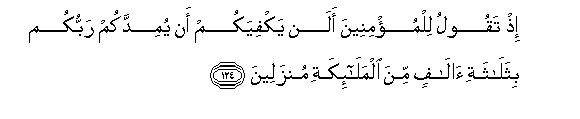
3:124 “ When you (Holy Prophet
not sufficient for you that your Lord may support you with three
thousand angels, (ready for) descending (in a disciplined manner)?” *
* These happy news were given to the believers against their enemy, 3000 in number - heavily equipped, before the Battle of Uhud, when Abdullah bin Ubayy separated with his 300 companions.
[See Tafheem-ul-Quran & Tadabbur-e-Quran under 3:124.]
Hasan Basri stated that in the ‘Battle of Uhud’ the tails of the horses of the angels were marked with white wool. Ibn Isaac stated the sign of the angels ‘in the Battle of Badr’ was that they wore white turbans on heads.
[Seerat-un-Nabi by Ibn Hashsham, Vol.II, P. 93, Ghulam Ali & Sons.]
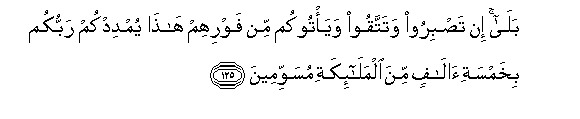
3:125 “ Certainly (it is sufficient), if you show perseverance and fear
Allah (only), and when the enemy suddenly attacks you, then your Lord
at that time will support you with five thousand angels, possessing
special marks of identification.”