.
.
2:226 - 2:242 FAMILY MATTERS
(Translation only)
2:226 “For those, who swear not to draw near their wives, they have the time limit of four months. Then, if they return (to their wives) (during this period), Allah is Most Forgiving, Most Merciful.”
2:227 “But if they decide to divorce (them), Allah is All-Hearer, Knowing every thing.”
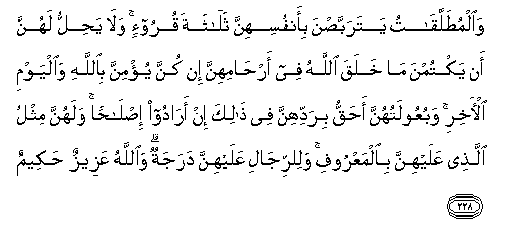
2:228 “ And the divorced women must wait for three menstrual periods. And it is not lawful for them to conceal what Allah has created in their wombs, if they believe in Allah and the Last Day. And their husbands have more right to take them back in this period, if they decide to reconcile. And they (i.e. women) have the rights (over men) just as men have the rights over them, appropriate to the prevailing conditions. Nevertheless, men have a degree (of responsibility) over them (i.e. the men have greater responsibility as the sustainer and protector of their families). And Allah is All Powerful, All Wise.
[Explanation of 2:226 – Oath for cutting off marital relations: If the husband breaches his oath and establishes marital relations within four months, his wife will remain in his wedlock and he will simply have to give an expiation for his oath. But, if he does not breach his oath even after four months, the wedlock will be broken and the wife will have the right to marry another man. Nevertheless, she may, if she likes, can remarry her husband. (Zia-ul-Quran under 2:226)]
[Explanation of 2:228 – The Waiting Time (Iddah):
a) The wife after getting divorce from her husband can not straightaway marry another man, as practiced by the Jews. As commanded above in 2:228, she must wait for the completion of her three menstruations, before she can marry again. This waiting time for the woman before marrying again is called ‘Iddah’ in ‘Shariah’ (Islamic Law. There is a great wisdom in it. During this waiting time, the husband can return to her provided that he has not divorced her thrice. Further, during this waiting time, the pregnancy can also be detected, which may compel the husband to return to his wife. Above all, the Islamic Law is more concerned about the baby in the womb of the mother, so that it may not be attributed to the wrong father. This time limit (of three menstruation periods) pertains to the woman whose menses have not ceased due to her old age. (Za-ul-Quran under 2:228).