.
.
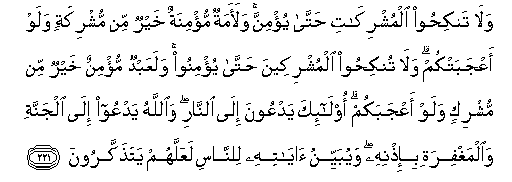
2:221 DO NOT MARRY A POLYTHEIST
2:221 “And don’t marry ‘Mushrikat’ (i.e. those women, who associate partners with Allah) till they accept Islam; and, indeed, a believing slave woman is better than a (free) ‘Mushrikah’ (i.e. a woman, who associates partners with Allah) though you may like her. And do notmarry (your daughters) with ‘Mushrikun (i.e. with those men, who associate partners with Allah) till they accept Islam; and, indeed, a Muslim slave is better than a free ‘Mushrik’ though you may like him. They (Mushrikun) (, of course,) call you towards the Fire, but Allah calls you to Paradise and Forgiveness with His Consent; and clarifies His Verses for mankind so that they may remember.”
___________________________
A Muslim must no take in marriage a Mushrikah, who may bring the filth of her belief and her religious, social and cultural values, which may eat away his own values as well as his religion with the result that he and his children may stand no where. Not only then his life as well as of his children may be destroyed, but the World hereafter for them is also endangered. The results are more horrifying, when a Muslim woman marries a ‘Mushrik’, since she may be easily influenced by him, and may quickly alter his faith and religion, if not through persuasion then from coercion or threat from him about separation.
It may be noted here that the Holy Prophet
married Jawairiyah and Safiyah (i.e. the war captives) only after they accepted Islam, as stated under the previous Verse 2:220. [Note that Jawariyah was previously a ‘Mushrikah’ and Safiyah was a Jewish lady and that their husbands had been killed in the battles.]. No doubt, marriage with the People of the Book has been allowed in Al-Quran under 5:5, but the Holy Prophet married Safiyah, after she accepted Islam. Both Jawairiyah and Safiyah were freed by the Holy Prophet