Nuclear
Regulatory Commission and the Nuclear Waste Policy Act of 1982:
Establishing
Professor Regis Wright
By,
Andrea L. Sitler
April 23, 2006
Nuclear Regulatory Commission and the Nuclear Waste
Policy Act of 1982:
Establishing
The Nuclear Regulatory Commission[1] was
designed to oversee nuclear related issues due to the hazards involved with
such a product. The transportation[2] of
nuclear material is highly regulated as are the dump sites for nuclear
waste. The factors of half lives[3]
and potential of contamination[4] is
what brought the need for the Nuclear Waste Policy Act of 1982[5]. From these policies comes the Yucca Mountain
Project which was selected to be the dump site for all of
In
1982, the U.S. Congress enacted a law called the Nuclear Waste Policy Act. The
Act established a comprehensive national program for the safe, permanent
disposal of highly radioactive wastes. This law is based on the principle that
our society is responsible for safely disposing of the nuclear wastes we
create.
The Act directed the U.S. Department of Energy to study suitable sites for a
geologic repository. The geologic repository envisioned by the Act is an
engineered disposal facility located deep underground. After more than two
decades of scientific study, in 2002, Congress and the President approved the
development of a geologic repository at
"Approximately 45,000 metric tons of spent
nuclear fuel is currently stored at 131 sites in 39 states. Each year,
approximately 2,000 metric tons of spent nuclear fuel is generated by operating
nuclear power plants. The total amount of commercial spent nuclear fuel is
expected to reach approximately 60,000 metric tons by the year 2010."[9] Locating a safe haven to rest these spent
fuel rods is what the Yucca Mountain Project is all about. Transporting the rods to
In June
1979, the Department of Transportation (DOT) and the U.S. Nuclear Regulatory
Commission (NRC) signed a Memorandum of Understanding (MOU) regarding the
transport of radioactive material. This agreement delineates the respective
responsibilities of DOT and NRC for the regulation of radioactive material in
transport. DOT and NRC also agreed to maintain consistent and comprehensive
transportation regulations. Due to advancements of transportation and security
programs, they both plan to review their regulatory plans within the next two
years.
The Nuclear Waste
Policy Act of 1982 made the U.S. Department of Energy (DOE) responsible for
site selection, construction, and operation of an underground disposal facility
for spent nuclear fuel and high-level waste. In 1987, Congress amended the
Nuclear Waste Policy Act to set up a process for Congressional review of the
site and directed DOE to study only
Under the 1987
Nuclear Waste Policy Act amendment in April 2002, the Governor of Nevada issued
a notice of disapproval of the site selection. The site is disapproved unless Congress passes a joint resolution to
approve the site during the first 90 calendar days of continuous
session following the notice of disapproval. On April 11, 2002, H.J.Res. 87 was
introduced by Congressman Barton. Pending proposed Subcommittee action, the
Energy and Commerce Committee plans to report H.J.Res. 87 on Thursday, April
25, 2002.
If the Yucca site is approved,
it is likely spent nuclear fuel will be shipped from around the country to the
site primarily by railroads. Despite railroad opposition, the Interstate
Commerce Commission ruled that railroads are required by federal law (as common
carriers) to transport all goods tendered to it. [12]
In the
1992 Energy Policy Act, Congress ordered the three agencies to focus their full
attention on this site and to devise the safest storage structure feasible
there.
To
ensure their success, Congress charged an independent panel of the National
Academy of Sciences (NAS) with analyzing
Analyzing
Yucca took much of the next decade. Working through its contingencies produced
a detailed knowledge of
"
The
chosen site, just as White Sands in NM, is one which has been used for years of
weapons testing. Radiation and such is
nothing new in this area. The disposal
site is to be situated on the edges of Nellis Air Force Base and the Nevada
Test Site. Both sites are government
properties. The next neighbor is
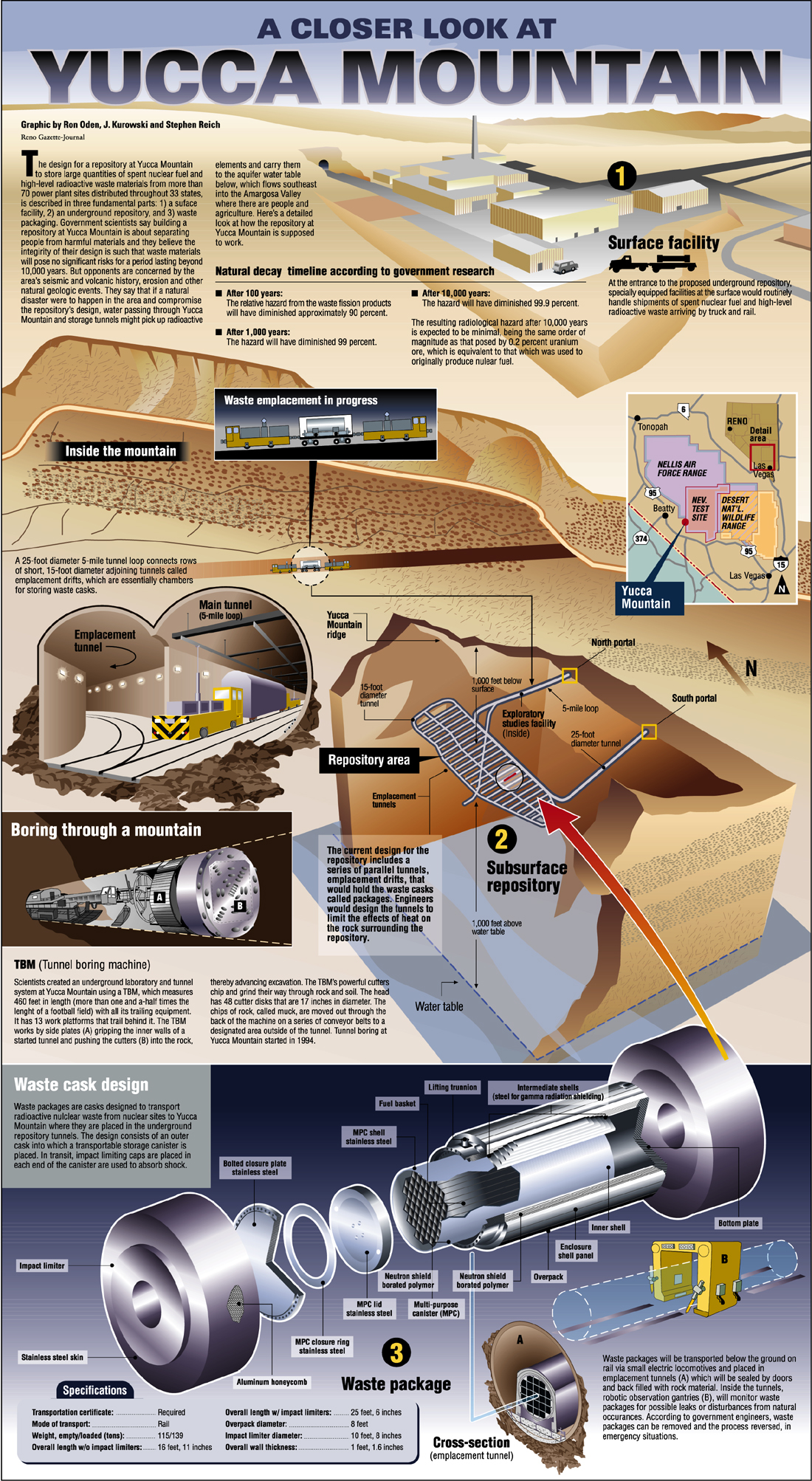
The nuclear waste is to be stored in emplacement tunnels[17]. These tunnels are bored into the mountain, sealed by doors and back filled with rock material. Inside the tunnels, robotic observation gantries monitor waste packages for possible leaks or disturbances from natural occurrences. According to government engineers, waste packages can be removed and the process reversed, in emergency situations.
The
design of the facility is such that waste materials will pose no significant
risks for a period lasting beyond 10,000 years.
The bulk of the disposed material is to be 90% inactive within 100
years. Opponents are concerned by the area’s seismic and volcanic history,
erosion and other natural geologic events.
They say that if a natural disaster were to happen in the area and
compromise the repository’s design, water passing through
Geological events are of concern when determining where to construct a nuclear waste disposal site. The DOE ordered studies of earthquakes and volcanic events in the area.
The
largest earthquake at the repository itself, as known from geologic evidence,
had a slip of about 1 meter; earthquakes of this size appear to recur at
intervals like tens of thousands of years there. The possibility of strong
ground motion from faults outside the immediate area exists at a much smaller
recurrence interval, but their ground motion is predicted to be less and is
being considered in the seismic design.
Study
1 - Analysis of the available data
indicates that, since 1976, there have been 621 seismic events of magnitude
greater than 2.5 within a 50-mile radius of
The most notable event during
this period was a magnitude 5.6 earthquake near Little Skull Mountain, about 8
miles southeast of the
The only significant cluster
of earthquake activity in the 50-mile radius area is in
Earthquake activity is a
safety concern both during operation, above and below ground, and after closure
of a repository at
The mountain ranges and
valleys of the Basin and Range, including the
Study
2 -
In the March 28
issue of the journal Science, Brian Wernicke of the California Institute of
Technology (Caltech) and his colleagues at the Smithsonian Astrophysical
Observatory in
"The question
is why the predicted geological rates of stretching are so much lower than what
we are measuring?" asks Wernicke. "That's something we need to think
through and understand."
The answer is likely
to be of interest to quite a few people, because
The problem the new
study poses is that the strain is building up in the crust at a rate about
one-fourth that of the most rapidly straining areas of the earth's crust,
such as near the San Andreas fault, Wernicke
says. But there could be other factors at work.
"There are
three possibilities that we outline in the paper as to why the satellite data
doesn't agree with the average predicted by the geological record," he
says. "Either the average is wrong,
or we are wrong, or there's some kind of pulse of activity going on and we just
happened to take our data during the pulse."
The latter scenario,
Wernicke believes, could turn out to be the case. But if
Earthquakes are common on the San
Andres fault. This line runs to the west
of the
The issue of earthquakes during transport is also taken into consideration and provisions have been put into place. Only solid waste is proposed for storage, therefore an earthquake would not result in any direct release of radioactivity to the air or ground water even if, in an extremely unlikely event, a canister were ruptured.[22]
Seismologists believe that the
level of seismic activity in the vicinity of
Transport of the nuclear waste to
Specially equipped facilities and personnel specifically trained in the handling of high-level radioactive waste will man this facility. This holds true for any personnel involved in any way with this facility, the transportation, packaging, handling at either end and so forth. What people in general fail to realize is that the people working with this product are taught to respect the product. They desire their own personal safety and will be subjecting themselves to great personal harm should they not be diligent in their work.[26]
President George W. Bush agreed with the logic and studies of these scientists and engineers enough that on July 23, 2002, after two decades of study[27] and debate in both the House and Senate, he signed House Joint Resolution 87- the Yucca Mountain Bill. This "will allow us, after a decade of scientific study, to take the next step in establishing a safe repository in which to store our nation's nuclear waste."[28]
Even after the President signed the Yucca Mountain Bill, much object still surrounds this project. "As always, the population in these remote areas is primarily Native Americans."[31] A local Indian Tribe, the Western Shoshone Nation,[32] is near by the mountain living on reservation land. Many claim that the government still sees this land as government land thereby being able to use it as they deem fit. History has proven to us that the government has placed little value in the life of an Indian[33] and therefore would not consider them a potential factor of risk.
Local groups, tribes and scientists
paint an entirely different view of the
Though the nuclear industry has been quoted as saying that
There are 33 known earthquake faults in and around the
Do you think that a small mountain that sits near volcanoes, in an active
earthquake region, and atop a large water table, the cleanliness of which
affects food products which feed the entire country, is a good place for
permanent high-level nuclear waste storage? Neither does the Department of
Energy (DOE), really. Since nuclear waste is so unpopular, the only "good"
place for it is wherever the nuclear industry can force it. It figures that
However, with the permanent population of
The U.S. Government, through Senate Bill 958[36],
introduced, May 24th, 2001, - the "Western Shoshone Claims Distribution
Act"[37], is
attempting to once again renege on a treaty with an Indian Nation. The government needs the Western Shoshone
Nation to sell them the land or to find a way to force the Nation off the land
in order to build this site and its railway.
This bill avoids just compensation under the
Fifth Amendment, which would provide approximately $20 billion to the Western
Shoshone Nation.
In the
The Treaty of Ruby Valley[39]
shares equal status with the US Constitution, Art. IV[40],
"This Constitution… and all treaties made… shall be the supreme law of the
land." Congress can not legislatively supersede the US Constitution. To do
so is constitutional subversion.
Additionally, the Western Shoshone Nation, as any Indian Tribe, does not
wish to sell their land.[41]
This entire land issue has delayed
but not stopped the project.
One
thing not mentioned is that the most legally secure argument against
This controversial project has gathered much attention. Studies upon studies continue as this project develops. Environmental Impact Studies top the list.[43] Even the studies[44] disagree and conflict.[45] This adds more fuel to the fire of the opposing parties.
The exponentially growing
Overall the
The Nuclear Regulatory Commission has taken on a tough and much needed
project. Much litigation and legal
issues have been examined and decided.
Many more legal issues are still on the horizon. A solution for disposal
should have been considered before construction but as with many projects, this
was not the case. Since the beginning of
the Nuclear Age[49]
in 1895 by the discovery of x-rays by Wilhelm Roentgen, we have been dealing with nuclear concerns.[50]
The Manhattan Project[51]
in 1942 brought the reality of the effects of radioactivity to the attention of
the government. Finally, over sixty
years later, thanks to the Nuclear Waste Policy Act of 1982, we are beginning
to provide an answer for these issues.
References
A Closer Look at
Action Alert. (2001). Retrieved April 11, 2006 from http://www.shundahai.org/claims_action_alert_0501.htm
American Geological
Institute. (2006). FY2007 Department of
Energy Appropriations, Retrieved April 22, 2006 from http://www.agiweb.org/gap/legis109/appropsfy2007_energy.html
Baciak, J. (2002). Pro Yucca Mountain Final Paper,
Retrieved April 22, 2006 from http://www.engin.umich.edu/class/ners211/project2002/pro/main_finalpaper.doc
Bills and Joint Resolutions Senate
Bill 958. (2001). Congressional
Record, p. S5635, Retrieved April 7, 2006 from http://www.nativeweb.org/pages/legal/shoshone/reid958.html
Buffa, A., et al. (2003).
Public
Citizen Global Exchange Corp Watch, pp. 17-18, Retrieved from http://www.citizen.org/documents/profilebechtel.pdf
on April 22, 2006
Census Scope. (2000). Retrieved April 2, 2006 from http://www.censusscope.org/us/m4120/chart_popl.html
Dann, C. (2004). Western Shoshone Defense Project, Retrieved April 12, 2006 from http://www.wsdp.org/arc_distribution.htm#060104
Department
of Energy. (n.d.). The
http://www.eh.doe.gov/ohre/roadmap/achre/intro_3.html
Department of
Transportation. (2002). Review of
Department Oversight for Transportation of Nuclear Waste, Retrieved April
22, 2006 from http://www.oig.dot.gov/StreamFile?file=/data/pdfdocs/cr2002073.pdf
Dickerson, A. (2003).
Environmental Impact Statements (EIS)
"Issues" for
Geologically Ill-chosen (n.d.). Retrieved April 22, 2006 from http://www.nvantinuclear.org/ill-chosen.htm
Gold, E. (n.d.). Nuclear Waste Disposal, Retrieved April
3, 2006
from http://www.history.rochester.edu/class/EZRA/
Kurowski, J. & Reich, S. (n.d.). How
Yucca Mountain Would Work, Retrieved April 2, 2006 from http://www.rgj.com/news/files/2002/01/11/4186.jpg.php
Makhijani,
A. & Saleska, S. (1996). High-Level
Dollars, Low-Level Sense.
Makhijani,
A. & Zerriffi, H. (2000). The Nuclear
Alchemy Gamble.
Makhijani,
A. Ph.D. (2001). Securing the Energy
Future of the
Nuclear Energy
Institute, Inc. v. EPA, et al., 373 F.3d 1251 (D.C. Cir. 2004).
Office of Civilian
Radioactive Waste Management. (n.d.). The Environment in the Potential
Waste Emplacement Tunnels, Retrieved March 28, 2006 from http://www.ocrwm.doe.gov/ymp/science/emplacetunnel.shtml
Office of Civilian
Radioactive Waste Management. (n.d.). Nuclear
Waste Policy Act, Retrieved April 5,2006 from http://www.ocrwm.doe.gov/ymp/about/nwpa.shtml
Office of Civilian
Radioactive Waste Management,
Pielke, R. (2004). Prometheus:
Pipeline and Hazardous
Material Safety Administration. (2005). Retrieved April 15, 2006 from http://hazmat.dot.gov/regs/rules/final/69fr/69fr-12088.htm
Riddel, M., Dwyer, C., Shaw, W.D. (2003). Environmental Risk and Uncertainty: Insights from
State of
State of
Subcommittee on Railroads
and Subcommittee on Highway and Transit, Joint Hearing. (2002). Transportation of Spent Rods to the Proposed
Yucca Mountain Storage Facility, Retrieved April 3, 2006 from http://www.house.gov/transportation/highway/04-25-02/04-25-02memo.html
Western Shoshone Claims Distribution Act. (2001). Retrieved April 2, 2006 from http://www.nativeweb.org/pages/legal/shoshone/s958.html
What's New -
[6] Makhijani,
A. Ph.D. (2001). Securing the Energy
Future of the
[7] Nuclear Energy Institute, Inc. v. EPA, et al., 373 F.3d 1251 (D.C. Cir. 2004).
[13] Colburn, J. (2004). The Yucca Mountain Radioactive Waste Site
Controversy: The Role A
Recent Federal Appellate Decision In The Controversy May Play in the
Presidential Election, Retrieved April 23, 2006 from http://writ.news.findlaw.com/commentary/20041014_colburn.html
[38]
[39] Native
[40]
[44] Pielke, R. (2004). Prometheus:
from http://sciencepolicy.colorado.edu/prometheus/archives/energy_policy/000131yucca_mountain_poli.html
[49]
[50] Makhijani, A. & Saleska, S. (1996). High-Level Dollars, Low-Level Sense.