By,
Dr. Andrea Leigh Sitler, PhD
June 20,
2003
No
one wants a radioactive waste dump in their backyard. We all want the benefits of clean
nuclear power but no one desires responsibility for the spent core. People hear the work nuclear or
radioactive and think of three legged children, two headed chickens, death and
all the other media hype one can fathom.
But let us get real and take a scientific look at nuclear
waste.
The
chosen site, just as White Sands in NM, is one which has been used for years of
weapons testing. Radiation and such
is nothing new in this area. The
disposal site is to be situated on the edges of Nellis
Air Force Base and the Nevada Test Site.
Both sites are government properties. The next neighbor is
“
The
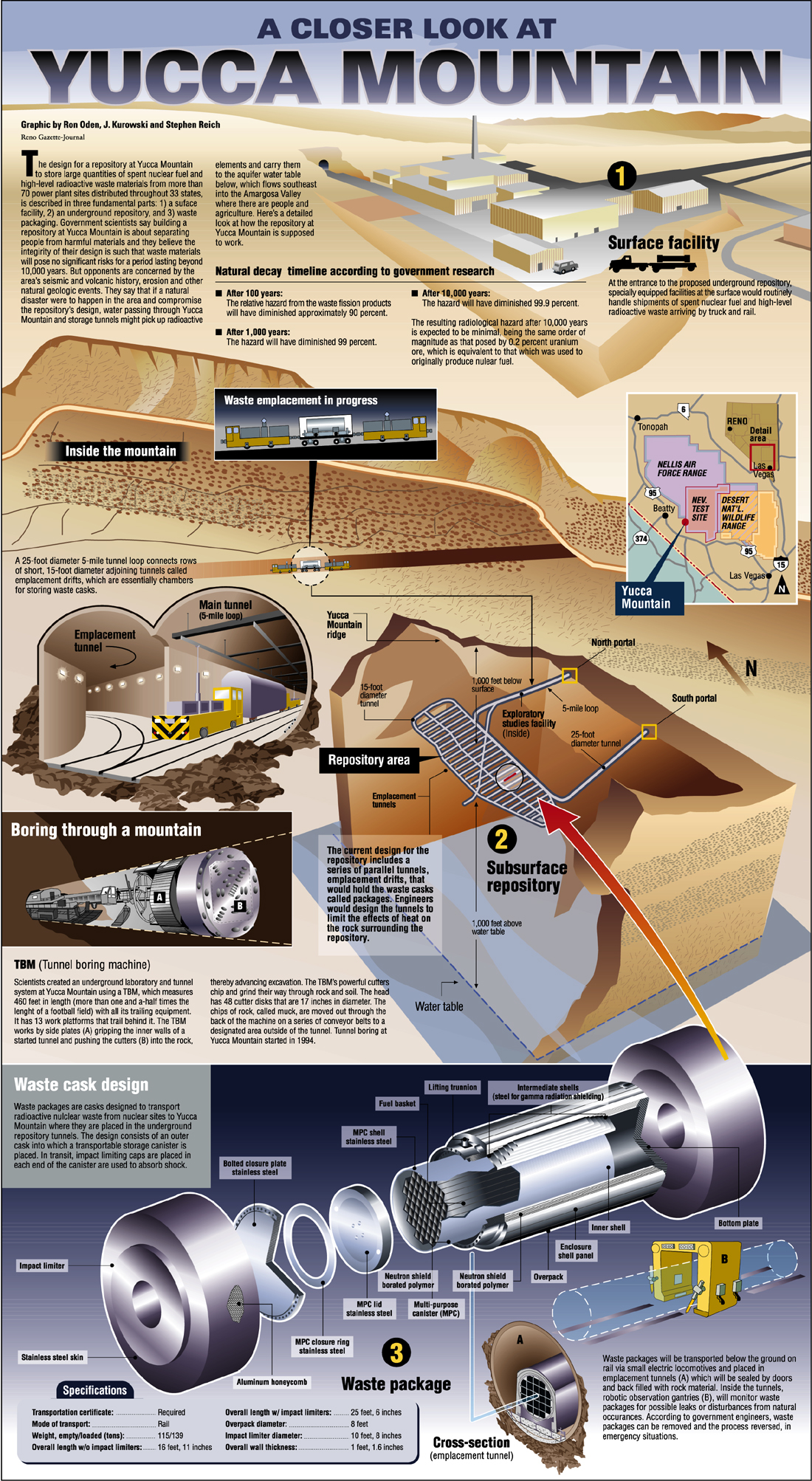
nuclear waste is to be stored in emplacement tunnels. These tunnels are bored
into the mountain, sealed by doors and back filled with rock material. Inside the tunnels, robotic observation
gantries monitor waste packages for possible leaks or disturbances from natural
occurrences. According to
government engineers, waste packages can be removed and the process reversed, in
emergency situations.
“The design of the facility
is such that waste materials will pose no significant risks for a period lasting
beyond 10,000 years. The bulk of
the disposed material is to be 90% inactive within 100 years. Opponents are
concerned by the area’s seismic and volcanic history, erosion and other natural
geologic events. They say that if a
natural disaster were to happen in the area and compromise the repository’s
design, water passing through
With earthquakes and
volcanoes being a hot topic for discussion allow me to present two studies from
the area in question. First bear in mind that possible damage to stored waste
canisters and potential effects on the long-term storage barriers will be
addressed by the DOE. The largest earthquake at the repository itself, as known
from geologic evidence, had a slip of about 1 meter; earthquakes of this size
appear to recur at intervals like tens of thousands of years there. The
possibility of strong ground motion from faults outside the immediate area
exists at a much smaller recurrence interval, but their ground motion is
predicted to be less and is being considered in the seismic
design.
Study 1 -“Analysis of the
available data indicates that, since 1976, there have been 621 seismic events of
magnitude greater than 2.5 within a 50-mile radius of Yucca Mountain. Reported
underground nuclear weapons tests at the Nevada Test Site have been excluded
from this count.
The most notable event
during this period was a magnitude 5.6 earthquake near Little Skull Mountain,
about 8 miles southeast of the
The only significant cluster
of earthquake activity in the 50-mile radius area is in
Earthquake activity is a
safety concern both during operation, above and below ground, and after closure
of a repository at
The mountain ranges and
valleys of the Basin and Range, including the
Study 2 -“PASADENA--Recent
geodetic measurements using Global Positioning System (GPS) satellites show that
the Yucca Mountain area in southern Nevada is straining roughly 10 to 100 times
faster than expected on the basis of the geologic history of the area. And for
the moment at least, geologists are at a loss to explain the anomaly.
In the March 28
issue of the journal Science, Brian Wernicke of the
California Institute of Technology (Caltech) and his colleagues at the
Smithsonian Astrophysical Observatory in
"The question is
why the predicted geological rates of stretching are so much lower than what we
are measuring?" asks Wernicke. "That's something we
need to think through and understand."
The answer is
likely to be of interest to quite a few people, because
The problem the new
study poses is that the strain is building up in the crust at a rate about
one-fourth that of the most rapidly straining areas of the earth's crust, such
as near the San Andreas fault, Wernicke says. But
there could be other factors at work.
"There are three
possibilities that we outline in the paper as to why the satellite data doesn't
agree with the average predicted by the geological record," he says. "Either the
average is wrong, or we are wrong, or there's some kind of pulse of activity
going on and we just happened to take our data during the pulse."
The latter
scenario, Wernicke believes, could turn out to be the
case. But if
Source: http://pr.caltech.edu/media/lead/032698YUCCA.html
Earthquakes are common on
the San Andres fault. This line
runs to the west of the
“Seismologists believe that
the level of seismic activity in the vicinity of
The
last active volcano in this part of the country was
Earthquakes of any noticeable magnitude nor volcanoes have occurred in this
area in recent history. Even the scientists can not concur as to why they think
the ground may be shifting. They
themselves say their tests are inconclusive. In my opinion these topics should not be
a significant issue. I feel many a smoke screen is being sent up to gain
attention. Data is being produced
to support the side that wishes to see such data. One group raises red flags on possible
earthquakes while failing to say that only a machine can even feel them. Too much colored data is being
presented. That is why I stand by
my opinion that volcanic activity and earthquakes are not a significant issue to
this project.
Another main cause for alarm
is the transportation issue. People
fear and panic when they hear that nuclear or radioactive products are being
transported through their neighborhood.
This transportation is highly regulated and safe. Bear in mind, the driver does not want
to ‘glow’. Drivers selected for
this type of transport are highly trained professional with a long and safe
driving record. Rookies and new
hires are not even considered for such work. This highly regulated transport is
conducted under the strictest of regulations and most cautious of drivers. Many a load has gone by your house
without your knowledge and without incident.
The
train load that caught fire inside a
The
routes for entrance to this facility are being carefully thought out and
designed. This is to insure the
least amount of access to people or natural disasters such as an earthquake
enroute.
To
add to the transportation issue, another hot topic is the fact of Nellis Air Force Base’s flight plan. Many people in power do not wish to see
planes within 30 miles of a storage facility. They also do not wish to draw red circle
where pilots can not fly. This is
another hot topic few wish to discuss.
In
short, anyone handling this material or material of the sort is a highly trained
professional. Specially equipped
facilities and personal specifically trained in the handling of high-level
radioactive waste will man this facility. This holds true for any personnel
involved in any way with this facility, the transportation, packaging, handling
at either end and so forth. What
people in general fail to realize is that the people working with this product
are taught to respect the product.
They desire their own personal safety and will be subjecting themselves
to great personal harm should they not be diligent in their
work.
More federal hearings are
scheduled for September 2003.
My
personal recommendation is that
Traffic and population in
the east is why too high to make a location there a practical consideration.
Coastal states have no mountains and are primarily below sea level. These are not adequate sites. The only place I could think to place
such a facility would be in NM or AZ mountains, CO, UT and ID mountains or here
in Yucca. The rest of our
backyard’s are too populated, too crowed, too busy with
traffic, unstable or to close to the water table.
The
only other alternative I wish to offer as well as a thought to the
populace. If you do not wish to
have this waste in your backyard, then nuclear power will have to become a thing
of the past. What do we have to
replace it? Consider the
alternatives? Even if we do not
have nuclear power, the other countries do. The possibilities for contamination by
air drift even at minute levels still can occur. If you are going to reduce this site to
such scrutiny consider that factor for a moment.
Andrea Leigh
Sitler
June
2003