GHOST PROJECT
Why people believe?The ghost in the mind: A brain-environment interaction model of the apparitional experienceBy Bryan J. WilliamGhost. "What are they?" Are they a simply subjective product of the mind of the person who has encountered them, or is there a physical aspect underlying their existence that implies that the reach of human consciousness is much greater than people ever thought it to be? To consider the latter, it is best that one first examines the cases in which the former might apply. In this paper, a testable interaction model is presented which suggests that some apparitions are actually altered perceptual phenomena produced through subtle interactions between the brain/nervous system and external factors within the surrounding physical environment. It is proposed that extreme fluctuations of these factors produce physiological effects that are either causing brief periods of hallucination or bringing about altered states of consciousness through which these phenomena may be perceived.
People want to hear unusual stories because it gives them excitement, something to believe, fear, ponder and even hope! It is also a form of escape from questions they can't answer, like why is someone suffering from a mysterious illness isblamed on bad spirits when there's no logical answers. The collection of studies by Persinger suggesting a relation among increased geomagnetism, cerebral melatonin levels, and complex partial temporal lobe epilepsy is reviewed and applied to further show how temporal lobe microseizuring can alter electrochemical activity within the mesiobasal structures and produce abnormal sensory and emotional behaviors often associated with apparitions. This action is further reinforced by the effects of strong artificial electromagnetic fields (EM), which have been consistently found in field investigations of haunting. It is further suggested that paroxysmal neuroelectric activity induced by entrainment from EMs resembling neural "burst-firing" patterns can encourage widespread activation throughout the right hemisphere and incorporate various functional areas into the experience in a manner similar to that seen in chronic hallucinators. This allows s several subjective sensory sensations, memories, feelings of fear, and impressions of meaning to be perceived at one time. This EM effect is further used to illustrate the second mode of interaction of brain influencing environment to account for the role of recurrent spontaneous psychokinesis in producing anomalous movement and possibly "creating" the apparitional experience. Preliminary findings with electrostatic fields, ionizing radiation, infrasonic waves, and meteorological factors are also examined to consider their effects on the brain in relation to apparitional experiences. The third mode of interaction involves the brain influencing its cognitive functioning to create the content of these experiences. It is proposed that the phenomenology resulting from the brain--environment mode is what gives rise to some types of visual imagery and allows them to be perceived as being external to the observer. The content of these experiences are then influenced by the interpretation of cognitive contextual variables related to survival. This model is only applicable to certain types of apparitional experiences, whereas other seemingly more complex ones remain unaccounted for. |
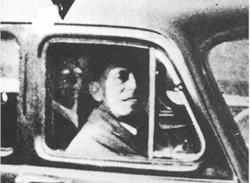 This next photo was taken in 1959 by Mrs. Mabel Chimney in a British churchyard. She had just finished photographing her mother's grave and then took a picture of her husband, who was waiting for her in the car (alone). But the developed photograph clearly showed Mrs. Chimney's mother in the back seat of the car. A photo expert declared, "I stake my reputation on the fact that this picture is genuine," he said.