

SHREVE TO BE GUEST SPEAKER AT JUNE MEETING !!
"Permanent Stamps"?
Rick Houghland
What is the world coming to that we now have "permanent stamps"? It appears that we have come full circle back to the days of a signature or mark on an envelope that indicates that some postage has been paid (not always the same rate by the way) for some piece of mail. There will be no more trying to add up the numbers on stamps to pay the going rate on a letter (or even having to know what the rate is!). You just buy a booklet of stamps ( whose price changes from day to day, month to month, or year to year) and stick one on your letter, post card, or package and take it to the post office. Why don't we just take our letters to the mailbox without postage and the postman debits our account for the correct rate of the day!!!!?????

Sorry, I slipped off the rail for a moment. Ah, yes, we are in the age of non-denominated stamps. I think it began about 1975 when the US, in response to daily changing postal rates, decided to introduce stamps with no value printed on them because they weren't sure what the final rate would be. It started out as just first class letter rates, but as time went on we had to have the "makeup rate" stamp to add to the old stamps we still had ! ( I do think it is noteworthy that the USPS stopped using alphabetic rates once they used H. I think there was something about an �I-rate� stamp that did not get executive approval !! Then there were the bulk rate, non-profit, corporate rate stamps with categories from "less than 100 but more than 50 pieces to over 10,000 pieces and several rates in between. Don't get me started on Official Mail !!! There have been several "improvements" along the way until in 2007 we reached the top of the line (or is it?), the FOREVER stamp.

Other nations have followed the practice such as Great Britain�s NVI (no value indicated) Machins in 1989 with text like �1st� and �2nd� on the stamp. How did a stamp of the Queen get through with �2nd� on it????? Ireland, Denmark and other European countries have come up with some other unique test on their stamps. Not to be outdone, Canada has their entry in the marketplace. In 2008, they introduced the �permanent� stamp with a large P on it. It seems that you should be able to use a "permanent" stamp over and over!
COULD THIS BE ANOTHER SPECIALTY COLLECTION??? !!! It sounds like it is right up there with Cinderellas and Potato Tax stamps or is it?
I guess I have poor vision, but I can't tell the difference between a "reverse printing" variety and a regular example of any of the Overrun Countries stamps in the photos I have seen in ads. Can someone explain what one is supposed to see?
The difference is quite easy to see on most of the stamps in this series without magnification if you compare them side by side. The black shading on the flag in the design is printed under the colors of the flag on the reverse printing copies whereas the shading is printed on top of the colors of the flag on the normal copies.
This image should help illustrate the difference. You should be aware that there is controversy surrounding "reverse printing" issues.
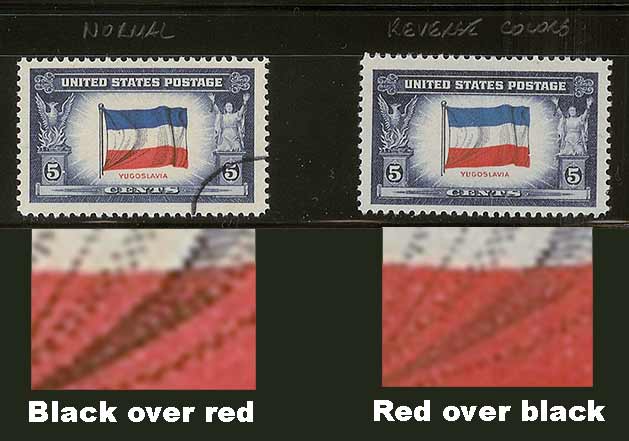
In addition to the stamps shown THERE ARE ALSO BLOCKS WHICH SHOW BOTH "NORMAL" AND "REVERSE" PRINTINGS. Obviously, it's "impossible" for stamps from the same block to exhibit "normal" and "reverse" printings, so what explains this phenomenon? (...and maybe more importantly, what does that imply for the Scott listing status and nomenclature being used?)
Several people are studying this so I will defer to them for more thorough explanations. One such explanation I recall hearing (Sarno?) involves "trapping" and "picking" of inks during the printing process (e.g. a "normal" printing with "trapping" could essentially look the same as a "reverse printing" with "picking.") More importantly, this "trapping" or "picking" phenomenon could vary within a sheet, which might explain my unusual block. BTW, this is just one hypothesis -- there are others.
The reverse is scarcer, EXCEPT on the Greece issue where it is more common. As for the reverse having a higher catalog value, they are not assigned a catalog value in the Scott Specialized. No doubt they are worth a premium, but judging from the number of copies I have seen pop up in auctions (both ebay and conventional) they may not be worth as much as some of the sellers are setying their reeserve prices at.
from "The Virtual Stamp Club"
At the Greabner meeting today, May Day Taylor gave us an update on the health status of Nick Carter. Nick is currently in the hospital undergoing treatment for cancer. He had previously had prostate cancer, which was treated. May Day cited stress from the election, among other things; but the cancer has re-appeared and metastized (sp) into his lungs. Nick is in Suburban Hospital (DC metro area). He will be in there for at least the better part of the coming week. She said he is in good spirits and accepting vistors. He prefers to see visitors, as opposed to receiving phone calls. He is also encouraged by cards and letters (with stamps, of course).
******In the recently
posted headlines for the Nov 12 issue of Linn's:
USPS allows papermaker to skip water-soluble
layer on some 2007 stamps
Problems soaking nine United States stamps issued in August and September have a
common thread. The paper supplier is the same for all of the stamps, and the
water-soluble layer in the self-adhesive laminate has been thinned to being
nonexistent over the course of recent stamp issues. The water-soluble layer
allows a stamp to be soaked in water to remove it from a clipping.
In what possible way is this in the interests of stamp
collectors?
Now we can't soak used US off paper.
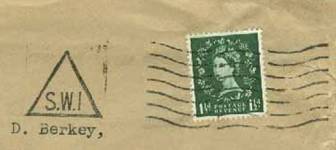
Triangular dies in machine cancels were used on bulk printed paper postings until 1968 when the PPR was abolished.
The triangle replaces the dated town die, but contains the telegraphic code, or provincial PO number (see earlier thread on numbered handstamps - the same ones are used) of the location. The other part of the cancellation is normally wavy lines (in three segments). Stamped PPR mail would have the same type of cancellation but in black, and with three segments of wavy lines.
The centre segment may be replaced by a valued PAID marking, such as 2D / PAID. PP 'PAID' marks should be applied in red ink. The postage is either paid on account or by cash or cheque at the time of posting.
Exceptions:
a. normal slogan in place of wavy lines (most likely in black);
b. on fully-paid mail in error due to ordinary mail being fed through the
machine before the dated town die is replaced.
HANDSTAMPS
For non-machineable printed paper, triangular handstamps were used with
telegraphic code letters, London District initials or Head office initials (MTP=Mount
Pleasant), or provincial office numbers.
"Inspectors marks" are also handstamps and they can be upright or inverted triangles, or ovals; others are used for mis-sorts and were used into the 1980s.
RECOMMENDED READING - "Collect British Postmarks".

Our GB stamps information
website:
http://www.norphil.co.ukk
Our online shop for stamps, fdcs, world postal history, and picture
postcards:
http://www.norphil.co.uk/catalog