The DC Golden Age period from 1938 to 1950
- Action Comics (1938)
the original Golden Age comics (as shown in Action Comics #1 (1938), Superman (volume 1) #1 (1939), and Superman (volume 1) #61 (1949), as well as in later post-Golden Age stories such as Secret Origins (volume 2) #1 (1986)), noted scientist Jor-L had discovered his planet of Krypton was about to explode yet was unable to convince his fellow Kryptonians to save themselves. However, he did manage to construct a spaceship to save his and his wife Lora's infant son, Kal-L. The ship was launched just as the planet finally exploded, with Kal-L landing on Earth around the end of World War I; his landing was watched by passing motorists John and Mary Kent. The couple took the infant to an orphanage, and soon returned to adopt the child, naming him "Clark." (The names of Jor-L, Kal-L, Lora, John and Mary were eventually changed to the more modern "Jor-El", "Kal-El", "Lara", "Jonathan" and "Martha" by the the late 1940s/early 1950s). Later, Superman would again be revamped after the Crisis.
Batman
The DC Comics superhero Batman (originally and still sometimes referred to as The Batman) is a fictional character who first appeared in Detective Comics #27 in May 1939. His "true" identity is Bruce Wayne, billionaire industrialist, playboy, and philanthropist. Although the character was co-created by artist Bob Kane and writer Bill Finger, only Kane receives official credit for the character. Batman was, at first, just one of several characters featured in Detective Comics. He has since become one of the world's most well-known comic-book characters, along with Superman..
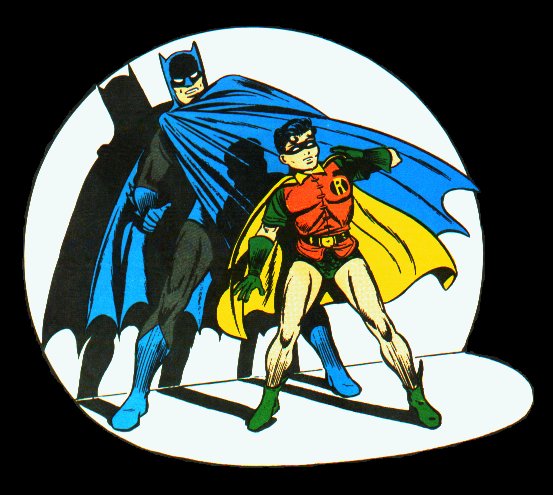
Robin (1940)
Robin was a popular character, was a kid, and Batman's young aid. Since 1940, several different characters have stepped into the role of Robin. In each incarnation, Robin's brightly colored visual appearance and youthful energy have served as a contrast to Batman's dark look and manner. The character helped influence Batman and the comic's company's policy on murder, violence and guns, none of which Batman sought outwardly after 1940.
The Flast (1940)
The Flash was a superhero possessing "super-speed", nicknamed the Scarlet Speedster. Created by Gardner Fox and Harry Lampert, the original Flash first appeared in Flash Comics #1 (1940). Thus far, three different people have assumed the identity of the Flash: Jay Garrick (1940-present), Barry Allen (1956-86), and Wally West (1986-2004), "Chris Khan" ([2004-present]) Each of these individuals somehow gained the power of "super-speed", which includes the ability to run and move extremely fast, use superhuman reflexes, and violate certain laws of physics. The golden age Flash was part of the JSA.
Wonder Woman (1941)
In December 1941, Wonder Woman made her debut in All Star Comics #8. Following this exposure in the second largest selling comic in DC's line, she was featured in Sensation Comics #1 (January 1942), and six months later in her own self-titled book (Summer 1942), making her the first super-heroine to have her own comic book. Until his passing in 1947, Dr. Marston wrote all of Wonder Woman's appearances. Artist H.G. Peter (previously best known for his Gibson Girl illustrations) drew the book, giving it a simplistic but identifiable "female" style that contrasted with other super-hero comic books of the day. The comic was littered full of images of bondage, causing the author to fall under high scrutiny in later years.
Hawkman (1940)
Hawkman first appeared in Flash Comics #1 (1940), and was a featured character in that title throughout the 1940s. This Hawkman was Carter Hall, a reincarnation of an ancient Egyptian prince, who had in the modern day discovered that the mysterious "ninth metal" could negate the effects of gravity and allow him to fly. He donned a costume with large wings to allow him to control his flight and became the crimefighter, Hawkman. An archaeologist by trade, Hall uses ancient weapons from the museum of which he was curator in his efforts.
Green Lantern (1940)
Alan Scott was a founding member of the Justice Society of America, and starred in his own title, Green Lantern, during the 1940s. His adventures during the Golden Age of comic books came to an end when superheroes fell into disfavor in the industry in the early 1950s, when the JSA's adventures ended with All-Star Comics #57 (1951). His powers came from magic, not from an intergalactic Corps.
Aquaman(1941)
In his Golden Age appearances, as seen in his first appearance in More Fun Comics #73 (November 1941), Aquaman was presented as the son of a human scientist who gave him the ability to survive and breathe underwater, but had no other powers whatsoever. This version of Aquaman was, in later years (after the establishment of DC Comics' multiverse) described as being the Aquaman of Earth-Two, an alternate Earth. The only appearances of the Golden Age/Earth-Two version of Aquaman after the Golden Age were in All-Star Squadron #59 and #60, just before he was retroactively eliminated from existence due to the changes wrought to DC's history by 1985's Crisis on Infinite Earths.
Captain Marvel (1930)
Fawcett Comics, a subsidiary of Fawcett Publications, was one of several successful comics publishers during the Golden Age of Comic Books in the 1940s. Its most popular character was Captain Marvel (not to be confused with Marvel Comics' character of the same name), the alter ego of boy radio reporter Billy Batson, who transformed into the hero whenever he spoke the magic word "SHAZAM!".Other characters published by Fawcett include Ibis the Invincible, Bulletman and Bulletgirl, Spy Smasher, Captain Midnight, Phantom Eagle, Mister Scarlet and Pinky, Minute Man, Commando Yank, and Golden Arrow. Fawcett Publications began in 1919 with the magazine Captain Billy's Whiz Bang and eventually expanded into a line of periodicals with a combined circulation of ten million a month. The company joined in the explosion of comic book publications in the United States in the late 1930s and early 1940s. Its initial entry, developed by writer Bill Parker and artist C.C. Beck, was Thrill Comics, a single issue of which was published only as an ashcan copy. The content was then reworked (for example, the lead character of Captain Thunder was renamed to Captain Marvel), and published as Whiz Comics #2 (Feb. 1940).
The Spirit (1940)
In June 1940 Will Eisner created The Spirit, a comic serial that appeared weekly in a Sunday newspaper insert. Eisner worked as editor, but also wrote and drew most entries. The Spirit was a feature about Denny Colt, a man presumed dead but who actually operated in secret as an anonymous crime-fighter. The stories included a wide variety of styles: crime drama, love stories, mysteries, horror, comedy, drama, and black comedy. DC comics later continued The Spirit long after he was originally created.
World War II: German troops enter Austria
German troops occupy Austria; annexation declared the following day.
The last reunion of the Blue and Gray commemerates the 75th anniversary of the Battle of Gettysburg in Gettysburg, Pennsylvania. Begins Communist Witch Hunt
Holocaust Begins
Great Depression Occurs
Hungary leaves the League of Nations
Holocaust: The last remaining Jewish enterprises in Germany are closed.
World War II brings allies together, however US declares nuetrality
Italy invades Greece.
Hungary, Romania and Slovakia join the Axis Powers.
In England, the city of Coventry is destroyed by 500 German Luftwaffe bombers (150,000 fire bombs, 503 tons of high explosives, 130 parachute mines leveled 60,000 of the city's 75,000 buildings; 568 people were killed).
Bulgaria signs the Tripartite Pact thus joining the Axis powers.
Attack on Pearl Harbor
Breakfast cereal Cheerios is introduced as CheeriOats by General Mills
After 14 years of work, drilling is completed on Mount Rushmore.
The United States officially declares war on Japan on December 8, then Germany declares war on US.
The first American forces arrive in Europe landing in Northern Ireland.
Daylight-saving time goes into effect in the United States.
Manhattan Project Formed
DDT First Used
Rome is bombed by the Allies for the first time in the war, then shortly after Italy surrenders.
Great Depression ends in the United States: With unemployment figures falling fast due to World War II-related employment, US President Franklin D. Roosevelt closes the Works Progress Administration.
Battle of Normandy begins - Operation Overlord, code named D-Day, commences with the landing of 155,000 Allied troops on the beaches of Normandy in France. The allied soldiers quickly break through the Atlantic Wall and push inland in the largest amphibious military operation in history.
IBM creates the first program-controlled calculator.
The Royal Air Force carries out one of the most successful precision bombing attacks of the war, sinking the German battleship Tirpitz off the coast of Norway.
National Council on Alcoholism and Drug Dependence established.
Franklin D. Roosevelt is inaugurated to an unprecedented fourth term as President of the United States.
Adolf Hitler and his wife of one day, Eva Braun, commit suicide as Red Army approaches F�hrerbunker in Berlin, as US troops occupy.
United Nations charter signed.
US bombs Japan, Japan surrenders. End of World War II.
First meeting of the United Nations
CIA established
Six prisoners unsuccessfully try to escape from the Alcatraz prison island.
Nuclear Testing Begins
Chinese Civil War intensifies between Kuomintang and Communist Party of China.
Proceedings of the U.S. Congress are televised for the first time.
Cold War Begins.
Downed UFO believed to be found in the Roswell UFO incident.
President Harry S. Truman signs the Presidential Succession Act into law which places the Speaker of the House and the Senate President Pro Tempore next in the line of succession after the United States Vice President.
The Communist Party seizes control of Czechoslovakia.
Hell's Angels founded in California.
U.S. presidential election, 1948: Harry S. Truman defeats Thomas E. Dewey for the US presidency.
World heavyweight boxing champion Joe Louis retires.
NATO is formed.
Soviet Union tests its first atomic bomb.