The DC Silver Age period from 1950 to 1970
- Justice League of America (1960)
-
- Members: Martian Manhunter, Green Lantern, Wonder Woman, Aquaman,
The Flash, Superman, Hawkman (in 1964)
-
- Superhero popularity was at a high in the
1950s and with the introduction of the Flash II in Showcase, the Silver
Age began. In 1960, a Silver Age team book debuted, bringing together
the greatest heroes of the day, in the same way the Justice Society
had brought together wartime heroes in the pages of All Star Comics.
The Justice League was a team book of Silver Age manifestations
of DC heroes, who had all appeared elsewhere already. Their first
appearance was in the Brave and the Bold #28 and has become a mainstay
of the DCU, in whatever incarnation. The wartime heroes had come
and gone, but in this new book, there was a chance to once again establish
the superhero team.
Action Comics/Superman
Action Comics is one of the longest running DC
comics to this date. It introduced Superman in Action Comics #1 and
starred Superman through the Golden Age, but its size allowed for other
Golden Age tales as well. Many of the superman family became extremely
popular in the 1950s, such as Lois Lane and Jimmy Olsen, both spinning off
to achieve success in their own titles. Action Comics, even through
the Silver Age, has always been synonymous with Superman stories. Superman
also had his own series, as did Supergirl and other superman family members.
Adventure Comics (Legion/Superboy/Aquaman) (1954)
Adventure Comics, which began under the "New
Fun" title in 1935, was one of DC's first comics. It first began
reprinting daily comic strips before settling into super-hero anthology
once the success of Superman in Action Comics and Batman in Detective Comics,
had taken off. Through the 1940s, the Sandman, Shining Knight and
other Golden Age heroes were the norm. However, the true popularity
and notority of Adventure Comics began when Superboy was introduced in 1945
in More Fun Comics, becoming a solo mainstay of Adventure until the 1950s,
when Superboy began regularily teaming up with the Legion of Super-Heroes.
In the 1960s, the Legion and Superboy were replaced as headliners
by another superfamily member, Supergirl. The Silver Age of Adventure
Comics ended when Supergirl was given her own title and the Spectre debuted
as an Adventure headliner, although the title was changed to Weird Adventure.
Adventure Comics was an oversized comic featuring usually three un-related
stories, thus could be devoted to more than one superhero. Aquaman,
Superman, Green Arrow the Legion and others appeared regularily until they
got their own series.
Legion of Super-Heroes (1963)
The Legion of Super-Heroes first appeared in
ADVENTURE COMICS #247 in 1958. In that story, Cosmic Boy, Saturn Girl, and
Lightning Boy travelled into the past to offer Superboy a membership in
their super-hero club known as the Legion of Super- Heroes. Their appearance
was intended to be a one-shot story. However, fan reaction to the team was
positive, and they made many appearances in various Superman titles until
finally landing an ongoing series in ADVENTURE COMICS. The Legion was DC's
first "teen book," becoming so popular that they were given their
own series, which succeeded through the Silver Age, although established
complicated continuity problems in the modern age.
Wonder Woman (1959)
Wonder Woman was created by Harvard-trained psychologist
Dr. William Moulton Marston and debuted in 1942 in All Star Comics. Batman,
Superman and Wonder Woman survived through a down period in popularity for
superheroes, establishing her as one of the Big Three. Most early Wonder
Woman stories were bizarre and fantastical in nature, although she was revitalized
in the Silver Age and several times in the Modern Age.
Teen Titans (1966)
Sidekicks were made popular by Jack Kirby in
the Golden Age and in the 1950s, especially in the Brave and the Bold series.
The Teen Titans would first appear in The Brave and the Bold #54 (June
1964). This team was made up of sidekicks or younger versions of major DC
heroes. In this issue there are only three sidekicks. Aqualad, Kid Flash,
and Robin. Later, the Teen Titans would get more famous members and would
grow in popularity. Some of the later members include Wonder Girl, Speedy
and Hawk. In January, 1966 the Teen Titans would have their own series.
The Spectre (1967)
With the popularity of the supernatural in the
40s, it was natural a supernatural superhero develop. He was created
however, by science fiction writer, Jerry Siegel and debuted in 1940. He
became one of the mainstays of the Justice Society. Following a team
up with the Silver Age Flash in The Brave and The Bold, The Spectre received
his own short lived title starting in November-December 1967.
Metal Men (1963)
One of the Silver Age teams to debut in Showcase
was The Metal Men, a team of robots, appeared in Nos. 37-40 from April to
appeared in Showcase Nos. 37-40 from April to October 1962 and then
received their own title with Metal Men No. 1 in April 1963.
Showcase (The Flash II) (1959)
Showcase is well known for bringing in The Flash
and starting the Silver Age. This comic is also responsible for bringing
a slew of other heroes and teams. In Showcase #17 (November 1958) a hero
called Adam Strange appeared. The Silver Age Green Lantern appeared in Showcase
#22. It was published in September 1959. In this issue Hal Jordan meets
a dying alien named Abin Sur, and becomes the Green Lantern in his place.
Showcase #34 would bring in another hero called Atom. He is Ray Palmer,
a physics professor who, through his costume, could change his weight and
shrink down to the atomic level. The Spectre would re-appear in the
Silver Age in Showcase #60 (January 1966), having been one of the few golden
age characters that DC did not revamp. He would go on to his own series
in November 1967.
Challengers of the Unknown (1957)
The Challengers were Ace Morgan (crackerjack
test pilot), Red Ryan (mountain climber and all-'round daredevil), Rocky
Davis (heavyweight boxing champ) and Prof Haley (scientist specializing
in underwater exploration).
Rip Hunter: Time Master (1960) Bonnie Baxter, Corkey Baxter, Jeffery
Smith, and Rip Hunter
Aquaman (1962)
Aquaman got his own series after a successful
debut in Showcase.
The Brave and the Bold (Green Arrow)
This title was better known for bringing in superhero
teams than individual heroes. The first of these teams was Suicide Squad,
who first appeared in The Brave and the Bold #25 (August 1959). It also
debuted the Justice League of America, Hawkman and the Teen Titans.
My Greatest Adventure (The Doom Patrol) 1964
The Doom Patrol first appeared in the 80th issue
of My Greatest Adventure, a DC comic that had hitherto featured non-series
fantasy stories, which were usually told in the first person. They
were billed as "The World's Strangest Heroes", and with writer
and series co-creator Arnold Drake letting his imagination run free, lived
up to that sobriquet. Fans responded favorably, and a year later, the title
My Greatest Adventure had been replaced on DC's schedule by The Doom Patrol.
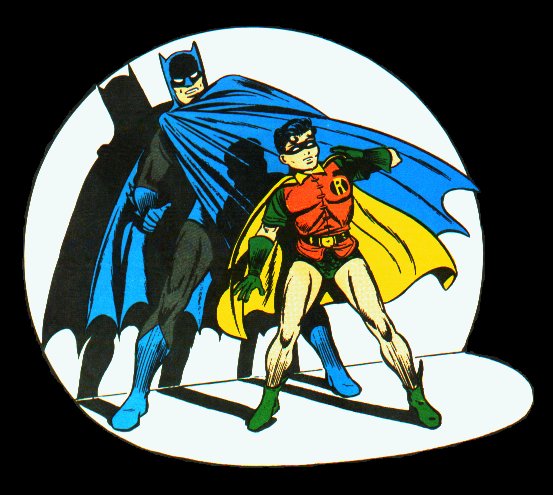
Batman & Robin
Detective Comics
featuring: The Boy Commandos,
NewsBoy Legion, Batwoman
Most of the early 40s Batman stories dealt with
a series of mysteries, usually with a narrator style prose and an adventure
for Batman to step into. In the 50s, Batman often undergoes a series
of challenges, set up by villains, which are often elaborate and fantastical,
especially when the Joker was involved. This is the closest to the
Silver Age version, which is heavily influenced by the Batman television
show, although often putting Batman in more fantastical places. The
New Look Batman of 1964 had a bat in a yellow circle, developed Batman as
a mythos, and introduced other bat-characters, such as Batwoman. Batman-Superman
tales also dominated the 60s, including an introduction of a World's Finest
series. Batman would not be given another new look until the 70s.
Sea Devils (1961)
While most of America has its face turned to
the skies and the exploration of the starts in the 1960s, the band of adventurers
known as the Sea Devils turned their sights to the depths of the world's
seas. This is another Showcase spinoff, with Sea Devils No. 1 premiering
in September 1961 after appearing in Showcase No. 27, 28 and 29.
Lois Lane
With her popularity on the then popular TV show,
Superman's girlfriend Lois Lane received her own title in the appropriately
named Superman's Girl Friend Lois Lane No. 1 in April 1958 after tryouts
in Showcase Nos. 9 and 10.
Jimmy Olsen (1954)
Jimmy Olsen had his own magazine from 1954 on.
The magazine published an unusually large number of good stories. It is
one of the biggest outpourings of pure storytelling in the history of the
comics medium. There were usually three short stories in each issue, mostly
focusing on adventure and comic genres. It lasted 101 issues from
1954-1967.
Captain Marvel (Fawcett)
Although the Marvel Family's last issue was in
the early 50s, Captain Marvel no doubt assisted in the rise of the superhero
that dominated the Silver Age. Captain Marvel was so popular in its
day that it spawned other spinoff series, even those dedicated to lesser
known Marvel Family members. Captain Marvel was such an integral part
of Fawcett that when the company lost a court case regarding the Marvel
license, it ceased publishing comics altogether.
Mystery in Space (Adam Strange)
Mystery in Space is DC's most important science
fiction comic book. During 1951 - 1964, its stories followed the same paradigms;
this is a very long run for a single editorial approach. All of the stories
were pure science fiction. They tended to be very dignified. The heroes
tended to be idealistic young men. They usually were members of some skilled
profession, one that plays a role in the story. If the story takes place
in the present, the hero will be in suit and tie; if in the future, the
hero will be in an elaborate sf costume. Mystery in Space contained both
Adam Strange and general, non-series science fiction stories. Adam Strange
stories are not discussed in this article. The early Knights of the Galaxy
tales are marked (KG); Space-Cabby are marked (SC); the Star Rovers are
marked (SR), Interplanetary Insurance Inc. are marked (I).
Strange Adventures (1950-1964)
Space Adventures was the companion book to Mystery
in Space, in that it had a similar tone and was completely science fiction
oriented, without deviation. However, whereas Mystery in Space dealt
with exploration of other planets, Strange Adventures stories usually took
place on Earth. Stories would often begin by presenting a normal situation
then twist it toward the fantastical. Captain Comet sometimes starred
and is extremely important to comics because he was the first mutant superhero.
Tales of the Unexpected
Tales of the Unexpected is important to the Silver
Age because of the development of science fiction and the introduction of
important characters spun off from Showcase, the Silver Age try-out book.
Stories often involved travel through the stars, star travelling villains
and fantastical situations, such as evil doubles. The Space Ranger
is one of the most important stars of this series. After his tryout
in two issues of Showcase (1958), the Space Ranger appeared in Tales of
the Unexpected (#40 August 1959 - #82 April-May 1964), then in Mystery in
Space (#92 June 1964 - #103 1965).
Weird Science (1954) (EC Comics)
Children and young adults loved the horror genre
in the early 50s, prompting the EC Comics to churn out horror stories by
the truck-load. Weird Science and Weird Fantasy are important to the
Silver Age because with the increase in concentration to the horror and
fantasy genre gave rise to the Comic's Code. The Comic's Code closed
down most of the gory, violent comics of this genre and turned the focus
even more intently on the superhero in the 60s.
Our Army at War (1952)
Most superheroes in the early 50s were outsold
by other genres, including fantasy and horror, until the comics code elliminated
the competition. However, because of the Korean War in 1953, war comics
once again became popular. The "Easy Company" of Our Army
at War by DC was one of the longest running war comics ever published. Other
companies joined in, including EC comics who published Frontline Comics.
DC changed the title of their Golden Age Star Spangled Comics to Star
Spangled War Stories, beginning with issue No. 131. This proved that
Golden Age heroes and stories regarding the war could be brought back with
some success, thereby possibly influencing later stories featuring the Justice
Society in the pages of Justice League of America.
Hawkman (1960)
This series was another revamp of an old Golden
Age character that had become forgotten. Hawkman was given a science
fiction/fantasy origin and placed on Earth, battling equally science fiction
oriented villains and mysteries. He was added to the Justice League
in 1964.
The Blue Beetle (Charlton)
The Blue Beetle is an important Charlton Silver
Age mainstay. The origin of the Blue Beetle changed over the years,
stretching into the 60s and 70s, in order with the prominent genre. When
the heavier influence was fantasy and the supernatural, then the Blue Beetle
derived his powers from an ancient scarab. Vitamin-derived power and
other science fiction aspects also were present in Blue Beetle stories.
The Beetle later was a more technological hero, using gadgets like
Batman and outwitting his opponents. Charlton also had other Silver
Age series, such as Captain Atom.
The Atom (1960)
Ever since the horror and fantasy genre declined
in the 60s, science fiction rose up and began to dominate that period. The
influence can be seen in superhero comics as well, such as the Atom. The
Golden Age Atom was just a tough guy with fists, but his Silver Age counter-part
could shrink. Atom stories had a heavy influence in science.
Green Lantern (1960)
Another revamp of a Golden Age character was
the Green Lantern. He was given a highly science fiction based origin
and could nearly do anything with his amazing, fantastical powers. Green
Lantern stories differed from most as they were mainly learning experiences
for the protagonist. He also epitimized other aspects of the period,
including a playboy lifestyle modelled after Paul Newman and fashioned after
an idealistic hero like JFK. Green Lantern stories even had an influence
by the romance genre, as can be seen in the Carol Ferris interactions with
Hal. The series also established some of its first re-appearing villains,
such as Sinestro, who is still well-known today. The Silver Age version
would not need revamping until the late 70s.
House of Secrets and the Phantom Stranger (DC)
- Our
all-time Silver Age lineup:
-
- Justice League of America
- Superman
- Action Comics
- Superman Family
- Batman
- Detective Comics
- Green Lantern
- Wonder Woman
- The Atom
- Hawkman
- Mystery in Space
- Showcase
- The Brave and the Bold
- Captain Marvel
- Legion of Super-Heroes
- Teen Titans
- GI Combat and Our Army at War
-
The House of Secrets and the Phantom Stranger are important to the Silver Age
because they are heavily influenced by the supernatural and mythic genres,
showing the turn away from horror and fantasy. The Phantom Stranger
had his own series from the late 50s into the sixties, but would not appear
again until the 80s. Alan Moore went on to write the fourth origin
of the Phantom Stranger in the late 80s, which is generally accepted today.
First Modern Credit Card Introduced
First Organ Transplant
First Peanuts Cartoon Strip
Korean War Begins
Senator Joseph McCarthy Begins Communist Witch Hunt
U.S. President Truman Orders Construction of Hydrogen Bomb
Color TV Introduced
South Africans Forced to Carry ID Cards Identifying Race
Truman Signs Peace Treaty With Japan, Officially Ending WWII
Winston Churchill Again Prime Minister of Great Britain
Car Seat Belts Introduced
Jacques Cousteau Discovers Ancient Greek Ship
Polio Vaccine Created
Princess Elizabeth Becomes Queen at Age 25
DNA Discovered
Hillary and Norgay Climb Mt. Everest
Joseph Stalin Dies
Julius and Ethel Rosenberg Executed for Espionage
Britain Sponsors an Expedition to Search for the Abominable Snowman
First Atomic Submarine Launched
Report Says Cigarettes Cause Cancer
Roger Bannister Breaks the Four-Minute Mile
Segregation Ruled Illegal in U.S.
Disneyland Opens
James Dean Dies in Car Accident
McDonald's Corporation Founded
Rosa Parks Refuses to Give Up Her Seat on a Bus
Warsaw Pact Signed
Elvis Gyrates on Ed Sullivan's Show
Grace Kelly Marries Prince Rainier III of Monaco
Hungarian Revolution
Khrushchev Denounces Stalin
Suez Crisis
T.V. Remote Control Invented
Velcro Introduced
Dr. Seuss Publishes The Cat in the Hat
European Economic Community Established
Soviet Satellite Sputnik Launches Space Age
Boris Pasternak Refuses Nobel Prize
Chinese Leader Mao Zedong Launches the "Great Leap Forward"
Hope Diamond is Donated to the Smithsonian
Hula Hoops Become Popular
Lego Toy Bricks First Introduced
NASA Founded
Castro Becomes Dictator of Cuba
International Treaty Makes Antarctica Scientific Preserve
Kitchen Debate Between Nixon and Khrushchev
The Sound of Music Opens on Broadway
U.S. Quiz Shows Found to be Fixed
Alfred Hitchcock's Psycho Released
Brazil's Capital Moves to Brand New City
First Televised Presidential Debates
Lasers Invented
Adolf Eichmann on Trial for Role in Holocaust
Bay of Pigs Invasion
Berlin Wall Built
Peace Corps Founded
Soviets Launch First Man in Space
Andy Warhol Exhibits His Campbell's Soup Can
Cuban Missile Crisis
First Person Killed Trying to Cross the Berlin Wall
Marilyn Monroe Found Dead
Rachel Carson Publishes Silent Spring
Betty Friedan Publishes The Feminine Mystique
JFK Assassinated
Martin Luther King Jr. Makes His "I Have a Dream" Speech
Beatles Become Popular in U.S.
Cassius Clay (a.k.a. Muhammad Ali) Becomes World Heavyweight Champion
Civil Rights Act Passes in U.S.
Hasbro Launches GI Joe Action Figure
Nelson Mandela Sentenced to Life in Prison
Warren Report on JFK's Assassination Issued
Japan's Bullet Train Opens
Los Angeles Riots
Malcolm X Assassinated
New York City Great Blackout
U.S. Sends Troops to Vietnam
Black Panther Party Established
Mao Zedong Launches the Cultural Revolution
Mass Draft Protests in U.S.
Star Trek T.V. Series Airs
Che Guevara Killed
First Heart Transplant
First Super Bowl
Six-Day War in the Middle East
Stalin's Daughter Defects
Three U.S. Astronauts Killed During Simulated Launch
Martin Luther King Jr. Assassinated
Prague Spring
Robert F. Kennedy Assassinated
Tet Offensive
ARPANET, the Precursor of the Internet, Created
Charles Manson and "Family" Arrested
Neil Armstrong Becomes the First Man on the Moon
Rock-and-Roll Concert at Woodstock
Senator Edward Kennedy Leaves the Scene of an Accident
Sesame Street First Airs
Yasser Arafat Becomes Leader of the PLO