
human race. European settlers brought this practice to North
America, where it was expected that children would help their
parents with the family enterprise, which was usually the farm. The
modern summer vacation from school hearkens back to such an era.
The expectation that children can provide an economic benefit to
their families was transferred from farm work to factory labor when
the nation began to industrialize. Many parents desperately needed
the extra income their offspring could earn, and some would omit
their children's names from school lists when education became
compulsory. Samuel Slater, a pioneer in the New England textile
industry, thought it natural to hire children to work in his cotton
mill in 1793, because their small hands could manipulate the
machines more easily.
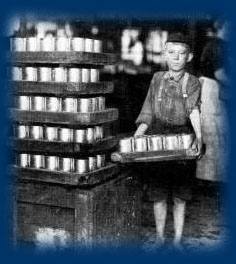
remembered as a philanthropist, and President Andrew Jackson
(1828-1836) respectfully referred to him as the "father of American
manufactures." As the nation continued to industrialize, many
children were forced to work under conditions that were
increasingly harsh. Boys would be expected to stand near hot
furnaces, molding glass for hours on end, or they would sort coal
by hand in the mines, where they might catch black lung disease or
other illnesses associated with a dirty, damp, and cold environment.
Children in factories were often mangled or killed, as they worked
with or near heavy industrial machines. Even in the best of
conditions, working children were denied their right to an education.