
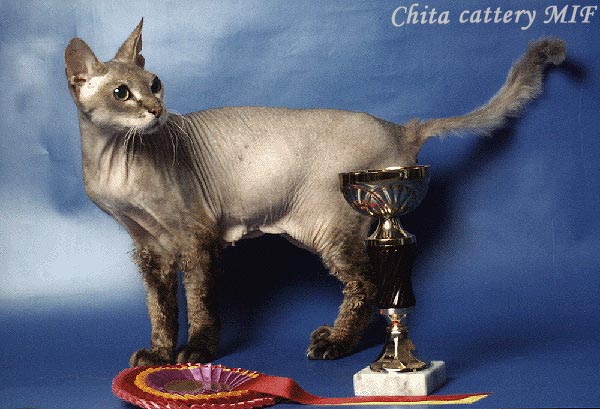
Don Sphynx is a pretty strong and muscular cat with wrinkled, warm skin. They are lively and graceful, clever and kind creatures. Don Sphynx is a cat with hairlessness of a dominant gene. A Canadian Sphinx used to be the only registered hairless cat until recently. Don Sphynx cats were first found in Russia in 1987 in Rostov-na-Donu. It all started with the cat Varya who was found in the street and taken home by Helen Konovalova. Cat "baldness" was mistakenly taken for a disease, but hairlessness proved to be stable and inherited. Irina Nemykina, a cat breeder and cattery owner (Myth) kept the cats and turned them into a breed. The originator of the breed is cat Chita. The following ten years of breeding in Rostov-na-Donu, Moscow and St. Petersburg resulted in a full-scale cat breed, enjoying popularity in Russia and Europe alike.
Russian experts on aboriginal breeds of cats established the standard for the breed on December 3, 1994. In 1996 Don Sphinx was registered with the World Federation of Cats {WCF}.
There are three basic types of Don Sphynx: hairless, flock, velour, and brush. Some of the hairless type lack even whiskers and eyebrows. The skin is soft, warm and even sticky. Soft creases all over the body characterize it. The velour type cats have delicate hair, which is much like velour to the touch. Brush type cats have got short and thin hair. Velour and brush type cats "undress" with time and become hairless. The initial coat doesn't break the breed standard and is not a breed-fault. The amount of hair influences only the kitten's price. Don Sphynx can be of different colors. All the three types are used in cat breeding.
Don Sphynx are characterized by high body temperature, so they seem hot to the touch, especially if the pet is just from the heating battery. This is the reason for some opinions that the cats can have the healing effect. Some say Don Sphynx do not cause allergy, but this is not exactly true. Naturally, cat owners are not troubled with cat hair, but some allergies are caused by skin discharges or by saliva, regardless of whether the cat has got hair or not.
Hairless cats first shocked people with their extraordinary appearance, but managed to win a great number of cat lovers all over the world because of hairlessness, cheerful character and unpretentious care. Feeding them is not of difficulty either. These fantastic cats know how to please their owners. They sometimes resemble dogs in their behavior. They quickly know their name and come immediately when called. These cats will meet you near the door when you come home from work. They like sleeping in the owner's bed, stealing delicatessen from the table and sunbathing on the balcony. Don Sphynx treats all members of the family well, and can hide only from noisy children.
Due to exclusiveness of the breed, some owners want to crossbreed Don Sphynx with Angora, Siberian or other cats. The only result is ruining the breed and losing the unique gene pool. As a result, we can witness lots of "bald" mongrels, which have not inherited either the phenotypes of the character of Donskoy Sphynx. A few catteries choose a more complicated way and deal with pure Don Sphynx only. Due to the effort of many breeders and enthusiasts Don Sphynx have become well known in many countries in the world and successfully take part in international exhibitions, impressing both specialists and spectators.
Let�s have a look at the true breed history. Real one, not taken from general description. Imagine small town Rostov-na-Donu on South of Russia. Warm climate, poor people, who lost their jobs after Perestroika and were growing vegetables to have some food. Lots of homeless cats supported from time to time by people. No one ever heard about felinology, clubs, and breeds. Poor people very often have sweet character. This is why Varvara was rescued. She could not be neutered � there was no vet service in this town. People used to destroy newborn kitten. Chita (Varvara daughter) remained alive only because the neighbor who used to destroy Varvara� kittens was far away.
In brief, there were no any cats except so-called ESH from the nearest yard to breed with. No one thought about making new breed seriously. This is why ESH is the basis of Don.
When by lucky chance the first Dons were brought to Petersburg and then � to Moscow, breeders tried to inspect hairless phenomenon and Dons were bred to all possible breeds. This is why you have what you have in Pedigree.
From the start of breed the idea of breeding of two hairless Sires was looking quite natural. But such a way of breeding was resulted in slim kittens with weak chin and bad immune system�s Siberians were introduced in order to get strong bones structure and because they are close to aborigine cats. Put your attention, that in Rostov-na-Donu most of ESH have Angora bloods. Siberians are the common cats of North Russia where Moscow and Petersburg are situated and were Dons were moved here in Ukraine we did not use Siberians, and I believe that it was better for the breed. A lot of Russian Dons have rounded heads and they are too greedy etc. The addition of Russian blue was not bad idea. But as a result and conclusion � the best outcrosses were (and are) ESH of the corresponding outlook and then � inbreeding the only outcrossing that was really interesting is Oriental cat and Peterbalds were developed on this basis. Peterbalds are still under discussion. Many of breeders can�t accept them as separate breed with its own special characteristics. Thai cats�. Here everyone who has Thai in their Pedigree is trying to move it out of Pedigree by all means.
So according my (and common) opinion ESH is principal outcrossing. Otherwise new Dons will be just hairless Russian Blue, hairless Thai, hairless Siberians, hairless Bengal�s. Moreover, we believe, that Dons are so magic, because they are the showing us the nobleness and beauty possessed by poor cats, homeless and abused by people.
The specific feature of this breed is hairlessness caused by spontaneous dominant mutation.
H. Kovaljiova in Rostov-on-Don, 1987, found these cats. All don sphinx derived from hairless queen named Chita ("Myth" cattery of I. Nemykina). 2001 the first Don appeared in USA {Mid-Michigan CFA cat show} by new owner; Sherri Mossop of Possoms Cattery. 2003 off springs of Step-an Out of Possoms {Out of Chita Myth ancestry} started to make there way across USA. Now the Don Sphynx can be found on the East coast to the West coast.