
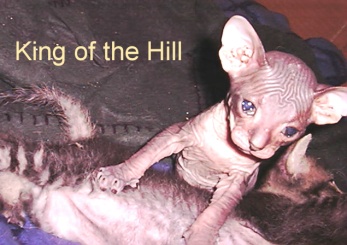
There are several types of a skin/hair/coat a Don can have, ranging from totally naked cat (much more naked than Sphynx, for example) to a "brush" kind of hair, which is somewhat similar to a normal cat's hair. With any type of those, a cat is still Don if they look the way the standard describes it.
(1) Completely hairless cats (also called "rubber cats" or "gummy cats"). The kittens of this type are born absolutely hairless. Their skin is soft, warm and almost sticky to the touch, forming charming wrinkles on all body. Completely hairless Don kittens are usually (not always though) born with open eyes and without whiskers and eyebrows. For people who have allergy from cat's hairs most advisable option is completely hairless Don, though it's still not 100% guarantee there won't be allergy.
There's some genetics-related discussion in Don-fanciers community. Some people tend to think that completely hairless Don are homozygous on the hairlessness gene, meaning that every kitten of that cat will have at least one of those genes too, and, effectively, have one of Don�s type of hair too. This opinion isn't confirmed at the moment, as all of suspected homozygous cats that were mated with Russian Blues, ESH or Thai cats produced kittens with normal hair. Since kittens have normal hair, they don't have hairlessness gene at all, therefore their mother (or father) is heterozygous, not homozygous.
(2) Flock. "Flocked" hair is short; fine down made of sparse rather little hairs. When you look at "flocked" part of the body from some distance (0,5 meters and longer) you don't actually see hairs on there (especially on light-colored cats), but if you touch it with hand you will momentarily note that it isn't "gummy", it's somewhat other, smoother sensation. Some breeders like to differentiate two subtypes of flock, usual flock and extra-short flock that is one little step from gummy skin. Still, from times to times hairs may very from one of those subtypes to another (with age, pregnancy and other factors).
It's useful to know that even flocked cats may have longer type of hair ("velour" or "brush") on some areas of the body. Usually it's points and tail. Flocked and velour cats may (though some don't) lose hair when they are growing up, right to two years. Usually down becomes shorter and finer on the backbone, from head towards tail.
(3) "Velour". Velour type of hair is made of 1-3 mm hairs, closely put one to another. Usually you can see those hairs from middle distance and when you touch a cat with a hand it's still somewhat smooth sensation, though hand get some resistance when you move it over skin, you sense some short hair (which you don't with flock). From longer distances you can notice "velour" by light's shining on the hair. Light doesn't shine on flock and hairless skin.
(4) "Brush". These are curly hairs, longer than velour. From even middle distance you can't say a brush cat is hairless. She is hairy, though curly. When you touch brush hair, it's absolutely unlikely to anything naked; it's just a soft wool or hard kinky hair, short or lengthy. Brush cats can have curly whiskers, which differs them from cats with normal hair, sometimes also called "straight hairs".
Sometimes a cat can be "brush-point", that is she has brush kind of hair on legs and tail and velour (or even flocked!) on other parts of the body.
Main thing is, there are no just 4 strictly defined groups of hairs, those groups are somewhat diffusive, you can't always tell if it's flock of velour, if it's extra-short flock or usual flock and so on. There are plenty of interim cases.
And final note, when you're not sure what kind of hair your cat is, check a legs (not tail) and decide upon its analysis.
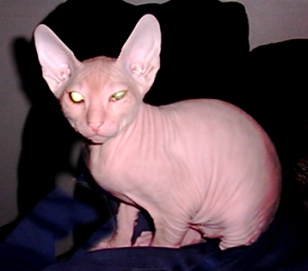
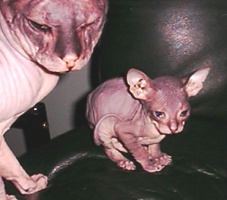
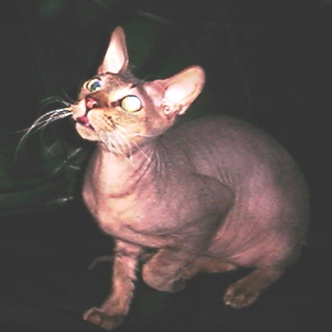
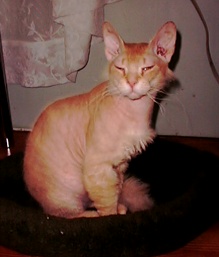
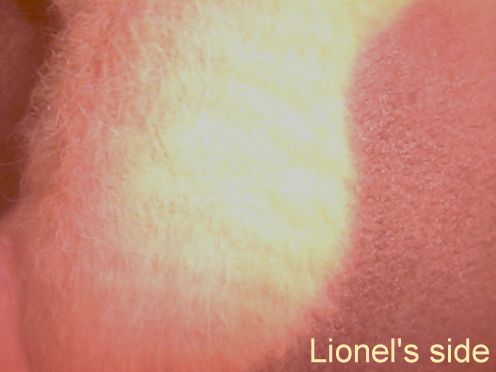
The first Don Sphynx had the short millimeter wool hair coat, which has almost losted it all byu one-year-old age. Their type of quantity of wool in the subsequent has been named "flock" as the wool remaining on a body reminded a fabric for a sofa a flock. Heterozygotic cats have very much a different woolen covering: from the easiest velvet a dust without moustaches and eyebrows, up to velour - a short wool on a body and longer on a tail and paws, different density. To foresee, how to undress by two years velour of a cat very difficultly. They can remove a wool completely, and there can be absolutely naked on a body, but with a residual wool on paws, a muzzle and a tail (brushes - points). Since the second generation, from Heterozygotic parents (that is, carrying a gene of a normal wool), kittens completely naked to the touch have started to be born. Near at hand their skin not suede, and lasts, as rubber. Such bald kittens from a birth (homozygous on a proponent gene), that is, not having in a genotype of a gene of a normal wool, appeared enough problem for unprepared the breeder. At overdue type of development in the first weeks of a life they demand the maximal participation of the person in their cultivation. In the best way they themselves feel at long natural milk with early feeding and constant heating. If on the average a Litter from five kittens one is born in a wool or a brush, two heterozygotic "flock" or "velour", and two homozygous bald from a birth more often these kids have not enough chances to survive without the round-the-clock help of the factory owner. It is possible to explain it that fact, which at a birth naked kittens much less than the dressed colleagues, and not always can independently make the way to dummies of mother. Therefore the competent breeder should undertake in time function of second mum and bring up such kids together with cat - mum, constantly observing for their health. Very dangerously and cooling of such kittens as their skin in infancy cannot protect them from differences of external temperature. However naked kittens, safely living lives first month, do active, viable and catch up in development of the with a wool of colleagues. As against naked from a birth, "velour" and "brush" kittens since a birth differ high ability to live, usually, do not deliver to factory owners of additional efforts.
The gene bald operates not only on a wool, but also on moustaches and eyebrows. Heterozygotic Don Sphynx they strongly wavy, and from first minutes after a birth it is possible to define the carrier of a gene without a wool (it especially important as at sphynx the kittens who are not carrying a gene bald) can be born and a direct wool. At homozygous Don Sphynx moustaches or are absent or strongly thin and are broken off. Now the breeders, engaged selection of the Don Sphynx, have started to be declined to idea about plurality of the genes influencing display naked. Most likely, it is necessary to speak about conditional (or incomplete) domination of a gene naked together with action of some genes - modifiers. And it, perhaps, one of the main secrets of mysterious Don Sphynx! If we have suggested, that naked the Don Sphynx is caused by one proponent gene at crossing naked individuals and cats with a normal wool kittens only two types - wool less and with a usual direct wool should be born. However, as practice shows, it does not occur. Kittens are born absolutely different types by quantity of wool: kittens with normal wool, with curly wool, "velour" or "flock", completely wool less. In turn, the kittens who have been born with a "curly" wool, it is possible to divide too into some types by quantity of a wool: Undressing in full or in part with the years, not undressing kittens sites partial bald with a curly wool and with a soft wavy wool. It would be difficult to explain such variety in types of quantity of a wool presence only two genes responsible for formation of wool. Probably, it is necessary to consider a gene Don Sphynx Hd as conditionally proponent, in relation to a gene hr (presence of a wool). It is logical to assume, that there is a number of genes - modifiers of a gene bald under which influence action of gene Hd either amplifies, or weakens.