 Facts about SouthKorea.

Facts about SouthKorea.
On this site I have compiled some facts about Southkorea, from the below mentined sources. If you want to read more about Korean history I recomend Asianinfo.org, Korean History or Prehistoric Korea.
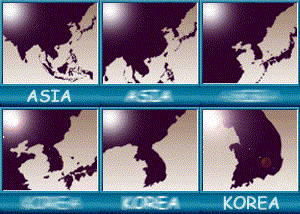
Location: Korea is located in Eastern Asia, southern half of the Korean Peninsula bordering the Sea of Japan and the Yellow Sea.
Area:98,190 sq km
Land boundaries:North Korea
Coastline:2,413 km
Climate: Korea's climate is regarded as a continental climate from a temperate standpoint and a monsoon climate from a precipitation standpoint. The climate of Korea is characterized by four distinct seasons: spring, summer, fall, and winter.
Population: 48,289,037 (July 2003 est.)
Capital:Seoul
Political System: Republic
Currency:Won, 1 US$=1183 Won
Language: All Koreans speak and write the same language, which has been a crucial factor in their strong national identity. There are several different dialects, but they are similar enough so that speakers have little trouble in understanding each other. The Korean language belongs to the Ural-Altaic group, which also includes Turkish, Hungarian, Finnish, Mongolian, and Japanese.
The written alphabet, Hangul, was developed by a group of scholars at the behest of King Sejong the Great (r.1418-1450), the fourth monarch of the Choson Dynasty (1392-1910). Hangul consists of 10 vowels and 14 consonants, which can be combined to form numerous syllabic groupings. It is easy to learn and to write, factors which have greatly contributed to the high literacy rate of Koreans.
Religions: Christian 49%, Buddhist 47%, Confucianist 3%, Shamanist, Chondogyo (Religion of the Heavenly Way), and other 1%
Food:
Korean foods are definitely different from foods elsewhere in the world. The one attribute which stands out the most is spiciness. The other is that many dishes are served at room temperature(yest some are served boiling hot). Korean food has a distinctive flavor, with the use of various vegetables and spices to complement the meats. Hanjongshik (한정식) literally means "full course Korean meal" which consists of grilled fish, steamed short ribs, and multiple side dishes. The usual Korean meal is rather elaborate when served in a restaurant even if defined only by the quantity offered. The staple of the Korean diet is kimchi (김치). It has become, through tradition and enduring style, almost a religious activity to prepare. Kimjang (김장), which occurs in the autumn harvest season, is the most important annual social event of Korea, at which time the dish is composed in great quantities. The ingredients are trucked in in huge piles. The women gather in groups to spend hours cutting, washing and salting the cabbage and white radishes. Then they are dosed with red pepper, then garlicked and pickled. The concoction is then buried in huge earthenware crocks to keep it fresh yet fermenting though the winter months. By the time comes to feast upon the final product, it is fiery hot. Some kimchi is milder, such as a light brine kimchi, usually prepared in the summer months when kimchi is difficult to retain its freshness. There is also a type of light kimchi soup, fermented water with vegetables which is usually served aside a variety of other side dishes.
The people and Culture:
The Koreans are one ethnic family speaking one language. They share certain distinct physical characteristics which differentiate them from other Asian peoples including the Chinese and the Japanese, and they have a strong cultural identity as one ethnic family. The Mongol tribes which migrated onto the Korean Peninsula from Central Asia particularly during the Neolithic Age (c. 5000-1000 B.C.) and the Bronze Age (c. 1000-300 B.C.). The Koreans were a homogeneous people by the beginning of the Christian era. In the seventh century A.D., they were politically unified for the first time by the Shilla Kingdom (57 B.C.-A.D. 935) and subsequently witnessed a great cultural flourishing.
Korean society retains a strong Confucian tradition, which is clearly manifested in the strong devotion to the family and the emphasis on heirarchy and vertical relationships, although modified to adapt to modern conditions. This tradition combined with the passionate nature of Koreans can perhaps explain the strong loyalties felt between relatives, co-workers, classmates, and friends. For things deemed worthy -- family, friends, company, causes, etc. -- Koreans will give their utmost. They work hard, and enjoy life and entertainment with the same fervor.
Koreans have always had a deep love for music and dance. Religion and philosophy play important roles in music and dance. Folk religion and shamanism, beliefs in the spiritual power of natural objects, have influenced the development of Korean dance and music. Dance and music brought people together and helped them express their feelings. Buddhist dance shows respect for the Buddha and the pursuit of truth. Court dance expressed the values of the ruling elite.
Among traditional sports, the martial art of Taekwondo is the best known internationally. It is a popular sport in Korea and is studied by young people around the world because it helps to develop the body and the mind. It is an art of self-defense. The two opponents use clenched fists, open hands and their feet to attack each other. Ssirum is a form of wrestling that has been popular in Korea since the Three Kingdoms period (57 B.C.-A.D. 668). Wall paintings in old tombs from the Koguryo (around A.D. 400) show men wrestling in ssirum matches, just as they do today. This Korean-style wrestling with simple rules was widely performed in all village festivals, the winner receiving a big bull in most contests. Ssirum involves two wrestlers who hold onto their opponent's cloth waistband and try to push, trip or throw him out of the ring. The match takes place in a sandy ring and is really exciting.
History in brief:
The Prehistoric Age:
Archaeological findings have indicated that the first settlements on the Korean Peninsula occurred 700,000 years ago
Ko-Joseon (2333 - 108 B.C)
According to legend, the mythical figure Tan-gun founded Ko-Choseon, the first Korean Kingdom, in 2333 B.C. Subsequently, several tribes moved from the southern part of Manchuria to the Korean Peninsula
The Three Kingdoms Period (57 B.C. - A.D. 676)
The three kingdoms, Koguryeo,Paekje and Shilla, were established in the 1st century A.D. During this period, the kingdom's political systems, religions (Buddhism and Confucianism), and cultures developed
The Unified Shilla(676-935)
The Unified Shilla Kingdom promoted the development of culture and arts, and the popularity of Buddhism reached its peak during this period. The Unified Shilla Kingdom declined because of contention for supremacy among the noble classes, and was annexed by Koryeo in 935.
Palhae(698-926)
The Palhae Kingdom began to emerge just as the Koguryeo Dynasty was on the verge of collapsing. Koguryeo General, Tae Joyeong founded Palhae along with his army of displaced peoples. At one point, Palhae became so powerful that it was able to acquire territories in northern and eastern parts of China, as well as many other developments within the kingdom. At those times, the Tang Dynasty of China referred to Palhae as 'the strong country by the sea in the east.' The significance of the Palhae Kingdom is greatly inherited from Koguryeo, including the land that it was able to retrieve.
The Koryeo Dynasty (918 - 1392)
The Koryeo Dynasty was established in 918. Buddhism became the state religion during this time and greatly influenced politics and culture. Famous items produced during this time include Koryeo celadon and the Tripitaka Koreana. During the Koryeo Dynasty, Jikji, the world's oldest movable metal type was published. It was invented 78 years before the German movable metal type created by Gutenburg.
The Koryeo Dynasty's strength decreased gradually in the latter half of the 14th century.
The Choseon Dynasty (1392 - 1910)
The Choseon Dynasty was formed at the end of the 14th century. Confucianism became the state ideology and exerted a massive influence over the whole of society. The Choseon Dynasty produced Hangeul, the Korean alphabet, which was invented in 1443, during the reign of King Sejong. The dynasty's power declined sharply later because of foreign invasions, beginning with the Japanese invasion of 1592.
The Japanese Colonial Period (1910 - 1945)
In 1876, the Choseon Dynasty was forced to adopt an open-door policy regarding Japan. The Japanese annexation of Korea concluded in 1910, and Korean people had to accept Japanese colonial rule until the surrender of Japan, which ended World War II.
The Republic of Korea (1945 - Present)
The Republic of Korea was officially established on August 15, 1948. The Republic has a democratic form of government based on the separation of powers and a system of checks and balances as prescribed in the constitution, which was promulgated on July 17, 1948. There are three government branches: the executive, the legislative and the judiciary. The President heads the executive branch and is elected to a single five-year term by direct popular vote.
In 1945, Japan surrendered to the Allies and withdrew from the Korean Peninsula. The Korean Peninsula was then divided into two zones, South and North Korea. The Korean War broke out on June 25, 1950 and fighting ended when an armistice was signed on July 27, 1953.By the time the war ended, two million people had died and the country had been officially divided. After a few years of semi-democracy in the South, martial law was declared in 1972. The next 15 years rollercoastered between democracy and repressive martial law, hitting a stomach-heaving low in 1980 when 200 student protesters were killed in the Kwangju massacre. By the late 1980s the country was at flashpoint - student protests were convulsing the country and workers all over Korea were walking off the job to join them. Among the demands were democratic elections, freedom of the press and the release of political prisoners. The government wasn't budging and civil war looked imminent until, to everyone's jaw-dropping surprise, President Chun suddenly decided that everything the protesters were asking for was alright by him.
In 1988 - the year Seoul hosted the Olympic Games - elections were held and Roh Tae-woo, another military figure, was elected president. Student protests continued apace, but, contrary to expectations, Roh significantly freed up the political system. Relations were re-established with China and the Soviet Union. In 1992, Roh was replaced by Kim Young-sam and his Democratic Liberal Party. Kim's hobby horse was corruption, and during his term of office several politicians were prosecuted for abusing the system. Most notably, ex-presidents Chun and Roh were brought to book for their role in the Kwangju massacre. Roh was sentenced to 22 years, Chun to death, but in December 1997, Kim granted them a presidential pardon and the two were released from prison. 1997 was a very bad year for South Korea's economy, with the won taking a tumble and tourism dropping dramatically. In February 1998, former dissident Kim Dae-jung became president, the first time a non-conservative had headed the country in its 50 years of independence. Kim promised to introduce economic and democratic reforms and improve relations with North Korea.
By mid-1998 the South Korean economy was actually shrinking - something that hadn't occurred for nearly two decades. Rising bankruptcies and soaring unemployment led to large-scale labour unrest, but the economy is now on the move again.
Making good on promises of more neighbourly relations with North Korea, Kim made an historic visit to shake the hand of reclusive North Korean leader, Kim Jong Il, in June 2000. As a sign of good faith he allowed the North Korean government to arrange for his security. In October 2000 he was awarded the Nobel Peace Prize, and as part of a partnership with Japan and the USA continues to pursue a policy of cooperation with North Korea. His desire for collaboration does not stop with Asia and America. His focus is on Europe, with whom he hopes to strengthen ties and increase trade. In December 2001 he was the first Asian leader to speak before the European Parliament in Strasbourg, and biennial meetings have been promised as a sign of future alliance.
Sources:
CIA The World factbook Southkorea
Tour2Korea.com
Korean Online
Facts On Korea
Southkorean History Lonely planet World Guide
Korean online-Korean food
About me
Interests
Study in Korea
Journeys to Korea
Korea gallery
Photo gallery
Travel gallery
Favorite links

Return to first page.

Copyright � Dong-soo Dan Hilmersson
[email protected]
last updated 2008-02-14
http://www.geocities.com/dongsoo66