| Useful Links |
| |
|
If you have any stories or comments you would like submitted, go to the contacts area and send them on!
Visitors comments will be posted and suggestions would be greatly appreciated.
Simply click here |
|
|
 |
| Red Deer |
|
|
A native herd of red deer formerly existed in North Donegal but was hunted to extinction by 1845. The present herd of around 750 is descended from introduced stock. IN 1891, six deer were brought to Glenveagh from Lincolnshire by Cornelia Adair and, over the next 20 years, 170 were introduced from deer parks in England and Scotland and from collections in County Fermanagh, County Down, Powerscourt in Wicklow and Dublin zoo. Henry Mc Ilhenney also added some fresh stock between 1939 and 1966.
A deer fence was completed in 1897 to enclose what was known as the Glenveagh Deer Forest. The deer fence still surrounds much of the park although it has never been impervious to the movement of deer and a large area of the countryside around Glenveagh has been repopulated by deer which escaped in the past. he lenveagh deer forest was managed as a private deer shoot by its former owners and the deer stalking rights were leased annually.
|
|
|
|
Red Deer Call A |
Red Deer Call B |
| |
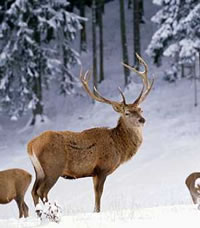
Deer stalking ceased when Glenveagh became a National Park. Red Deer are the largest and most obvious wild animals in the Park and may be seen at any hour of the day, although they are most active at dawn and at dusk. In Summer, they frequent the hilltops, while winter, or periods of bad weather, finds them mostly on lower ground. For such a big animal, the red deer confines itself to a surprisingly small home range and recognisable individuals can be located again and again at the same spot.
The 'rut' or mating season extends from mid September to mid-November, the best time of year to watch the deer. Mature stags round up large harems of hinds and spend much energy keeping them from the attentions of rival males. The stags find little time to eat, but oblivious to cold or hunger, they wallow in wet ground, covering themselves in mud, and bellow hoarsely, which is their way of throwing down the gauntlet to rivals |
|
|
|
|
|
|