Music Theory by
Example
Part2
We’ll
review what you should have learned from the example in part 1 and working with
the Chord Progression chart.
|
all the chord progressions in the example are contained in the key
of C |
|
an addional Em cord could
also be used.. |
|
each major key contains 3
major and 3 minor chords for each Key. |
|
there is a definite relationship between chords in each key |
|
the Major Scale defines all
notes available for creating and modifying a melody. |
|
the example progression can use all notes in the C major scale |
|
this can be confirmed by playing the the C major scale over each chord in progression |
You
now know that we can edit our melody fragment and modify it using any note from
the C major scale. Also it was shown that we have 3 major chords (C, F, G) and
3 minor chords (Dm, Em, Am) available for developing the Harmony. What you may
not have noticed is that every scale has a similar group of related chords,
built from its notes, which naturally sound appropriate for music written in
that scale.
You
had an opportunity to hear my version 4 of the cabbage song. I will lead you thru the process I used to
arrive at that point. If you want to review at any time during this session,
click on Cabbage4 or the original Cabbage to compare. Remember this is intended to
demonstrate a process and not to create an outstanding piece of music. It is
hoped when we finish with section, you will follow a similar process to develop
your own version from the original simple starting point totally distinct and
better than mine.
My
first step was to call on the aid of chords to fill in the harmony as well as
help in modifying the melody fragment for sections A.
Section
B will utilize what we will have
learned and be used to create a chord structure that can be used to develop a
musical reprieve from the A
sections.
What do these chords look
like, how do I find them and what about these scales?
These
questions will be answered as we go along looking at the science aspect of
Musical Theory. For now, we will have to accept some information, use charts
developed from the science of Musical Theory in order to finish the artistic
development.
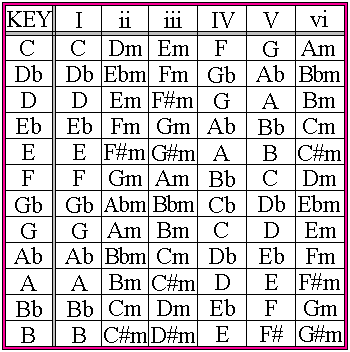
Look
at this next chart which displays three major
and minor chords for the 12 major keys. Find the row signifying the Key of C.
Notice the column headings utilize Roman Numerals in upper and lower case
format. The Upper case Numerals represent the 3 major chords (C, F, G) and 3
minor chords (Dm, Em, Am).These chords are all based on the C major scale.
Write them down somewhere.
The
C Scale contains no sharps, or flats
which makes it easier to visualize. What we will be doing relative to the C
scale holds true for all other scales as well. Scales can be numbered as well,
starting with the name of its major key if we start at Middle C on a keyboard;
the notes are numbered 1,2,3,4,5,6,7 then repeat starting at 1 for the C note
in the octave above. The notes are usually played by the right hand on a piano.
The
same holds true for notes below middle C, normally played with the left hand on
a keyboard. Thus the note C which is 1 octave below middle C would be number 1.
On a keyboard, the right hand would be placed with the thumb on middle C and
the left hand would place its little finger on C the octave below. Middle C in
midi notation is designated as C4, which is the halfway point between octave 1
and octave 8 on a full 88 key piano keyboard. To play the notes of the C scale
on a keyboard starting at middle C, you simply start at C4 and move up the
keyboard from D (D4) etc until you reach next highest C note (C5). That would
complete 1 octave of the musical tones (notes) of the C scale starting from the
middle of the keyboard’s range. On a musical staff, these notes would belong to
what is known as the treble clef.
In
forming chords, I will be referring to the notes starting an octave below
middle C as beginning at C3, and the octave above as starting at C5. If you are
playing instruments other than a keyboard, you will have to figure these out
relative to the scale of C used by that instrument. Notes starting at C3 thru
B3 are considered as belonging to the base clef and are played with the left
hand on a keyboard. Chords are normally considered as belonging to the base
clef with the melody notes played in the treble clef. However notes from the
chords are also used in the treble clef with the rule that the melody note is
the highest pitched tone in the treble clef.
Chords
can be designated using numbers or letters from the musical scale. If we look
at them as numbers, we can develop formulas from them in the C major key that
can be applied to any of the Major Scale keys by starting with the first note
of that scale and playing the numbers game using the notes of their respective
scale.
If
you are afraid that you have to learn all 12 major scales to proceed, don’t get
discouraged yet. The major chords for any key are called TRIADS because they
consist of 3 notes. They are designated as position 1, 3, 5. The C major chord
in the right hand would be formed by placing your thumb on C4(middle C), your
next closest finger on the 3rd note of the scale E4 and a third
finger on the fifth note of the scale at G4. To form the F chord in the key of
C, you would start with the F4 as note 1, A4 for note 3, and C5 for note 5.
All
major chords in any scale can be formed in the same way
Forming
a major chord with the left hand starts with the little finger on C3, next
closest finger on E3 and perhaps the thumb on G3. How about the chords from the
chart for F, G , Dm , Em and Am? The same thing, the three notes in the right
and left hands would start on the F and play the third and fifth notes from
there which are F4, A4, C5 for the right hand, and F3, A3 and C4 for the left
hand. Notice that the C note for each hand is moving up to the next octave. The
G, Dm, Em, Am chords are formed the same way.
Another
way of looking at the Triad (our 1, 3, 5 formula) is to consider that starting
with the first tone or note of the chord (C) as the first note, skip a tone to
note 3 (E) and skip another tone to note 5. It should be noted that this
alternating note pattern can be used to select other chords related to a
particular scale. The only rule for determining if a chord can be used in a
certain scale, is ”Any chord make entirely from scale tones (and not having any notes
from outside the scale) is related to the scale, and is likely to suit a piece
of music written in the scale.”
You now know how to form all
the notes from the chart by remembering the formula 1, 3, 5. You could begin
using them right away to add harmony to the melody. This was already shown in
the Chart sample when each chord of the key of C was played in the left hand
while the notes from the key of C were played with the right. To make harmony
for our melody, we could simply play chords in any order in the left hand while
playing the melody with the right. We could even, take some notes belonging to
the chord and add them to the melody staff as long as we did not add any notes
higher in pitch than the melody note.
Let’s
give that a try. I have taken the cabbage song and added chords for each bar in
no particular order knowing that they all belonged in the key of C. The order I
selected was C, F, G, C, Am, Dm, Em, C. Then I copied those bars and pasted to
the end. In that second or repeat section, I took notes from the chord in that
bar and added them to the treble staff under the melody notes as long as they
did not use a pitch higher than the melody.
Check
our Cabbage by linking to cabbageV1.
Ok,
we have created something like a song that we could keep and go onto making our
B setion. In this case, I found some
sounds in the harmony not as satisfying as other parts, and the melody line
seems a little boring. I notice all the notes had the same length and decided to
make the very beginning of section A
different at the start by using 1/8 notes instead of quarter notes.. This would
help me remember when I began to repeat the melody line which I called cabbageDS and add a little interest.
Using
this as my new starting point, I looked at the next chart Simple C
If
you followed the description of how to use that chart, it shows chords
connected by arrows indicating specific paths for these chords to follow.
Also
it stated that starting from the IChord
root position, you can jump anywhere to any one of the other chords and follow
the arrows back to the 1Chord. I
made my example even simpler by just choosing 2 chords. I jumped to the Vchord (G) chord and back to IChord) using the following order: C / G / / C / / / C / / / C G C / for
the 16 beats in the 4 measures.
This was then copied and pasted to create the
second (A section). I then filled in
notes from the chords on the treble staff as long as they did not have a pitch
higher than the melody note as in the cabbageV1
example.
I
intentionally left heavy chord harmony in the treble staff to give a Church
hymn type sound, eliminated some of the base chord notes so I could add a
counter melody in the bass section.
This I thought would add more interest by
contrasting the movement of the melody line and is a common technique heard in
a lot of music. In bar 2, 3 and 4, I started with the base note of the chord
and begin walking up the scale at the same time the melody was coming down.
Likewise when the melody was going up, I was
walking down. This is possible since all the note of the scale can be used with
any of the chords (cabbageDS1).
Having
completed my A A sections, I used an
expanded chart of chords which we will show later to select a progression for
the change/relief section B from
which to build a contrasting melody section for this AABA structured song.
At this point you should try to make your own
modifications to the melody either before, during or after you choose your
chord progression based on the simple map and complete your own A sections.
You
could use this simple chart to create an 8 bar progression for your song and
make a melody part for the treble staff without proceeding to part 3 of this
series and make beautiful music with it.
To
complete your B section from this point using what you have been shown so far.
The next link ProgressionA3 is an 8 bar
progression based on C Am F G C Am F G
(I vi IV V I vi IV V) that could be used based on this map, I’m sure you
can find many others.
This
sample shows how you can use the base note octave(C2 & C3 played together)
of a chord for the first beat then the chord on the second beat. The octave of
the 5th note of the chord was used for the 3rd beat
followed by the chord to add a rhythmic nature to the progression in 4/4 time.
This
demonstrates how you are free to use the notes of the chord progression in any
way you chose to add interest/variety to your music.
You
can create your B section melody
from these chords or any notes of the C scale to complete the section.
Then
cut and past the A section you
created at the end of this 8 bars to complete the AABA structure. Notice that I left the last note in the progression
leading towards the expected C (I)
chord at the beginning of the A section.
After
you are finished with your first song, you enter the realm of sequencing by
creating separate tracks and instruments playing various parts of your music,
adding new tracks based on the principles of harmony discussed so far and
working with the dynamics of your various parts to bring out the melody.
You
can look at adding rhythm sections and all the other things that create a
performance from your creation. You are telling a story even with instrumental
music. You create a sense of anticipation that hopefully builds to a conclusion
as the song unfolds.
Repetition
is a good way to build familiarity for your themes but too much can feel
limited and become stale quickly. You are also free to create any song
structure beyond the two basic structures alluded to so far as long as it fits
your musical ideas. You can also add lyrics to it as well and there are entire
books in libraries dedicated to that subject.
If this has peaked your interest and wish to
continue expanding your base and knowledge of Musical Theory, you should
continue with this series. It will expand the chord selections available, show
their relationships using maps for the various musical keys, give example
progressions based on music from the past up until today, introduce other
scales available (melodic and harmonic minor scales etc) and how they can be
used as well as touching on improvisation. Go ahead and create some music, it
will be your artistic part that you will be calling on to come up with
something that sounds good to you and invokes some kind of emotion. This must
be felt not taught.