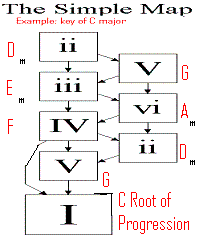
The Simple Map
All six chords on this map come from the same
scale and work well enough together to bounce from one to the other. Chords
flowing through a song also flow into the minds of your listeners. Some chords that feel stable, strong and expected
while others feel like they're going off on their own. Tension can be created
by some chords while another chord may be expected to relax that tension. Some
chords are meant to surprise the listener; others to soothe and this sets up a
kind of guessing game with the audience as to what chord comes next.
They need to be able to guess right
sometimes and be stuck by a curve ball at others. You usually want to throw
enough curves to keep them guessing, but not to the extent they start coming
after you. They will feel better when they guess correctly on but sometimes
want to be surprised.
The following is a map designed by
Steve Mugglin in 1995 that shows chord sequences that audiences tend to
"guess in advance." These chord sequences sound natural, like walking
down the stairs, with no sudden jumps or unexpected turns. A lot of music is
created with simple sequences like these. I have annotated this map indicating
chords from the key of C.
To use the map, remember two things.
First, you may jump anywhere from I. Second, a chord appearing at more than one
place has an "imaginary tunnel" connecting both spots, so you
can jump from one to the other.
Notice the V (G) chord directly above the I
(C root chord) and also the V (G )chord on the upper Right hand
corner. You could return to the root taking either the direct path from the one
above the root to the I root cord (a
two chord sequence or loop).
You use the tunnel and come down
using the vi (Am) , ii (Dm), V (G) to the I
chord.(a 5 chord loop)
You could also have taken a path
down by using the V (G), iii (Em), IV
(F) , then around the V directly
to the I chord (a 4 chord loop)
or take the V, iii , vi, IV ,ii, V,I..( 7 chord loop) etc.
You can do exercises like:
1. Write a long "loop,"
starting with the I chord, Jump from
I to wherever you like. Then work your way back to I by following the arrows.
2. Write several short three or four
chord sequences by starting anywhere on the map and following the arrows. For
example:
I - iii - vi - IV - ii - V - I is a "loop."
It starts and ends on
IV - V - I is a three chord sequence.
vi - ii - V - I is a four chord sequence.
ii - V - iii - vi is another.
There are a lot more.
The Map helps you find natural,
smooth-sounding chord patterns. Experiment with these natural-sounding patterns
and you will automatically start using them in your music. An audience will
relate well to these sections. This is good for your audience. You want them to
"hear" things in advance and guess right, a good percentage of the
time.