MCC Church
Sandy and Lauren Aupi
DOVE Missions
Brad Munn
Ridgefield United Methodist
Scott Hanson
Mens Bible Study group of Ridgefield
Jack V
Brad Munn from Manitoba
Anonymous donors
Brittany from Canada
Hazel from England
DOVE Missions
Tina from Alaska
Melody from Luperon
Darren Wertz
Frank T from Quebec
Mr & Mrs Hayden-Colwell
Snailmail
Dale and Marta Johnson
P.O.Box 39
Ridgefield, Wa. 98642
Phone
(809) 257-7246 DR
(360) 936-0992 USA
Send payments and/or contributions to: Dominican Outreach by major credit card through Pay Pal. Click below
Benefiting Homeless and Neglected Children Voluntourism:
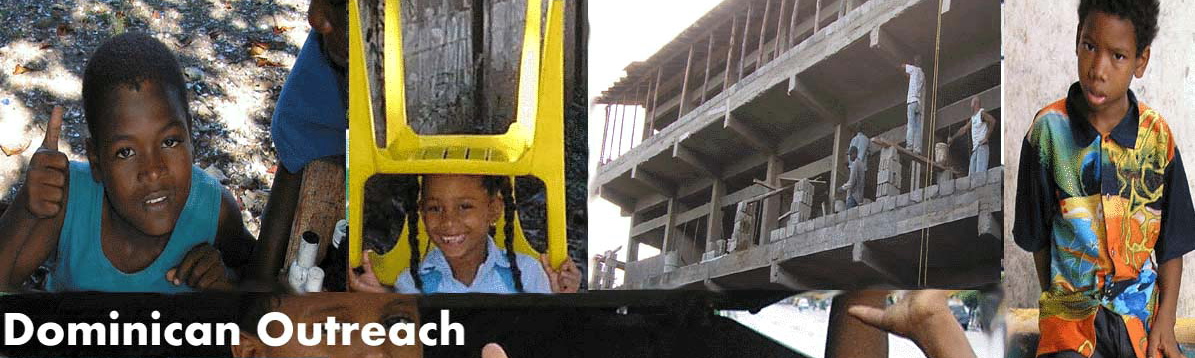
Be a volunteer caseworker/witness/teacher in the DR for a few hours, for a day, or a weekWork among homeless street kids, teach children who have no access to Dominican schools, hospitals, and basic sanitation because of the color of their skin and race.
Dominican Outreach has forged alliances with a number of NGOs in the Puerto Plata area in an effort to provide volunteers opportunities to work with the homeless and neglected. Our volunteers have opportunities now to work with an orphanage for disabled children, an orphanage for abandoned street children,a feeding center for homeless children, a school in a private batey for mostly children of haitian origin, and a school in a campo for poor Dominican children.
We pioneered a survey of children at risk on the streets of Puerto Plata, a major tourist destination where children are sexually and emotionally exploited. Our 3rd annual census database has been turned over to government officials who have committed to partner with us to rescue the most needy children."
Projects 2008
Feeding Centers and our Census on Homeless Children
1) Census Project for homeless children: perhaps this has been our most successful program as we have been operating feeding centers in various barrios of Puerto Plata. Children and women come to the centers where we not only feed them but take information on their medical needs, living conditions, reports of abuse, and educational needs. We put this data into a database that we share with other faith-based organizations as well as the government social service offices that are almost non-existent and under-funded. We use this data to identify the most needy homeless children and refer them to an orphanage for homeless boys that just started this year. Next year we hope to participate in starting an orphanage for girls. Our costs run about $105.00 a week.
Milk & Pampers Project for Women with HIV/AIDS
2) Through our census project we have identified dozens of women who have children and are in the later stages of HIV/AIDS infection. Because many of them are Haitian Economic immigrants from across the border, they have no access to medical care or help of any kind. We call this our 2) Milk and Pampers Project: we distribute canned milk to dozens of mothers who have been diagnosed with HIV/AIDS who have children 1-5 years old. It puts us into weekly contact with these women so when they become too sick we can intervene and find places for their children. We work with a local judge to find homes for the children. The Pampers are highly desired by these mothers. When you are poor, it is difficult to get access to clean water, energy to wash properly, and dispose of human waste. Pampers are making some of these hygene problems easier for these women. When we have excess Pampers we donate them to the Mustard Seed orphanage for disabled children where there are about 18 children who are mostly bedridden and brain damaged. Many have been recovered from toilets and garbage bins where they have been left to die. A missionary group from Jamaica supplies the workers who care for these children.
Education
3) Our third project is Education Intervention which has two thrusts: first we have a teacher training project which has received seed money from a Canadian couple in Brandon, Manitoba who are sponsoring the building of a teacher laboratory. This is a fully equipped classroom where we will start this Fall (2007) to train teachers from schools in the barrios on better methods of teaching. We will use Master Dominican Teachers and volunteer teachers from North America to do the training. Most teachers here do not have university educations and most are appointed by local political parties. Many teachers are simply the older sisters and brothers in a community. Nevertheless, we have found many inspiring people who have the gift of teaching and we will help them with continuing education workshops for teachers starting in October when our teacher laboratory is finished. The second thrust of our education endeavor is direct support of poor children who need uniforms, backpacks, and supplies to go to school. Thousands of children are blocked from going to school here because they do not have the $20 a month to go to public school. Poverty often pushes then onto the street at an average age of 10 years old to shine shoes, sell food, or beg to help support family members.
Micro-Credit Project
4)Micro-Credit: We currently have a micro-credit project with 15 families. Many families on the North Coast of the Dominican Republic have subsistence occupations. Foe example we previously funded several fishing families. We received a small gift from a member of the Canadian Royal Mounted Police who wanted to help one family. So we met with a cooperative of fishing families. With the help of two other organizations we loaned money to the cooperative to buy a boat motor. This allowed several families to move out of poverty who paid back the loan ahead of time. World-wide these micro-credit programs are highly successful. Banks will not loan to the poor but groups like Vivebank and Esperanza International here in the Dominican Republic have helped several hundred families rise out of poverty and subsistence living through private managed loans. Our census work ties in nicely with this work as we discover many worthy people who simply need someone to believe in them.