
Oceanic Dolphins

 | Common Dolphin |

Grows up to 2.6m long.
DESCRIPTION
Common dolphins are easily recognized by the pattern and tan, or
yellowish patch on each side. They have a streamlined body, long slender beak, pointed flippers, hourglass pattern on sides, dark flippers, tail and
fin, dark cape (area of the back around the dorsal fin), and are fast active
swimmers.
Common dolphins are often found in large, socially active groups.
Common dolphins are widely distributed with many different populations in all oceans. They are found in many enclosed seas and are rarely seen in waters less than 180m deep. In some areas common dolphins are present all year round but other populations migrate seasonally.
| Bottle Nose Dolphin |

Up to 3.9m long.
DESCRIPTION
Bottle nose dolphins have a robust body, Round melon, pointed flippers,
dark cape (area
of the back around the dorsal fin), lighter belly, fast active swimmers who are
often seen bow riding.
Adults can weigh between 150 and 650 kg, and new-borns between 15
and 30 kg.
| Atlantic hump-backed Dolphin |
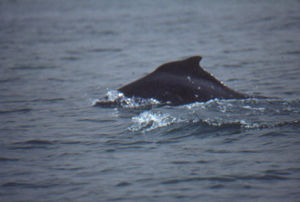
DESCRIPTION
Their colour can be mid to dark grey (sometimes speckled), with a paler coloured belly. They are usually seen in groups of between 3 and 7.
The Atlantic hump-backed dolphin is found along the coast of West Africa, preferring shallow coastal waters.
| Saddle backed Dolphin |

(also known as bottlenose dolphin, SEE ABOVE).
| Risso's Dolphin |
DESCRIPTION
When born the Risso's dolphin is grey all over, and then become a chocolate-brown
colour and
eventually pale grey with a pale underside. they usually swim in groups
of between 3 and 50 animals. They prefer deep offshore waters, although around Britain and Ireland they are
usually seen within 11km of the coast. They also like warm waters.
| Atlantic white-sided dolphin |
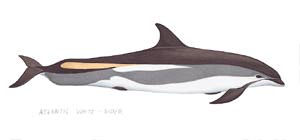
DESCRIPTION
Mainly black or grey with a bright yellow patch on the rear flanks and a
light under-side (belly). They are generally found in larger schools
offshore (up to 1000 animals), and smaller groups of between 5 and 50 animals
inshore. They are found in cool temperate and sub-arctic waters of the
North Atlantic Ocean.
| White-beaked dolphin |
DESCRIPTION
The white-beaked dolphin is dark grey to black, with a lighter "saddle patch" just behind the dorsal fin.
The white-beaked dolphin can be found in the temperate and sub-polar waters of the North Atlantic. They usually swim in small groups of 6-10 animals.
| Rough-toothed dolphin |
DESCRIPTION
Rough-toothed dolphins get their name from the vertical wrinkles found on their teeth. Other visible features include a long narrow beak which blends smoothly into the forehead giving them a reptile look. Their skin is dark grey or blue-grey, sometimes with a hint of purple. The area around their mouths is often white or pinkish. They have quite slim bodies. up to 2.8m long. They live in groups of about 10-20.
Rough-toothed dolphins prefer deep, warm waters away from the shore and avoid places with cold currents. They have been seen near Hawaii, the Bahamas and Ogasawara in Japan.
| Striped dolphin |
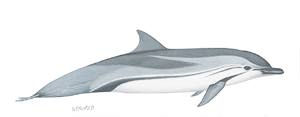
DESCRIPTION
Striped dolphins have a pale grey, finger-shaped marking below the dorsal
fin. The other feature is a black line that stretches from their beak, around
the eye patch to the underside of the rear flank.
up to 2.6m long. They form large social groups of between 10 - 500, but can
be found in schools of up to 3000. They prefer warmer waters which are mainly
tropical and subtropical.
| Black dolphin |
DESCRIPTION
Black dolphins have a dark grey body, with a white belly, a white throat and a small white patch behind each flipper. Group size can vary from 2 - 3 but sightings of 4,000 animals traveling together have been made. Black dolphins live in the cold, shallow, coastal waters of Chile.
| Spotted dolphin |
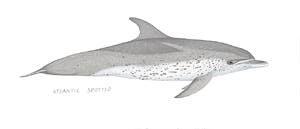
Atlantic spotted dolphins have dark purple/grey capes with light spots, and white undersides with dark spots. Along each side they have a wide grey stripe. Their beaks are quite long and thick with white tips and white "lips". There is a light grey stripe running from the eye to the flipper which is curved with a pointed tip. They live in groups of between 5 and 15. Found in the warm and tropical waters of the Atlantic. They are particularly common in the western North Atlantic and the Gulf of Mexico.
| Orca |
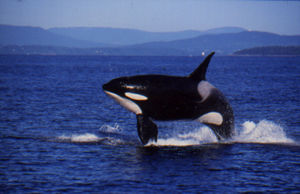
Orcas are the largest of all the members of the dolphin family, and are also known as killer whales. Adults can range from approximately 5.5 to 9.8 meters. They have jet black, white and grey markings, and the males can have a very tall dorsal fin (up to 1.8 meters).
Orcas are among the most widely-distributed mammals on Earth. They are found in all the oceans of the world, preferring cold waters (such as the Arctic and Antarctic).
| Commerson's dolphin |
DESCRIPTION
Commerson's dolphins are mainly white with black tails, fins and flippers. There is always a white patch under the chin and a black patch on the belly. Their dorsal fins are also rounded and always black. Commerson's are not found in many parts of the world, living mainly in the water off the east coast of Argentina.
| Dusky dolphin |
They have a short, dark beak and gently sloping forehead. Their upper sides are predominantly dark or blue-black, but there are white or pale-grey blazes along their sides. Their dorsal fins are very tall with an area of light grey on the rear half. They are very social and can be found in groups of hundreds.
Dusky dolphins are widespread in the southern hemisphere. There are three main populations; New Zealand, South Africa, and South America.
River Dolphins
River dolphins are not classified under the family Delphinidae. In fact they comprise several families, including Iniidae, Platanistidae, Lipotidae, and Pontoporiidae. Most of them live in some of the world's largest and most complex river systems such as the Amazon, the Indus, Ganges and the Yangtze. River dolphins have long beaks and small eyes, some can bearly see! They are among the most endangered animals on Earth.
| Indus river dolphin |
| Amazon River Dolphin (Boto) |
| Baiji |
| Franciscana |
| Ganges river dolphin |
Bibliography:
Whale & Dolphin Conservation Society: http://www.wdcs.org