
BODY SHAPE OF THE DOLPHIN
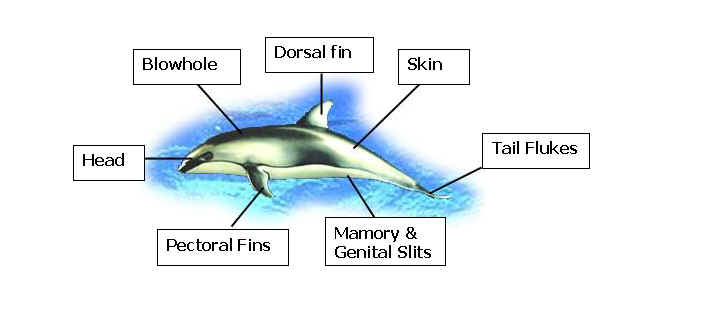
All dolphins have a similar streamlined, torpedo-shaped body - their bodies are larger at the front than at the back. The dolphin has a short, stiff neck. As with all the ceteceans, all visible traces of hind limbs have disappeared. The forelimbs have developed into paddle-shaped flippers which helps in steering through water. The tail of a dolphin (called the fluke) is used for propulsion: it is therefore very muscular
Dolphins can sometimes be mistaken for sharks. Although the shark on the surface has a more vertical fin.
DORSAL FIN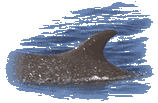
There is generally a prominent dorsal fin on the back of the dolphin though it is absent in northern and southern rightwhale dolphins. Some of the river dolphins do not have a dorsal fin, but only a slight ridge or hump on the back.
The size, shape and position of the dorsal fin varies from one species to another. The fin is not supported by any bone, but by tough fibrous tissue inside it. Dolphins can have fins that are curved, triangular, bluntly rounded or totally absent. Some people believe that dorsal fins help dolphins to maintain stability in the water, while others believe that a well-developed fin is not essential for survival.
Blood vessels in the dorsal fin help to control dolphins body temperature.
TAIL FLUKES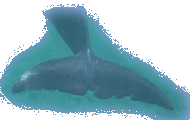
The tail of the dolphin (everything behind the dorsal fin) is used for propulsion, and it is very muscular. The shape of the tail fluke vary considerably between species of dolphin.
PECTORAL FINS (FLIPPERS)
Again dolphin's flippers vary widely in shape, size and colour from one species of dolphins to another. Flippers are important in steering and stopping. They provide are shaped like paddles. They are used primarily for twisting, turning and for maneuvering.
Pectoral fins are made of cartilage and bone. They are similar to the skeletal structure of land mammals with fingers.
HEAD
The head of the dolphin has many interesting features. The face of a dolphin is rather unexpressive. Dolphins seem to wear a permanent smile, but this is deceptive since the head, like the rest of the body, carries significant blubber under the skin. Blubber prevents major muscles on the face to reach the surface. Therefore, dolphins are capable of only a limited range of facial expressions.
 | EYES |
Dolphins are born with elastic lenses on their eyes that expand and contract to let them focus under and above the water. They also have special glands that protect their eyes from salt water.
| EARS |
It is hard to tell that Dolphins actuarially have ears, but they do. They are only small pinholes on either side of the head, just above the eyes. They also have very good hearing.
| MELON |
The melon is a fatty, rounded section of the dolphin's forehead. This is used mostly for echolocation (see behavior for an explanation of echolocaction).
| TEETH |
A dolphin's teeth aren't used for chewing, because dolphins swallow their food whole. But they are used to grab their prey.
BLOWHOLE
Being mammal, dolphins need to go to the surface to breath. The blowhole is like nostrils, except these are at the top of the head, allowing dolphins to breath while still swimming. While sleeping, the female dolphin lies on the water's surface with their blowhole out of the water, so they can breath. male dolphins sleep just below the surface, going up to the surface as a reflex action.
SKIN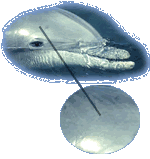
Dolphins have extremely smooth, firm and velvety skin. This causes less friction, making it easier for them to swim through the water quickly. the skin is very sensitive to touch, this is why most adult dolphins have lots of scars and scratches. these wounds are also helpful to researches to find out more about them. (such as their predators.) Dolphins have fat, or blubber under their skin which keeps them warm.
Bibliography:
The ultimate guide to dolphins. http://www.discovery.com/stories/nature/dolphins