
The Preparation for the Pups
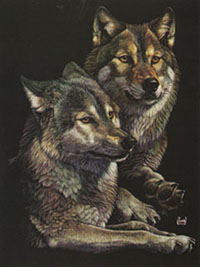 Wolves in the wild tend to breed at some point after their second year. Many females
probably do not begin to raise their first family until they are four or five, possibly
a reflection of the difficulty of gaining a mate and a territory to settle on.
Wolves in the wild tend to breed at some point after their second year. Many females
probably do not begin to raise their first family until they are four or five, possibly
a reflection of the difficulty of gaining a mate and a territory to settle on.
The mating season starts in the winter from about January and continues for roughly a month. Females come into oestrus at this time for five to ten days. Fertilised females produce cubs in the spring. The time of breeding corresponds to the part of the year when hunting is easiest. Parents are therefore relatively well fed and in peak condition for the task of bringing up a family. Foetuses will be well nourished in the womb and cubs in the den may have ample food.
Onset of breeding activity relates to latitude. Wolves living geographically further
north start breeding later than in southerly climes. Arctic wolves give birth as late as
May to June. They also have fewer cubs on average than their more southerly neighbours.
The wolves build dens for the spring so that they can raise their cubs in a safe
environment, with all members of the pack helping in the raising of the pups by bringing
food to the mother 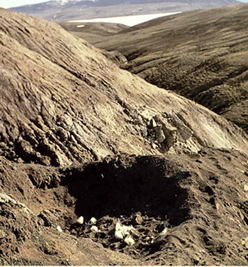 so she doesn't have to leave the den and by protecting the den from
predators.
so she doesn't have to leave the den and by protecting the den from
predators.
As wolves are raised, playing serves as an important part of their social development. Wolves have differing personalities just like humans, and their social development can be very important, determining whether or not they will be accepted into the pack or forced to go out on their own as loners.
A den must be selected and prepared each breeding season to shelter the cubs and is commonly a hole in the ground, a cave or a crevice in rocks. But wolves make use of whatever they find in their environment, be it a hollow log, the roots of an up-turned tree or even an abandoned beaver lodge high and dry Wolves dig their own den or take over a den from another species, expelling any resident foxes, coyotes, or other animal, and enlarge the den as necessary.
A wolf pack may occupy the same den each year, sometimes for several years in a row.
Some wolf dens are known to be at least generations old and substantial rock dens may be
occupied by wolves for centuries.
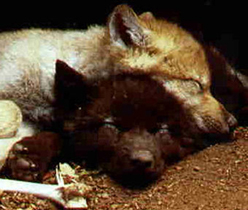 Wolf dens can also be very transient. Wolves in the
Arctic, if they are not lucky enough to find a more protected den, cannot dig in the
ground because it is so frozen and have to make do by clawing out a shallow hollow.
Wolf dens can also be very transient. Wolves in the
Arctic, if they are not lucky enough to find a more protected den, cannot dig in the
ground because it is so frozen and have to make do by clawing out a shallow hollow.
In May or June the dominant female bears a litter of four to six pups in an underground den. When the pups are small other pack members bring food to the mother. As the pups get bigger, pack members take turns bringing them food, playing with them and even "babysitting" when the mother herself goes hunting.