
Looking for Food
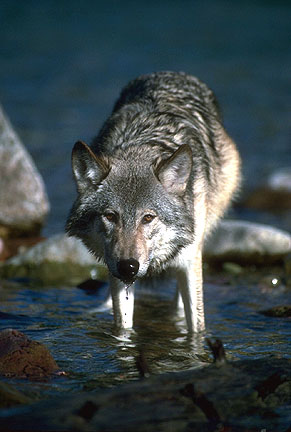
Unless wolves locate thier prey by chance encounter, their manner of approaching the animal is usually the same each time. Direct scenting and tracking both allow the sensing of the prey for long distances. As wolves close the gap between themselves and their prey they become excited but remain restained. They quicken their paces, wage their tails, and peer ahead intently. They seem anxious to leap forward at full speed but continue to hold themselves in check. This same stalking scenario is true of wolves hunting alone, in a small pack of three, or even a large one comprised of 15 or 16 members. In all cases where the stalk is used, wolves sneak as close to the prey as they can without making it flee. Wolves move directly upwind.
Ths stage of the hunt that comes right after the stalk is the encounter, the encounter is the point when the prey and the predator meet eachother. An individual prey animal can respond in three ways: (1) by approaching the wolves, (2)by standing its ground, 0r (3) fleeing. Seldom do prey animals aproach the wolves, however, moose, elk, and musk oxen are known to stand their ground, probably due to their formidable sizes. As soon as wolves see theri quarry has sensed them but is not running, they stop their stalk. Larger prey are usually able to fend off a wolf pack. Smaller prey such as deer or the calves of larger prey are almost defenseless.
In the winter wolves look for food to survive the winter. But wolves
can eat much more than the winter supple can give. When looking for food
wolves leave their cubs with an Aunt or Uncle to watch over them. Some
times wolves have to look for prey till after night fall, but most of
the time wolves will run into a suitable prey(encounter). 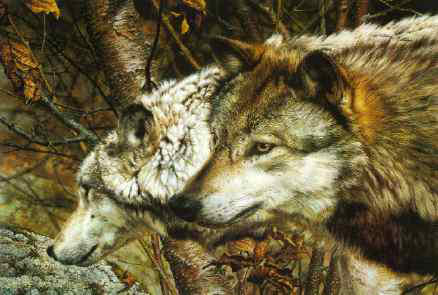
Most of the time wolves will hunt in pairs or with a pack. One wolf alone could not bring down a moose or musk oxen, but 2 can, or 5, or even 10. Wolves are well known for there cunning and skill, but even with skill they need others to help them out.
The wolves who are "assigned" to go out and hunt are usually the strongest and sometimes the smartest. Wolves like to hunt larger animals like elk, deer, oxen, moose, ext. The wolves will search silently and carefully. When the wolves get the scent of a prey it is no longer the search it is the chase!
The Chase