
The Mirror and Mirror Cell


The Primary Mirror or Objective

The heart of a Newtonian telescope is it's primary mirror, (also known as it's objective ). Without a quality primary, there is no way to
produce a quality telescope. Most would think that the bigger the primary, then the bigger the image and better the telescope.
This however is not true, as mentioned eairler it is the eyepiece that determines the magnification and not the mirror. The purpose
of the primary is to gather light from the object being viewed and reflect that image to the secondary mirror and finally to the
eyepiece for magnification. The quality of the mirror is it's most important factor. The advantage of a larger primary is that it can gather more light from the object and produce more detail. So a smaller primary of good quality is better than a large one of lesser quality. A  6" scope  (meaning a scope using a 6" primary), of good quality, can produce excellent views of planets, star clusters, galaxies and nebulea.  If you move up to an  8" or 10" with a quality mirror, then the image will have a higher resolution and contrast. Again, it is the eyepiece that will determine the size of what you see, so it makes sense to start with a clear image before you magnify it.

Did I mention quality ?  OK,... now lets look at the benefit of size. A 6" is a good intermediate size and can give great results, so how
much of a difference would an 8" make? It's only 2 inches...right?  Well, a 6" mirror will have a light gathering surface area of about 28 sq. ins. where as an 8" mirror will have about 50 sq. ins. That's a big increase for only 2 inches!  Just a small increase in diameter will yield a big gain in what you will see.  Of course, the bigger the mirror the bigger the scope.

To sum it up, buy the largest mirror of only good quality that you can afford or are willing to spend. Keep in mind the size of
the finished telescope. You want it to be pratical and not a pain to lug around or you'll hesitate to use it.


The Mirror Cell

The primary mirror must be mounted in the tube in such a way that it's tilt is adjustabe to assure allignment to the secondary mirror.
It is traditionally mounted in a cell made of light weight material such as wood, aluminum, or plastic and held in place by three or four clips.
It usually consists of two sections, the bottom section is stationary and mounted to the inside of the tube. The top section floats
on top usually by springs which make allows it's angle to be adjusted. There are usually three adjusting knobs or screws running
through the springs, as one is tightened or loosened, it pivots the angle of the mirror so it can be adjusted to alignment with the secondary mirror.


loading image...


loading image
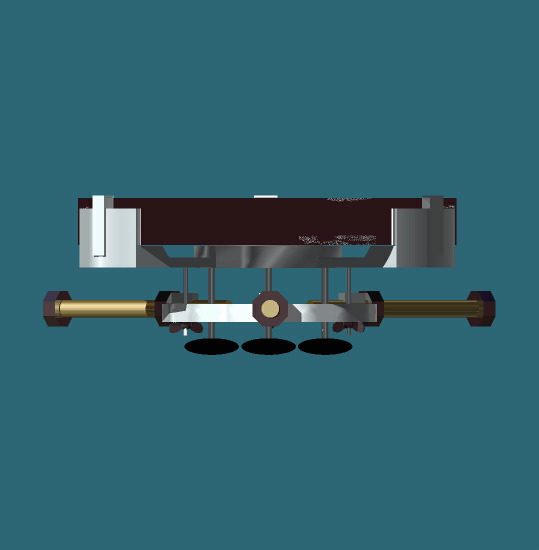
Above is a side view of the mirror mounted in the cell.  Visible underneath are the three screws with wing nuts that adjust the mirrors angle.  Once the desired adjustment is made, the three black knobs are tightened to lock it in place.


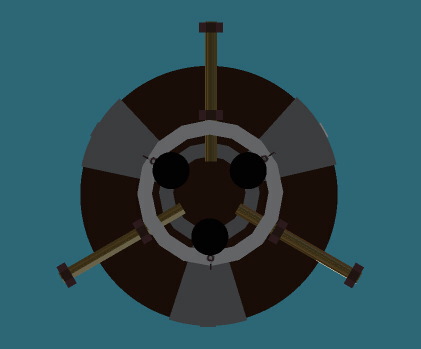
Here is a top view showing the three clips that hold the mirror in the cell
These should be blackened with paint or tape to eliminate unwanted
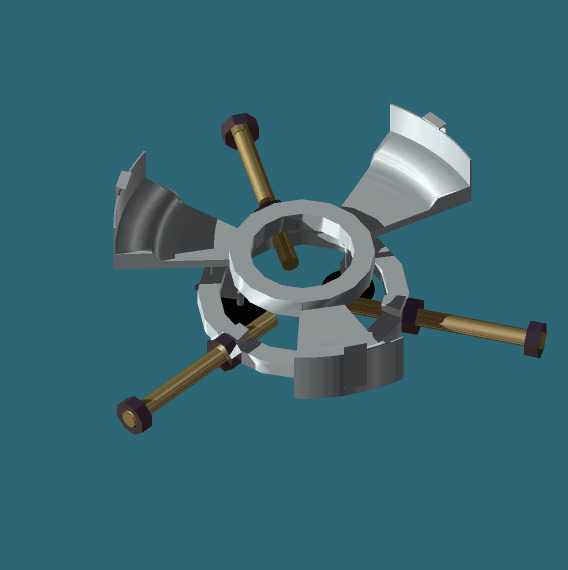
reflection (defraction).  Extending from the sides  forming a "Y" are three threaded rods.  Each rod extends through the wall of the tube and is secured by a nut on the outside.


loading image...
loading image...
Here is an isometric view of the cell alone.
            Bottom view.


Next

Home


top of page

Hosted by www.Geocities.ws

1