
cblE disease
Identification of the molecular defect in cblE disease
Patients of the cblE complementation group of disorders of folate/cobalamin metabolism who are defective in reductive activation of methionine synthase exhibit megaloblastic anemia, developmental delay, hyperhomocysteinemia, and hypomethioninemia. Methionine synthase catalyzes the remethylation of homocysteine to methionine via a reaction in which methylcobalamin serves as an intermediate methyl carrier. Over time, the cob(I)alamin cofactor of methionine synthase becomes oxidized to cob(II)alamin rendering the enzyme inactive. Regeneration of functional enzyme requires reductive methylation via a reaction in which S-adenosylmethionine is utilized as a methyl donor. Using consensus sequences to predicted binding sites for FMN, FAD, and NADPH, we have cloned a cDNA corresponding to the "methionine synthase reductase" reducing system required for maintenance of the methionine synthase in a functional state. The gene MTRR has been localized to chromosome 5p15.2-15.3. A predominant mRNA of 3.6 kb is detected by Northern blot analysis. The deduced protein is a novel member of the FNR family of electron transferases, containing 698 amino acids with a predicted molecular mass of 77,700. It shares 38% identity with human cytochrome P450 reductase and 43% with the C. elegans putative methionine synthase reductase. The authenticity of the cDNA sequence was confirmed by identification of mutations in cblE patients, including a 4-bp frameshift in two affected siblings and a 3-bp deletion in a third patient. The cloning of the cDNA will permit the diagnostic characterization of cblE patients and investigation of the potential role of polymorphisms of this enzyme as a risk factor in hyperhomocysteinemia-linked vascular disease.
Importance of methionine synthase reductase
Methionine is an essential amino acid in mammals. It is required for protein synthesis and is a central player in one carbon metabolism. In its activated form, S-adenosylmethionine, it is the methyl donor in hundreds of biological transmethylation reactions and the donor of propylamine in polyamine synthesis. The eventual product of the demethylation of methionine is homocysteine and its remethylation is catalyzed by a cobalamin-dependent enzyme, methionine synthase.�� The enzyme-bound cobalamin cofactor of methionine synthase plays an essential role in the methyl transfer reaction by acting as an intermediate methyl carrier between methyltetrahydrofolate and homocysteine. Cleavage of the methyl-cobalt bond of the methylcob(III)alamin intermediate occurs heterolytically so as to leave the cobalamin in the highly reactive cob(I)alamin oxidation state. During the cycling between methylcob(III)alamin and cob(I)alamin, the cofactor may be oxidized to cob(II)alamin with consequent inactivation of the enzyme. The restoration of enzyme activity is dependent on the reductive methylation of cob(II)alamin in a reaction in which S-adenosylmethionine provides the methyl group.
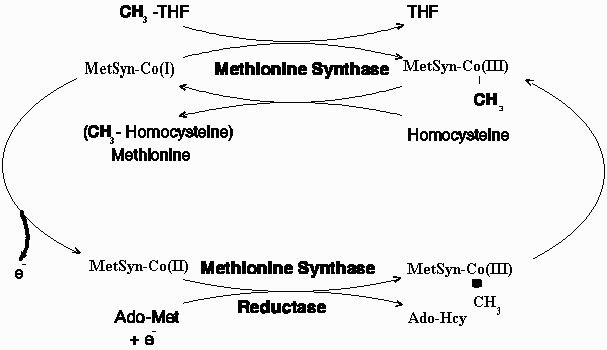
Role of methionine synthase reductase. Transfer of the methyl group of methyltetrahydrofolate (CH3-THF) to homocysteine via methionine synthase-methylcobalamin [MetSyn-CH3-Co(III)] as an intermediate methyl carrier. The reductive methylation in the lower part of the scheme is the mechanism by which S-adenosylmethionine (Ado-Met) together with an electron reactivates the enzyme after oxidative inactivation. Ado-Hcy, S-adenosylhomocysteine.�����
cblG disease is as different disease
Severe deficiency of methionine synthase activity leads to megaloblastic anemia, developmental delay, hyperhomocysteinemia, and hypomethioninemia. Two forms of methionine synthase deficiency are known. We and others recently cloned cDNAs encoding human methionine synthase and showed that patients from the cblG complementation group of folate/cobalamin metabolism have mutations in the methionine synthase gene. For a second class of patients, belonging to a distinct complementation group, cblE, net methionine synthase activity appears reduced. Their defect is in a reducing system required for maintenance of the enzyme in a functional state.
A member of a large family of electron transferases
The E. coli methylcobalamin-dependent methionine synthase has been well characterized. The reductive activation system required for its maintenance is a two component flavoprotein system consisting of flavodoxin and NADPH-ferredoxin (flavodoxin) oxidoreductase, a member of a family of electron transferases termed the "FNR family". Banerjee and colleagues recently documented an NADPH-dependent reducing activity defective in cblE patients, suggesting that the reductive-activation system in higher organisms would bear some resemblance to that in E. coli.�� Given the absence of flavodoxins in mammalian cells and the occurrence of a single complementation group accounting for defects of the reductive-activation system, we hypothesized that the human counterpart would be a single protein structurally related to the combination of flavodoxin and flavodoxin reductase. Significantly, this would imply that FMN, FAD, and NADPH would be bound by a single polypeptide, as is the case for cytochrome P-450 reductase and NO synthase. We isolated cDNA clones corresponding to the reductive activation enzyme defective in the cblE complementation group. The deduced protein is a novel member of the FNR family. We have called this enzyme methionine synthase reductase.����

Click here to get regularly updated information about cblE disease
and here to know more about methionine synthase reductase deficiency.
You can also see (general reference):
� Leclerc, D., Wilson, A., Dumas, R., Gafuik, C., Song, D., Watkins, D., Heng, H.H.Q., Rommens, J.M., Scherer, S.W., Rosenblatt, D.S. and Gravel, R.A. (1998)
Cloning and mapping of a cDNA for methionine synthase reductase, a flavoprotein defective in patients with homocystinuria.
Proc. Natl. Acad. Sci. U.S.A., 95, 3059-3064.
PDF file

Gene structure of MTRR gene is now well determined:�
See :
Leclerc, D., Odievre, M.-H., Wu, Q., Wilson, A., Huizenga, J.J., Rozen, R., Scherer, S.W. and Gravel, R.A. (1999)
Molecular cloning, expression and physical mapping of the human methionine synthase reductase gene.
� Gene 240, 75-88.
�� A PDF file is also available.���

Several of the mutations in MTRR gene (mutations causing cblE disease) are documented in:�
Wilson, A., Leclerc, D., Rosenblatt, D.S. and Gravel, R.A. (1999)
Molecular basis for methionine synthase reductase deficiency in patients belonging to the cblE complementation group of disorders in folate/cobalamin metabolism.
� Human Molecular Genetics 8, 2009-2016.
�� A PDF file is available.���

Llnk to Daniel Leclerc Home Page.

