|
Beginners
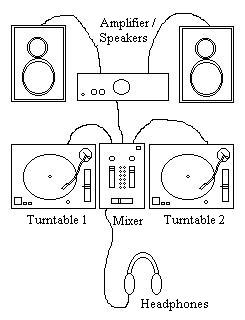
Info Here we go, my attempt at trying to cut down on the amount of replica e-mails i receive. I suppose in my infinite wisdom i should have seen it coming, because obviously people are most worried about being royally screwed over when it comes to shelling out top money on equipment they probably have never used before. So this is kind of my way of putting the record straight and making that initial purchase or foray into dj'ing a little less scary. I could put a few extra things into my F.A.Q. page, but as most people coming to my site will be beginners or first time buyers, i thought it best they have a dedicated page all to themselves. It might sound patronising at times, but it's meant to serve as a help page for people with basically no knowledge of anything dj related. Before i impart any pearls of wisdom though, i'd like to have a little rant. If you think what i say is the gospel truth, then there really is no hope for you. There's a time and a place for everyone, what i say reflects my opinions and outlook on dj'ing at the mo'. I'm certainly not going to tell people not to start dj'ing, far from it. I always try and take time to show friends (or strangers) what it's all about if i can. But judging from some of the e-mails i get, i really don't know what is motivating some people. I think the first and vitally important thing anyone who wants to start dj'ing should take to heart, is that very few people will ever make a living from it. There really aren't any geniune overnight sucess stories. Very few make it to the top, and if they do, it's probably taken them near to 10 years. If you're in it for the fame and idol status, then fine, just don't ever expect to get there. So where does that leave the rest of us then? Well personally i've grown up listening to dance music, so it's an intrinsic part of me and my personality. Dj'ing just kind of lead on from me having listened to and bought dance music for years. So this is why i find it bizarre and a little scary when i receive e-mails from people asking me what sort of music they should mix. I mean come on......what the f**k? If you're taking the route of becoming a 'mix' dj, then the fundamental thing that defines who you are as a dj, is the music you play. It's your personal choice, and hopefully why people would want to pay to hear you do a set. Unless i'm mistaken, most of us are individuals, and have our own taste. Play what YOU like. Play tracks that move YOU, not what you think you should be playing. Fair enough if you've heard a certain style of music that you like but aren't really clued up about it, and want to find out more. There's plenty of discussion boards, online record stores with soundbites etc. that should help you dig a little deeper into whatever style you fancy. I don't mind that people see clips of famous dj's and think "I want to do that", but how are you really going to be a good dj if you aren't even into the style of music you think will make you popular. Be true to yourself and it'll come through in your dj'ing. Don't play hardhouse or 2-step garage just because it's popular at the moment. Play it because you love it. Play it because you love trawling through hours of fresh vinyl in record shops to find the tracks that no-one else has. Don't just perform replica anthem sets because you know muppets will love it. On the other end of the dj'ing spectrum, you have the turntablist side of things (which i define as being skratching, beat-juggling and drumming). Now i can easily see how after witnessing a showcase or battle that you can be inspired to take up this side of things. But be under no illusions that to develop those kind of skills takes as much dedication and practice as learning any musical instrument. The top battle dj's would probably put in at least a few hours solid practice a day. If you're not into hip-hop particularly but still want to develop the turntablist side of things, it's worth taking time appreciating where it came from, how the sounds developed, who the key players were / are etc. There's plently of dedicated turntablist info out there, it wouldn't take you more than 2 mins to enter terms into a search engine and find lots of quality sites. So don't be so damn lazy. I'm sure there's loads of other dj related things i could moan about, but i'll leave it there for the moment. Just make sure you realise what you're trying to achieve and why. Nothing in life comes too easily. Practice, be patient, love what you're doing and above all enjoy yourself. And as a side note, nothing i can type in an e-mail will make you a better dj overnight. There are no quick fixes. If you want quick gratification i suggest you take a few quid down to your nearest red light district. Right, on we go: What do i need equipment wise to start dj'ing? At the very fundamental level you'll need: 2 turntables with dj cartridges / styli & slipmats, 1 mixer, 1 pair headphones, loadsa records and some sort of playback system. Typically the playback system will be an amplifier and a pair of speakers. But if you have an existing mini hifi style system which has an AUX. input then you can hook up the mixer to that. And as pictures are easier on the mind it should look something like this (ooooh marvel at my artistic genius).
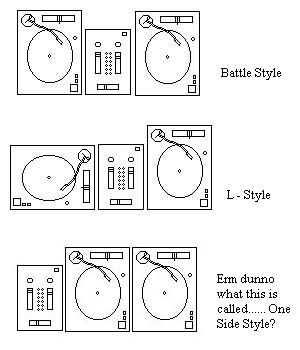
Now it should be roughly set up as shown above. The turntables may come with the RCA cables hard-wired (i.e. not removable) or with just the female connections (i.e. you just plug in an RCA cable yourself). If the RCA is hard-wired it means it's a little harder to upgrade your interconnect (but you really don't need to be worrying about that for a long while). Turntables also come with a grounding wire. It's essential that you connect this to the GND post on your mixer, otherwise you'll get a rather evil ground hum through your sound system. Also remember to put the turntable RCA's into the PHONO inputs on your mixer (i.e. left turntable into PHONO 1, right turntable into PHONO 2). Somewhere on the back of the mixer should be a output marked MASTER or MASTER 1 etc. Using a standard RCA cable you connnect this output to any line input on your amplifier (i.e. anything that isn't marked PHONO). Finally you hook your speakers upto your amp using whatever speaker cable you have. You can also get 'powered' speakers, which means you don't need a separate amplifier (i.e. the speakers have their own power supply and amp contained inside them). If this is the case then you hook your powered speakers straight upto your MASTER output. You might also have some kind of recording device (Tape, MD, CD recorder etc.) for capturing your masterpiece sets. Most mixers will have a second MASTER output, or an output marked REC. Just hook your device upto that. If it hasn't got a second main output then you can use the tape loop on your amplifier (if it has one). The way the turntables and mixer are set up above is normally referred to as 'normal style'. This is the way you'll normally find them set up in a club. But skratch dj's tend to set them up differently to allow more hand room on the vinyl, easier manoeuverability and to reduce skipping (i.e. the further your hand is away from the stylus, the less powerful any vibrations you make will be). So below i've shown a further few ways some people set up their decks. You can obviously switch the L and side depending on how you want it.
So there we are, the fundamentals. But the real question on most people's mind is what equipment they should buy, how much it should cost them etc. Now i can appreciate what a complete nightmare and how overwhelming the seemingly endless list of products can be. I compare it to looking at buying a new computer. Is there really a difference between all the models, makes etc? But contrary to popular belief, i don't actually have access to all the dj products in the world to test them. But i do know a little bit more than your average monkey, and since i don't work in a shop, i can give you advice without worrying about profit margins and my sales targets. But that doesn't mean i can give you yes / no decisions on packages and prices etc. Maybe it's me getting old, but people seem to get lazier everyday. And it also scares the hell out of me that someone would spend lots of their money on the strength of my advice (remember........trust no-one........i could be a Vestax sales rep for all you know). Also the problem with dj'ing and initial equipment buying (particularly the mixer) is that you won't really develop your style for quite a while, so you probably won't know what sort of features you really need. Catch-22. But you need to ask yourself a few questions before any equipment purchase. 1) How much money do i have to spend? (important) 2) Do i really need this ...........?<-------insert expensive item here (something i'm constantly asking myself) 3) What features am i after? Now because i know people like things kept simple, i'm just gonna sit here and think of all the buying advice i can, and list it in bullet point form (and try and put it in some kind of structured order, but it could be a little chaotic). Hopefully it'll cover most things, but i'm going to try not to be too specific. I'm also purposefully not going into too much detail or giving long reasons why. Anyways........on we go.
General Buying Advice
First Time Packages / Buyers
Technics Vs. Vestax Vs. Other brands
Skratch Mixers Vs. Other Mixers
O.k that's about as much as my poor little brain can think of in one go. Hopefully you should be able to make choices and decide what you want to go for with a little bit more confidence. Good luck and happy dj'ing.................
|
|
||||||||||||||