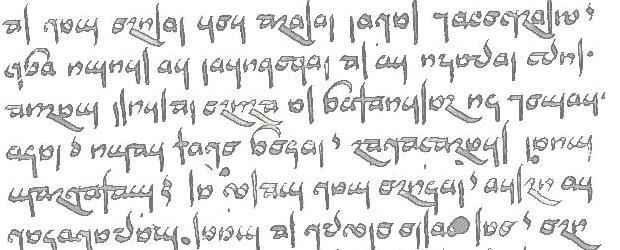
The language is called "Diallic" only because it is the language of a literary work called The Sundial, a philosophical epic poem much like Lucretius's De Rerum Natura and Hesiod's Theogony. "Diallic" is not the indigenous name of the language, but is simply what I have come to call it as it is being developed.
The purpose of developing an entirely original language for The Sundial is to engineer an intuitive metaphysical worldview from which a particular philosophical system will emerge. Just as the concepts of ancient Greek philosophy emerged in part from the structure of the Greek language, the philosophical system inherent in The Sundial will emerge naturally and easily from the structure of Diallic. This process works two ways: first, the process of creating and deriving words from basic roots is influenced by the native worldview of the hypothetical Diallic culture; but also, the language itself has an influence over the types of metaphysical conclusions that are drawn by its speakers-- it determines to some degree what "makes sense" to those speakers. Most often this influence takes the form of etymological connections and associations, though grammatical features can also have an impact.
So far, I have created an outline of the grammar which describes the phonology and phonemic inventory, the morphology, and includes the most important function words (i.e. pronouns, prepositions, particles and conjunctions, etc.); however, I plan to add a thorough description of the syntax and phrase-structure rules.
The dictionary is also under construction. The words are constructed from the ground up: I first established a root structure, then devised different ways that the roots would manifest themselves (i.e., as nouns, verbs, adjectives, etc). Out of the possible roots (some 60 pages, when listed), some have been assigned general meanings and basic root words are derived from them. The dictionary (in progress) lists these basic root words and a few select derivatives.
Finally, there will eventually be an outline of the philosophical system that goes hand-in-hand with the language, along with other features of the culture, such as the musical system, the mythology, the calendar, and the religious practice. The Sundial is ultimately not a work of fiction, but a commentary on modern life and thought, an attempt to return to a "first philosophy" which will be meaningful in a modern context but which can also accommodate a spiritual and mythologically-oriented way of living and thinking. The story, mythology, and language of The Sundial is set in a fictional context, but nevertheless it will be an allegory for a new way of looking at the world.
Here's a translation of the Lord's Prayer in Diallic.
This is an interlinear translation of the Babel Text in PDF format.
Diallic has a relatively simple phonemic inventory. It makes distinctions between voiced and unvoiced obstruents (with stop and fricative allophones) in three points of articulation: labial, dental, and velar. There are six vowels and two diphthongs; no length distinctions are made (more precisely, all long vowels become one of the two diphthongs). Double consonants are pronounced long, as in Italian sonno.
Diallic also has its own indigenous script. It is obvious that it was slightly influenced by Tolkien's alphabets (especially in the early stages), but a lot of the similarity simply comes from using the same style and slant of pen. Furthermore the script has taken on an evolution of its own over the past several years and now has a distinct look and feel. For practical reasons, I have given the script an alphabetical order, and the entries in the dictionary will be roughly grouped in that order.
| Bilabial | Dental | Alveolar | Palatal | Velar | Glottal | |
|---|---|---|---|---|---|---|
| Stop |   |
  |
  |
 |
||
| Fricative | |
|
 |
|
 |
|
| Nasal |  |
 |
 |
|||
| Trill |  |
|||||
| Lateral |  |
|||||
| Glide |  |
 |
| Phoneme | Pronunciation | Script |
|---|---|---|
| æ | as in cat |  |
| v | as in vat; sometimes as in bat | |
| d | as in that; sometimes as in dance | |
| g | as in get (never as in george) | |
| e | as in pet, hair |  |
| w | as in English | |
| i | as in hit, feet |  |
| ? | glottal stop, like the sound in the middle of "uh-oh" | |
| s | as English s; between two vowels, or before a voiced stop or nasal, as z | |
| h | as in English | |
| ai | as in high (never as in stay) |  |
| l | as in English | |
| a | as in hot, father, but |  |
| m | as in English | |
| n | as in neck or ant (never as in ink) | |
| ŋ | as in sing, ink | |
| o | pure o, as in Spanish Yo |  |
| r | trilled as in Spanish | |
| u | as in goo (never as in cute) |  |
| f (p) | as in fat; sometimes as in spin | |
| t | as in thin,pronounced at the teeth (never a flap as in butter); sometimes as in tap | |
| k | as in king | |
| au | as in house, cow (never as in law) |  |
| y | as in English (never a vowel); ty as in chin, dy as in jump, and sy as in ship | |
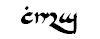
Note: When the Diallic script is used to write English words, a diacritic dot can be placed over consonants to signify that they should be pronounced as fricatives. For example, "farm" would be written:
The same diacritic can be used to differentiate between tightness and laxness in vowels (a distinction that is important in English, but not in Diallic). For instance, the words "keen" and "kin" are written, respectively:
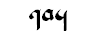
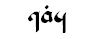
(You might notice, by the way, that the text written at the top of the page is not Diallic but a passage from the Latin Vulgate.)
Back to Table of Contents
The Phonological structure of Diallic, within morphemes, is basically Consonant-Vowel; across a morpheme boundary more complex patterns can occur. Each syllable consists of an Onset and a Nucleus (and a possible Nuclear Adjunct). Onsets can be Simple (t) or Branching (tr, consisting of a stop/fricative + liquid/glide), though branching onsets in which the two components are homorganic are prohibited (so there are no onsets like fw or tl). Root structure is often obscured by processes of metathesis, epenthesis, etc. Nuclei can have one or two metrical positions, but the second must be an off-glide; this means that all long vowels become either ai or au.
The most basic roots in Diallic consist of the pattern ONO-: an onset, a nucleus, and another onset to which is attached the inflectional morphology. So some basic word shapes are
v(V)n- (vener "to drink, to wet") kl(V)t- (klot- "door") tr(V)kw- (trekwer "to chase, to pursue")
Because of the different kinds of onsets, there are different classes of nouns. (See Noun Morphology)
The Nucleus in a root word undergoes Ablaut. There are three grades and two "valences": the grades are Long, Short, and Null; the valence refers to whether the vowel is a mid front (e) or a mid back (o) vowel (i and u do not occur in the nucleus position in the basic roots).
Back to Table of Contents
Its regularity actually makes the language a little unrealistic; the assumption is that, like Homeric Greek, Diallic is an artificial literary language made from several related dialects. Perhaps due to its use as a religious and traditional language, it was extended to large numbers of non-native speakers. Irregularities have since been ironed out and salient patterns have been amplified so that overall the language of The Sundial is extremely simple and symmetrical.
Verbs are constructed in a very straightforward manner. The basic component, of course, is the verb stem. The verbal stems are those words discussed above (See Phonological Structure and Ablaut). For our example, we will use the stem fer- "to shape".
The sequence of morphemes attached to the verb:
| Aspect | Stem (Duration) | Tense and Mood | |||
|---|---|---|---|---|---|
| fe-: Perf. fo-: Ant. |
fer-: Aorist (snapshot) fair-: Cont. (film) |
-e-: Present Ind. -o-: Past Ind. -æ-: Future |
-i-: Present Subj. -u-: Past Subj. |
-ai-: Present Opt. -au-: Past Opt. |
-a-: Imperative |
| Person and Number | Voice | ||
|---|---|---|---|
| -a (-m): 1s -s: 2s -(t): 3s |
-ïd: 3rd dual | -ma(d): 1pl -di: 2pl -n(d): 3pl |
-Ø: Active -i: Middle -ai: Passive |
Here a few forms of this verb, with glosses:
Note that the dual verb has a Null-grade stem (see Phonological Structure and Ablaut). The form in the following sentence, though written with an a, would probably be pronounced with a syllabic r: "fafrreïd".) The Continuous marker of dual verbs, then, is e. An example of a dual sentence:
feræ "he/she/it will shape" (but feræt eŋas) "he/she/it will shape us"; the t appears when the following word starts with a vowel fafairea "I have been shaping" (but fafairem is) "I have been shaping" fairosai "You (s) were being shaped" foferimi "I may be about to shape myself" fefere(t) "he/she/it has shaped" feferoma(d) "we had shaped" fairondai "they were being shaped"
tu dememil yokwi fafareïd y'eŋara yolas.
These two ravenous pains have shaped our lives.
It should be noted, however, that the Dual form is rare in both pronouns and verbs, and quite often a dual pronoun will be used with a plural verb, and vice versa. Often this is a result of metrical considerations.
All Diallic verbs are completely regular, except the verb esya "to be":
| Indicative | Subjunctive | Optative | Imperative | Infinitive | Participle | |
|---|---|---|---|---|---|---|
| Present | s. emmi essi esti pl. esmadi edyi endi |
s. immi issi isti pl. ismadi idyi indi |
s. aimmi aissi aisti pl. aismadi aidyi aindi |
assi adyi |
esya | emil/emilis |
| Past | s. ommi ossi osti pl. osmadi odyi ondi |
s. ummi ussi usti pl. usmadi udyi undi |
s. aummi aussi austi pl. ausmadi audyi aundi |
osya | omil/omilis | |
| Future | s. æmmi æssi æsti pl. æsmadi ædyi ændi |
æsya | æmil/æmilis |
The 2s Imperative form is occasionally reduced from assi to si; the negative Present 2s Imperative is regularly found in the reduced form sio "do not be!"
The last set of changes undergone by Diallic verbs is the addition of the negative particle o as an enclitic. The verb and negative enclitic are written as a single word, but this does not affect the form except in the Passive voice. The examples from above, made negative, are
feræto "he/she/it will not shape" fafairemo "I have not been shaping" fairosayo "You (s) were not being shaped" foferimio "I may not be about to shape myself" fefereto "he/she/it has not shaped" faferomado "we had not shaped" fairondayo "they were not being shaped"
There is a certain subset of sentences in which the verb takes polythematic endings--endings which indicate not only the verb's subject, but also the direct (and very rarely indirect) object. This variation has certain religious overtones that make it prominent in the sections of The Sundial composed of ancient hymns; it conveys a very formal and religious tone.
| Subject | Object | |||||||
|---|---|---|---|---|---|---|---|---|
| Intrans/ Reflexive | 1s | 2s | 3s | 1pl | 2pl | 3pl | Passive | |
| 1s | -mi | -Ø | -nse | -ŋke | -meŋ | -moŋ | -ŋkes | -mai |
| 2s | -si | -spe | -Ø | -ske | -seŋ | -soŋ | -skes | -sai |
| 3s | -ti | -twe | -tse | -(t) | -teŋ | -toŋ | -lkes | -tai |
| 1pl | -madi | -madwe | -matse | -malke | -Ø | -madoŋ | -malkes | -madai |
| 2pl | -dyi | -dime | -dise | -dike | -dyeŋ | -Ø | -dikes | -dyai |
| 3pl | -ndi | -nwe | -nse | -ŋke | -neŋ | -noŋ | -n | -ndai |
Back to Table of Contents
| Infinitives | Participles | |||||||
|---|---|---|---|---|---|---|---|---|
| Active | Middle | Passive | Active | Middle | Passive | |||
| Present (neg) |
-er (-ero) |
-eya (-eyo) |
-ie (-ielo) |
-aiŋ/-eŋis | -emil/-emile | -aid/-edye | ||
| Past (neg) |
-or (-oro) |
-oya (-oyo) |
-io (-iolo) | -auŋ/-oŋis | -omil/-omile | -aud/-odye | ||
| Future (neg) |
-ær (-æro) |
-æya (-æyo) |
-iæ (-iælo) | -æŋ/-æŋis | -æmil/-æmile | -æd/-ædye | ||
If the verb stem contains the r sound, the active infinitive ending will become -l by dissimilation.
Infinitives often take personal pronouns as enclitic suffixes (much like Spanish). When the third person pronoun is attached to the infinitive, it changes from he to ke.
ferelse "to shape you"; feriesar "to be shaped by you" feroloke "not to have shaped him/her/it"
The Infinitive preceded by the definite article forms the gerund. Though the infinitive's form never changes, the gerund can be declined through the inflection of the article. Gerunds can govern objects (in the Accusative and Dative), however, there are no clauses in which the subject of the gerund is different than that of the main clause (i.e. "He hates me helping her."). Such clauses are expressed using the complementizer (e.g. "He hates that I help her.").
ye ferel "shaping" (NOM and ACC) ye ferelo "not shaping" yo ferelke "of shaping him/her/it" yi ferelme "for shaping me"; "in order to shape me" ki me feri(t) "for (the fact that) he/she/it shapes me"; "in order for him to shape me" yar ferie "by being shaped" kar feritai "because he/she/it is being shaped" fewomi yar ferie "I came to exist by being shaped"
There are also two "gerundive" constructions, indicating roughly necessity and probability. These simply involve prefixing the modal particles ofta and gana onto the participle or infinitive. Attaching the prefix to the participle yields an adjective, and attaching it to an infinitive yields a noun.
ye gamferie "the necessity to be shaped" gamferedye "having to be shaped" ye opferel "the obligation to shape" opfereŋis "obliged to shape"
For the declension of Participles, see Adjective Morphology.
Back to Table of Contents
Syntactically, the two Grammatical cases are the NOM and ACC. The NOM is assigned by a following finite verb, and the ACC is assigned by a preceding active transitive verb or a preposition that assigns the ACC. The GEN, which is basically the adjectival case, is assigned to any Noun Phrase that falls inside another NP (i.e., bracketed between an article and noun; c.f. Greek). DAT, ABL, INST, and LOC are treated as adverbials; therefore they are usually placed before the verb.
Certain verbs take DAT or GEN objects: however, the verbs that take DAT objects are actually intransitive verbs, and those that take GEN objects usually represent transitive verbs whose D.O. has been elided, leaving only a partitive genitive phrase. (i.e.: "I drink of water" is actually "I drink (a gulp) of water")
| Class 1 | Class 2 | Class 3 | Class 4 | ||||
|---|---|---|---|---|---|---|---|
| STEM | k--f- | l--ŋ- | r--sy- | tr--kw- | gl--tr- | agl- | isr- |
| Singular | |||||||
| Nominative | kof | lauŋ | rosi | troku | glotar | agul | isir |
| Genitive | kofo | loŋo | rosio | trokuo | glotaro | agulo | isiro |
| Dative | kofal | loŋal | rosil | trokul | glotral | agulli | isral |
| Accusative | kofa(n) | loŋa(n) | rosi(n) | troku(n) | glotra(n) | agla(n) | isra(n) |
| Instrumental | kofar | loŋar | rosir | trokur | glotarri | aglar | isirri |
| Ablative | kofava | loŋava | rosiva | trokuva | glotarva | agalva | isirva |
| Locative | kofa? | loŋa? | rosya? | trokwa? | glotra? | agla? | isra? |
| Dual | |||||||
| Nominative | kofu | loŋu | rosyu | trokwi | glotru | aglu | isru |
| Genitive | kofaira | loŋaira | rosyua | trokwia | glotria | aglia | isria |
| Accusative | kofais | loŋais | rosyus | trokwis | glotris | aglis | isris |
| Plural | |||||||
| Nominative | kofes | loŋes | rosis | trokus | glotres | agles | isres |
| Genitive | kofara | loŋara | rosira | trokura | glotarra | agalla | isirra |
| Dative | kofai | loŋai | rosyai | trokwai | glotrai | aglai | israi |
| Accusative | kofas | loŋas | rosyas | trokwas | glotras | aglas | isras |
| Instrumental | kofau | loŋau | rosyau | trokwau | glotrau | aglau | israu |
| Ablative | kofavas | loŋavas | rosivas | trokuvas | glotarvas | agalvas | isirvas |
| Class 5 | Class 6 | Class 7 | Class 8 | Class 9 | |||
|---|---|---|---|---|---|---|---|
| STEM | fy- | gl- | sr- | v--tr- | sw+lit- | o- | h--tw+s- |
| Singular | |||||||
| Nominative | fya | gil | sur | vors | sulis | o | hetuse |
| Genitive | fyo | gilo | suro | vorto | sulito | oo | hetusio |
| Dative | fyal | gilli | sral | vortal | sulital | ol | hetusil |
| Accusative | fya(n) | gla(n) | sra(n) | vorta(n) | sulita(n) | o(n) | hetusi(n) |
| Instrumental | fyar | glar | surri | vortar | sulitar | or | hetusir |
| Ablative | fyava | gilva | surva | vortava | sulitiva | ova | hetuspa |
| Locative | fya? | gla? | sra? | vorta? | sulita? | o? | hetusa? |
| Dual | |||||||
| Nominative | fyu | glu | sru | vortu | sulitu | ou | hetusu |
| Genitive | fyua | gilua | suria | vortua | sulitua | oia | hetusua |
| Accusative | fyus | glus | srus | vortus | sulitus | ous | hetusus |
| Plural | |||||||
| Nominative | fyes | giles | sures | vortes | sulites | os | hetuses |
| Genitive | fyara | gilla | surra | vortara | sulitara | ora | hetusara |
| Dative | fyai | glai | srai | vortai | sulitai | oai | hetusai |
| Accusative | fyas | glas | sras | vortas | sulitas | oas | hetusas |
| Instrumental | fyau | glau | srau | vortau | sulitau | oau | hetusau |
| Ablative | fyavas | gilvas | survas | vortavas | sulitivas | ovas | hetuspas |
Back to Table of Contents
Note the umlaut that occurs in stems with a null-grade vowel. The empty vowel slot is filled by one of the two low vowels (æ, or a), depending on whether the following syllable's consonant is front or back.
| Type 1 | Type 2 | Type 3 | Type 4 | Type 5 | ||||
|---|---|---|---|---|---|---|---|---|
| STEM | r--g- | f--kl- | w--tr- | w--ty- | v--dw- | f--w- | s--y- | e- |
| Indecl. | rag | fækil | wætir | wæti | vadu | fau | sai | eyu |
| Singular | ||||||||
| Nominative | rægis | fækile | wætire | wætiye | vaduye | fauye | saiye | eye |
| Genitive | rago | fækilo | wætiro | wætiyo | vaduyo | fauyo | saiyo | eyo |
| Dative | rægi | fækilli | wætiri | wætiyi | vaduyi | fauyi | saiyi | eyi |
| Accusative | raga(n) | fækila(n) | wætira(n) | wætiya(n) | vaduya(n) | fauya(n) | saiya(n) | eya(n) |
| Instrumental | ragar | fækilar | wætirri | wætiyar | vaduyar | fauyar | saiyar | eyar |
| Ablative | ragava | fækilva | wætirva | wætiva | vaduva | fauva | saiva | eva |
| Locative | raga? | fækila? | wætira? | wætiya? | vaduya? | fauya? | saiya? | eya? |
| Dual | ||||||||
| Nominative | ragu | fækilu | wætiru | wætiyu | væduyu | fauyu | saiyu | eyu |
| Genitive | ragua | fækilua | wætirua | wætiyua | vaduyua | fauyua | saiyua | eyua |
| Accusative | ragus | fækilus | wætirus | wætiyus | vaduyus | fauyus | saiyus | eyus |
| Plural | ||||||||
| Nominative | ræges | fækiles | wætires | wætiyes | vaduyes | fauyes | saiyes | eyes |
| Genitive | ragara | fækilla | wætirra | wætiyara | vaduyara | fauyara | saiyara | eyara |
| Dative | ragai | fækilai | wætirai | wætiyai | vaduyai | fauyai | saiyai | eyai |
| Accusative | ragas | fækilas | wætiras | wætiyas | vaduyas | fauyas | saiyas | eyas |
| Instrumental | ragau | fækilau | wætirau | wætiyau | vaduyau | fauyau | saiyau | eyau |
| Ablative | ragavas | fækilvas | wætirvas | wætivas | vaduvas | fauvas | saivas | evas |
The comparative prefix is ar- (artim, sharper); the superlative is ava- (avatim, sharpest; avædi, dearest, most beloved).
Back to Table of Contents
Diallic pronouns have a slightly different accidence than nouns and adjectives. There are usually no gender distinctions, though a few rare gender forms (huis, hie) are used for clarity in the third person singular. In the first person plural, there is an inclusive (we = you and I) and an exclusive (we = he/she/they and I) form.
| First Person | |||||
|---|---|---|---|---|---|
| Singular | Dual (incl.) | Dual (excl.) | Plural (incl.) | Plural (excl.) | |
| Nominative | is | eŋu | eŋalu | eŋes | eŋales |
| Genitive | mo | eŋua | eŋalua | eŋara | eŋalara |
| Dative | mi | eŋai | eŋalai | ||
| Accusative | me | eŋus | eŋalus | eŋas | eŋalas |
| Instrumental | mar | eŋau | eŋalau | ||
| Ablative | mva | emvas | eŋalvas | ||
| Locative | ma? | eŋa? | eŋala? | ||
| Second Person | Third Person | Reciprocal | |||||||
|---|---|---|---|---|---|---|---|---|---|
| Singular | Dual | Plural | Singular | Dual | Plural | Plural | |||
| Nominative | us | oŋu | oŋes | huis, hie, his | hu | hes | |||
| Genitive | so | oŋua | oŋara | huo, hio, ho | hua | hara | ellara | ||
| Dative | si | oŋai | hui, hil, hi | hai | ellai | ||||
| Accusative | se | oŋus | oŋas | hue, hie, he | hus | has (ha) | ellas | ||
| Instrumental | sar | oŋau | huar, hiar, har | hau | ellau | ||||
| Ablative | spa | omvas | huava, hiava, hava | havas | ellavas | ||||
| Locative | sa? | oŋa? | ha? | ha? | |||||
The possessive adjectives corresponding to each of these pronouns (and the demonstratives and pronominal adjectives in the next section) are formed from the bare stem of the pronouns; they are declined according to the type 1 adjective declension above (see Adjective Morphology). The forms are ma/mis "my", eŋ(al)a/eŋ(al)is "our", sa/sis "your" (singular), oŋa/oŋis "your" (plural), ha/his "his/her/its, hara "their", ella/ellis "each other's".
The prefix i- gives the third person pronoun an intensive force. (This may be the definite article, in its contracted form, affixed to the front of the possessive adjective.)
Back to Table of Contents
ye definite article we relative and interrogative pronoun la, lis "this" da, dis "that there, that near you" ta, tis "that" tya, tyes "some(one, thing)" "a certain" um(is) "any(one, thing)" "-ever" (also used as an indefinite relative) em(is) "one, alone" "only" yaim(is) "the one, the single, the very" waim "what exactly, what one" laim(is) "this only, this alone, this very" daim(is) "that there only, that there alone, that very thing there" taim(is) "that only, that alone, that very" aum(is) "no(one, thing)" "none" ail(is) "every" "all" "each" fle, flis "many" "much" ofle, oflis "few" an(is) "same" "like" "such" (also used as the specific relative) al(is) "other, another" "else" (also used as a reciprocal pronoun) tyal(is) "some other, someone else" aumal(is) "no other, no one else" umal(is) "any other, anyone else" aille, aillis "every other, everyone else" fille, fillis "many other" ofille, ofillis "few other" sætir, -is "either (of two)" lætir, -is "other (of two)" (also used as a reciprocal pronoun) ostir, ostris "neither (of two)" wætir, wætris "which (of two)" ke complementizer (always neuter singular)
When used as adjectives, these forms take the adjectival declension (see Adjective Morphology).
Of the words above, the definite article ye and the complementizer ke are unusual. Both are found only in the "neuter" or "inanimate" singular form. ye is declinable in principle, but often (especially in poetry) it is contracted and attached to the beginning of the noun or adjective of whose clause it forms the boundary; for instance:
ye troku becomes y'troku (pronounced "itroku") yo trokuo becomes y'trokuo ye æm becomes y'æm
ke (which is cognate with the 3rd person pronoun) only serves to introduce substantive clauses. In Diallic a substantive clause can be case-marked by declining its complementizer; for instance:
leros ke se traikwia "You said that I was following you" (lit. "You said that I am following you"; an indirect statement occurs in the same tense as the original statement.) fewosi kar se ferua "You came to be because I shaped you"
Note that the verb following the complementizer is in the subjunctive mood.
Back to Table of Contents
Also note the adverbial uses of the following case forms:
-æ "-ly" adverbial ending (wæ: "how" indeterminate) -æm time (wæm: "when") -æmu way, manner (wæmu: "in what way, in what manner, how") -æro extent, degree (wæro: "to what extent")
Dative wi "to/for whom/what" "why (for what purpose)" Accusative wan(a) "to where" "whither" Instrumental war "by what route, by what means" "how, why (by what means)" Ablative wava "from what" "from where, whence" Locative wa? "at what" "where"
Like infinitives, adverbials can be used with articles to form noun clauses.
y-læm "now, the present" (lit: "the (things) at this time") yan læm "(the) up to now" = "the past" yava læm "(the) from now on" = "the future" yava tæm "since then, after that"
Back to Table of Contents
The cases themselves carry the most basic "positional" meanings, with the Accusative indicating motion toward, the Instrumental indicating motion through, and the Locative indicating position. To these case-endings are attached various other morphemes, originally adverbs but now rather like postpositions, which further specify the meaning of the case. The Ablative case denotes motion from, and is in fact a fusion of an earlier adverbial element with the inflection of the noun. The Ablative, therefore, is not used with postpositions.
| Accusative | Instrumental | Locative | |
|---|---|---|---|
| Ø, or a | to, towards | through, with | at, in, on, in the presence of | im | into | throughout | within, inside |
| kwa | between (persons) | about, regarding, concerning | |
| ek | out of | outside of, without | |
| eli | around | around, surrounding | |
| æd | toward | between, among | beside, near, close by |
| æl | beyond | across | far from |
| avya | up, onto | on, upon | over, above |
| osuŋ | without | in the absence of | |
| san | down to, onto | down from | under, beneath, below |
| fel | as far as | along | as far as |
| aira | before, until, up to | throughout, during | before |
| fasa | past, beside, around praeter | behind | |
| siŋ | for, on account of | with | in the presence of |
| ev | against | in front of, in the way of |
Back to Table of Contents
Back to Table of Contents
?e? "yes", "indeed, very" ra interrogative ile "for, because" yor "therefore, so" kya "also, even, too", "not only... but also" okya "not even" kiya, tatya "even if" fe "and", "both... and" ai "and not, but not" ul (whether/either) "...or" ya "if", "if... then" isto "except" ra ya "what if" tat "but, yet", "while... still" (weak adversative) dad "although... nevertheless" (strong adversative) ya?e? "if only, would that" ŋa counterfactual particle hæ "as, how, than" hæfar "just as, just like" hæsya "as if" læŋki "even now, still" mesi only, just, merely far "just, exactly, quite" otta verbal particle denoting probability or weak obligation gana verbal particle denoting necessity or strong obligation
Suffix Function Meaning Example -se (9) V to N process, state, action agarse "cultivation"
(from agrel "to farm")-me(9) V to N result, outcome agarme "crop, harvest" -tu (9)
or -we (9)V to N agent agartu "farmer" -ve (9) V to N place or time agarve "farm" -ku (9) V to N means, tool resiku "chisel"
(from resyel "to carve")-ik/igis N to ADJ pertaining/related to
ordinalandrigis "masculine, manly"
(from andur "man")-ud/-idye N to ADJ
V to ADJfull of, made of
likely to, engaging inuntridye "wooden"
(from untur "tree, wood")-in (1) N to N diminutive andrin "boy" -ilis, ilito (7) ADJ to N property (-ness, -tas) agillis, agillito "safety"
(from agile "safe")
Back to Table of Contents
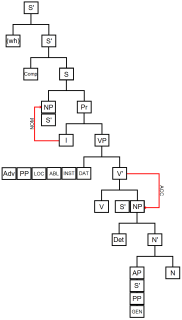
The general syntax is head-initial, but like English, Diallic exhibits some head-final features, such as adjectives coming before nouns. The main departure in Diallic from head-initial structure is Noun Phrase framing--adjectives, adjectival Prepositional Phrases, and other descriptive elements are framed inside the Def. Art. and Noun.
The basic syntactic tree is as follows:
f) The article joined with the infinitive creates the gerund. (See above: )