


Back to the Basics
 I had been looking for a recipe to include in the DBF's Website, trying to find some complex formula that would impress and challenge our most seasoned brewers. However, I decided to give some thought to the many new club members who are unfamiliar with the art of home brewing. After all, he who has the most experience probably also has the most books, including all the material in my collection.
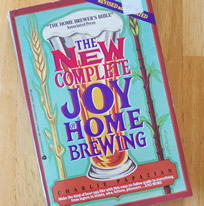
Eventually, I settled on the first book on home brewing that I ever owned. I am referring to The New Complete Joy of Home Brewing, by Charlie Papazian. Aside from the great collection of beer recipes at which, admittedly, I can only marvel (I am not a very skilled home brewer), the book is an invaluable resource whenever I get in the mood to bubble up some ale.
Among other things, Papazian introduces the reader to the basic steps required to make a batch of beer at home. The recipe and steps are simple, even though what goes on inside the fermentation tank and bottle is a rather complex chemical change. Perhaps the most intimidating factor in brewing that first recipe is not having the know-how to carry out the steps. That is where membership in the DBF can help. Following along with Papazian's instructions and photos, circa 1983, is very useful indeed. Having an experienced brewer demonstrate the proper techniques to avoid burning the extract (I've done it), killing the yeast (done it), introducing unwanted bacteria (yeah, that, too), and losing carbonation (guilty) can be the crucial aspect leading to successful brewing.
With that introduction, here are Charlie Papazian's recipe and 10 steps to making that first batch of home brew. Can it really be this simple?
5-6 lbs. hop-flavored malt extract
5 gal. water
1 package ale yeast
1 ¼ c. plain dried malt extract (for bottling)
Dissolve the extract in 1.5 gallons of water, bringing to a boil for 15 minutes.
Sanitize the fermenter with a weak solution of chlorine bleach and water. (While you're at it, sanitize everything else that will come into contact with the brew, such as a metal spoon, a plastic funnel, a glass candy thermometer, and a Pyrex measuring cup. When in doubt, sanitize!) And then rinse away all odors of bleach.
Add 3 gallons of clean, cold water to the fermenter.
Add hot malt solution to the fermenter.
Check the temperature of the mixture. When the temperature is below 78 degrees Fahrenheit, measure and record the specific gravity using the hydrometer. Add yeast. (Prior to pitching the yeast in the fermenter, I recommend cooling a cup of boiled water in the Pyrex measuring cup, adding the yeast to the water after the temperature has dropped below 78 degrees Fahrenheit.)
Add the fermentation hose and stand back. After the initial fermentation subsides (about two days), replace the fermentation hose with a fermentation lock.
Ferment for a total of 8 to 14 days. You may confirm that fermentation has stopped when the reading on the hydrometer will remain unchanged for 2 or more consecutive days.
Bottle and cap. Prior to bottling, you will boil the dried malt extract in water before adding this mixture to the fermented ale.
Age for 10 days.
Chill, smile and enjoy your home brew.