Leaving Port Augusta, the road heads west over the northern part of
the Eyre Peninsula (Pronounced 'Air' "Come for the fresh Eyre" as the
slogan goes), which officially ends at Ceduna, which turns out to have
pretty complete services, so a big 'shop' at Port Augusta wasn't
entirely needed. About 100K west of Port Augusta we passed a roadhouse
with a 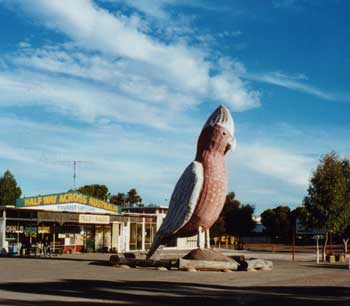 big plaster statue of a galah - a pink and grey parrot common in
the area, and a sign advertising that it's 1/2 way across the
continent. Parrots are quite common, the galah being the commonest in
this area, further east we had seen huge flocks of Sulfur-Crested
Cockatoos, and red, green and blue Ringnecks were often seen in the
trees, as well as small green parrots along the roadsides.
big plaster statue of a galah - a pink and grey parrot common in
the area, and a sign advertising that it's 1/2 way across the
continent. Parrots are quite common, the galah being the commonest in
this area, further east we had seen huge flocks of Sulfur-Crested
Cockatoos, and red, green and blue Ringnecks were often seen in the
trees, as well as small green parrots along the roadsides.
Crows and ravens are also common eating roadkill. There were also "Australian Magpies", or Currawongs, which are very much like crows, but with a white beak and patches of white on back and wings. These birds have many variations of amount of white. They behave just like the crows along the roads. The crows - or ravens, or both have a "Caw" just like ours, but only to start: after starting with a vigorous "Caw, caw" they slow it down, and drop the pitch, so it fades down, as if the bird was dying. The currawongs have a lot of sounds - one of the commonest being an "oh,Oh!", sounding exactly like about a two year old kid spilling something. There is another black and white roadside bird called a "Magpie-Lark", about half the size of the crows and currawongs, and marked just like some of the currawongs with the most white. All of these roadside birds have the curious habit - unlike our roadside scavengers, they rarely fly at the approach of a car: they simply turn their back on the road and step a few feet aside, where they wait with raised beak for the annoying car to leave. It's a sort of backward salute. Naturally, if you try for a photo, they fly away.
So, after Ceduna, we are 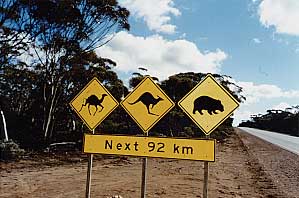 really headed west. The road plunges on thru
the desert, and a short distance south - often mere yards, the desert
comes to an end in
really headed west. The road plunges on thru
the desert, and a short distance south - often mere yards, the desert
comes to an end in 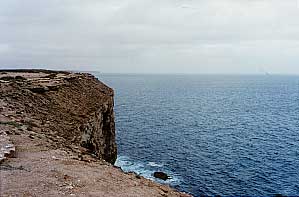 sheer cliffs which fall several hundred feet right
into the sea, and go for many hundreds of miles. Desert whale watching.
This is the famous "Nullabor Plain", supposedly named in botched latin
for 'null' - no, 'arbor' - tree. This stretch of road thus gets VERY bad
press. Usually the guidebooks say something like "no trees - well..." as
if there are a few stunted trees. Actually, though there are several
stretches with nothing at all in sight but some low bushy stuff, most of
the 'Nullabor Plain' is covered with 20-30 foot eucalypts which we
found beautiful with their umbrella shaped crowns. The drive does take
several days (no night driving unless you like hitting kangaroos)
but we really enjoyed the constant, subtle changes in the trees and
undergrowth. And the roadhouses which appear to be towns on the map, but
which are usually just a gas station, semi-fast food place, and a very
'basic' motel. They are sited just far enough apart that you don't have
to worry about running out of gas - but you don't want to pass any of
them by, either. West of Caiduna, on the way to Belladonia, there is a
sheer cliffs which fall several hundred feet right
into the sea, and go for many hundreds of miles. Desert whale watching.
This is the famous "Nullabor Plain", supposedly named in botched latin
for 'null' - no, 'arbor' - tree. This stretch of road thus gets VERY bad
press. Usually the guidebooks say something like "no trees - well..." as
if there are a few stunted trees. Actually, though there are several
stretches with nothing at all in sight but some low bushy stuff, most of
the 'Nullabor Plain' is covered with 20-30 foot eucalypts which we
found beautiful with their umbrella shaped crowns. The drive does take
several days (no night driving unless you like hitting kangaroos)
but we really enjoyed the constant, subtle changes in the trees and
undergrowth. And the roadhouses which appear to be towns on the map, but
which are usually just a gas station, semi-fast food place, and a very
'basic' motel. They are sited just far enough apart that you don't have
to worry about running out of gas - but you don't want to pass any of
them by, either. West of Caiduna, on the way to Belladonia, there is a
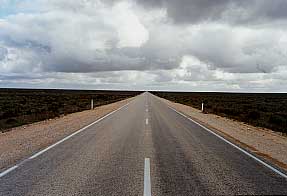 stretch of road which is dead straight for over 90 miles, then a slight
right bend, and about 50 more straight miles. One of the guidebooks (I
checked at the library this morning) implies that you will be totally
hypnotized, but we hardly noticed - there were still subtle ups and
downs, and after all 90 miles straight isn't much different from 90
miles almost straight!
stretch of road which is dead straight for over 90 miles, then a slight
right bend, and about 50 more straight miles. One of the guidebooks (I
checked at the library this morning) implies that you will be totally
hypnotized, but we hardly noticed - there were still subtle ups and
downs, and after all 90 miles straight isn't much different from 90
miles almost straight!
This land looks like it should be covered with farms and grazing cattle, but it is actually one of the dryest places there is. It does rain a bit in winter, but there is no surface water at all. When John Eyre explored it, even his Aboriginal scouts couldn't find water. They almost died, it was a very close thing. Problem is, the whole area is an almost flat limestone plain, with huge caverns underground, so any water just runs underground into the sea. At the Caiguna roadhouse there is a sign: "Please don't ask us for water, because you may be upset when we refuse". So, plenty of drought-tolerant trees and nothing else. We spoke to a couple from Kalgoorlie (we never went to Kalgoorlie, it was a bit north of our route). The husband had a heavy equipment company and told me that his equipment is being hired to go out into the bush and drill prospect holes for mining companies. He said that before water was finally piped from Perth, something like a 500 mile pipeline, the people in Kalgoorlie had to run railroads out into the bush to get wood to distill the salty water which was all that could be got from deep wells for drinking water. When the rail lines became impractically long, they ripped them up, and built another not far away from the first. He said they now find the abandoned camps in the bush from these days, entirely untouched, like ghost towns that no one even knew existed.
SO, two and a half days along the Eyre Hihghway brought us to Norseman - named after a horse who pawed up a huge gold nugget which started the gold rush to Western Australia. Here the road finally splits, going north to Kalgoorlie which is still mining gold, and south to Esperance, on the sea, where we went.
In Esperance, we treated ourselves to a motel (it was raining) and a steak dinner.
Then we pushed on for Albany, also on the coast - the next town, really, though it took most of a day to drive there, so we camped in a really nice place some hours north of Albany where I had an introduction to a retired gentleman who is said to consider a 40K run out into the bush to see a color variant of some obscure orchid to be the way to entertain a visitor. Sounded good to me!
Well, we had a nice camp dinner, and I even considered leaving the stove etc on the picnic table for the night, even though it was cold and windy. There were some nasty looking clouds, though, so I followed usual procedure and stowed it. Good thing, too! Sometime in the middle of the night it was pouring and blowing - one of the fiercest storms we have ever camped in. All was well in the morning, though, and good coffee and breakfast were made, although it was cold work!
Heading for Albany ( 'Al Bany', not like the Albany in New York) we passed thru a small mountain range - like the Cacoctins in Maryland. These mountains, the Stirling Range, were weird! Exploring a dirt road in the mountains, I saw a "Grass Tree" which looked different from other Aussie grass trees - had a bunch of club-like things sticking out a all angles rather that just a tall straight flower spike. So I got out to take a photo, and realized that NOTHING growing there looked like anything I'd seen before. I knew that the flora of WA was unique, but this was more different than I was prepared for.
This area has been seperated from the rest of the world for something like 200 million years, and even seperated from the rest of Australia for some 50 million. Even now, the Nullarbor plain keeps most wildlife from crossing, and for several million years about 15 million years ago, it was a REAL desert of drifting sands. The southwest has had a nice, rainy climate all the while, ever since it was split off from Antarctica, back when Antarctica had plants! To make it even stranger, the land has been just about exactly the same for all that time, and many nutrients have been leached out of the soils, with no volcanoes or overunning seas to replenish them. Looks like great farm country, but for years, no crops would grow until this was discovered, and a few pounds per acre of 'trace minerals' made it fine for farming. They say that there are 8,000 species of wildflowers in W.A., most of which grow nowhere else. We met some folks who had photos of some clumps of wildflowers which grow in ONE PLACE, only, and can't be grown anywhere else, even with soil dug from their home. I have not been able to verify this.
Now I was really drooling to look up the plant guy in Albany, but when we got there in pouring rain, his phone didn't answer. Well, it WAS saturday, he probably had things to do, so we had fish and chips, and pushed on to find a place to camp on this rainy night.
Next morning, we soon came to the town of Denmark in spitting rain. I realized too late that the two gas stations were IT, so pulled over to turn around. The street I turned into was next to a Catholic church, and mass was in 8 minutes according to the sign. We quickly spruced up and went in - sat 'way in back. St Mary's was just a little church - about 50 people at mass. There was the usual general invitation to "A Cuppa'" - tea or coffee and cake next door. We went, and met a few people, including two 'Tony's - Tony Jones and Tony Shepherd and his wife Elanor.
Leaving church, we decided to get a nice lunch, and then call the guy in Albany. Went to the cafe we liked the look of, and the damned door wouldn't open, so a customer inside politely came and helped - "Hi, Tony, fancy meeting you here" Tony Jones was sitting with Tony and Elanor, so we sat with them. In the course of the conversation, when they learned that we were car-camping, Tony Jones said he had plenty of land, we could camp at his place. "or you could camp in our driveway" said Tony Shepherd.
They were all just having coffee, and soon left, both giving us phone numbers.
We ate our lunch, and tried to phone the Albany guy - no answer. Frustrating.
The weather was improving, so I stopped to get a photo of the church. We were in a quandary as to what to do - wanted to call Albany again before we got too far away, and it was getting late, but we felt 'funny' about imposing ourselves on either Tony - hell, they were just 'saying that', right?
Well, as I pulled back on the road, a white car blinked it's lights, and, recognizing Tony Shepherd, I pulled over. They had said that we "have to see green's cove", and Tony said "Follow me - I'll show you where we mean." When we followed them off the main road, they pulled over and told us it's just a K&1/2 further down the road - "And when you come back, go up this little road, last house on the left, we'll have a 'cuppa' waiting!"
So, we did , and we did, and wound up also having some supper, and were re-invited to camp in the driveway (driveway sounded originally like it was in town, but no, nice country place with a view of the Antarctic ocean, and a beautiful cape. Well, we could camp in the driveway, but for the frogs. I never saw ome but they SOUNDED as big as german shepherds! So we wound up in their guest wing. Tony is a watercolor artist, ex architect. Great house! Hot water free - solar in summer, by pipe thru the woodstove in winter. Lots of other neat things - the house was built of 'mud brick' made of soil from the land mixed with 10% cement. ALL water collected from the roof into a 30,000 gallon tank, no well of city water. They had two ponds out front, just in case, also. Very nice.
Next day we had to tear ourselves away, and my call to Albany was still unanswered. The guy's name was pretty unusual, too, and there was a listing for someone of the same name owning a photographic studio. Tried that. No answer. So I had to give up on him, and some undoubtedly great plant hunting.
Part 4, From the West to the Red Centre