|
 Land
Land
|
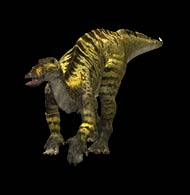 Anatotitan was a "bird-hipped" dinosaur from the group known as the duck-billed dinosaurs or hadrosaurs. It had long, powerful back legs with three hoof-like toes and small, more delicate front limbs, with a mitten-like covering on its hands. It grazed on all fours but could rear up onto its hind legs on occasion.
The front of Anatotitan's jaw formed a long wide beak. Further back, it had batteries of strong cheek teeth. It had a good chewing action with hundreds of teeth forced to rub abrasively past one another. Like Iguanodon, it had a sturdy tail and stocky neck.
Evidence for this dinosaur comes from three skulls and partial skeletons found in Hell Creek, Montana, and other finds in South Dakota, in the USA. Recently palaeontologists have suggested that Anatotitan may just be a large Edmontosaurus. Three species of Edmontosaurus have been identified in the same area but are one metre shorter and weigh one tonne less.
|
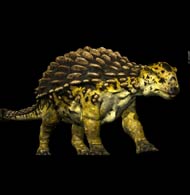 Ankylosaurus was a "bird-hipped" dinosaur from the heavily armoured group known as the ankylosaurs. Much of its skeleton was fused together to produce a heavily plated back. Its head had robust triangular horns in each corner. Its skull was nearly 1 metre long, very broad but very thick leaving little room for a brain.
Ankylosaurus was one of the larger armoured dinosaurs. It's club-like tail, the most impressive part of its body, was made of large clumps of bony tissue fused to the tail vertebrae and encased in tough reptilian skin. Its muscular tail was flexible and able to swing the club powerfully from side to side. Ankylosaurus was not built to reach upwards and grazed on low-lying plants.
It was named by Barnum Brown in 1908 and is known from three fairly complete specimens from Alberta in Canada, and Wyoming and the Hell Creek Formation in Montana, USA. Its fossil remains are restricted to rocks from the Cretaceous period. Ankylosaur trackways have been found near Sucre in Bolivia, South America.
|
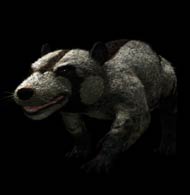 An early marsupial, Didelphodon was one of the pouched mammals, related to the modern opossums. It was the size of a badger, making it one of the largest mammals of the Mesozoic era. Didelphodon lived in burrows in lush forest habitats in North America during the Late Cretaceous period. It was a scavenger that lived on small reptiles, insects and carrion, as well as any eggs it could steal from dinosaur nests.
Like most Mesozoic mammals living in the shadow of the dinosaurs, Didelphodon was probably nocturnal, hunting under cover of darkness and relying on its good vision and keen sense of smell. Didelphodon fossil remains have been found in Hell Creek, Montana, in the USA. Its close relatives, the opossums also evolved in the Late Cretaceous period, and survive to this day. They are found in North and South America, and Australia.
|
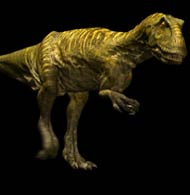 The evidence for the dwarf allosauris controversial being based on a single ankle bone found in the Otway Range, near Melbourne, Australia. This bone has been identified as belonging to a smaller descendent of the fearsome Jurassic carnivore, Allosaurus. By comparison to other carnivorous theropod dinosaurs, the dwarf allosaur was about 6 metres long and could rear up to about 2.2 metres high. Although smallish by theropod standards it was the largest predator yet found from the Early Cretaceous period.
Before this discovery it had been thought that allosaurs died out 30 million years earlier. Some scientists think that the dwarf allosaur survived its cousins by adapting to the cold south.
|
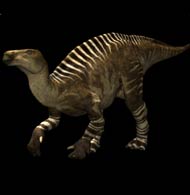 Iguanodon was a big herbivore, the largest species grew to about 10 metres. It had a turtle-like horny beak at the front of its mouth which was ideal for cropping vegetation. Numerous teeth were arranged in parallel rows at the back of its jaws. It was one of the first known dinosaurs to be able to chew. It had a hinged upper jaw, that was able to flex from side to side. This meant that its upper teeth could grind over the lower ones as it bit down hard. Reptiles generally cannot chew their food like mammals because they don't have the special muscles to move their lower jaw from side to side. Iguanodon was no exception, but with its hinged jaw it still managed to chew very effectively in its own unique way.
The footprints of these kinds of animal are common and show that it usually walked on all fours. It is thought to have had thick column-like back legs, and thinner, lighter front ones. It could rear up onto it's two back legs in order to escape from predators, and to use its hands to gather food. Its middle three fingers were bound together by a plump pad of skin, while its little finger could be curled over to grasp food. Its thumb had a vicious defensive spike.
Remains of Iguanodon and closely related species have been found throughout the world. They were a fantastically successful group of dinosaurs. One particularly rich find was of 30 skeletons in a Belgian coal mine.
|
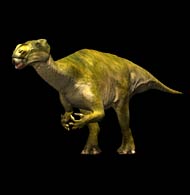 Muttaburrasaurus was a large four-legged herbivore that was capable of rearing onto two legs. It was very similar to Iguanodon. Like it, its three middle fingers were joined together into a hoof-like pad, for walking on.
Muttaburrasaurus had very powerful jaws which were equipped with shearing teeth. These were probably an adaptation for eating tough vegetation such as cycads, which were common in this part of Australia at the time. It also had an enlarged hollow upward-bulging muzzle, that might have been used to produce distinctive calls or for display purposes. However, as no fossilised nasal tissue has been found, this remains conjectural. It is known from one partial skeleton found at Muttaburra, Queensland, Australia.
|
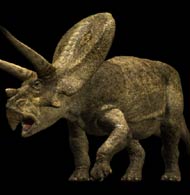 Torosaurus was a "bird-hipped" dinosaur from the group known as the horn-faced dinosaurs or ceratopsians. It was a large sociable herbivore with a strong beak, able to handle the toughest vegetation including small branches. It had powerful legs that were short at the front and longer at the back, which gave it a very stable posture.
Its enormous 2.6 metre crested skull is the largest known from any land animal. It had two brow horns, a short nose horn and a long-frilled crest giving it a fierce appearance. Many theories have been proposed for its use: originally it was thought that it was primarily used for defence or to house massive muscles for eating tough vegetation.
However, the presence of two large holes in its crest have led palaeontologists to believe that it was used for sexual display and to intimidate opponents. The holes would have been covered by stretched skin creating vivid eye-spots when flushed with blood.
Torosaurus was discovered by John B. Hatcher and named in 1891. Evidence for the Torosaurus includes several partial skulls and incomplete skeletons from Alberta and Saskatchewan in Canada and states in the USA, including Montana, Texas, Utah, and Wyoming. In all, 21 skeleton fragments have been identified as Torosaurus, but there is debate amongst paleontologists as to how many species of Torosaurus existed.
|
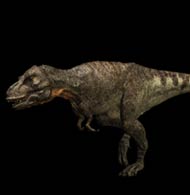 Tyrannosaurus was the largest of the "lizard-hipped" carnivorous dinosaurs known as theropods. It was a massive two legged with a powerful tail, large head and tiny arms. Its primary weapon was its mouth, with a 1.2 metre long jaw and a 1 metre gape. Curved serrated teeth, longer than a human hand, could be used to puncture an animal's organs, before Tyrannosaurus tore the flesh off. Tyrannosaurus could not chew, so had to swallow its food whole. It could probably gulp up to 70 kilograms in one go. One fossil shows the danger of this - a large carnivore had died swallowing, with two long bones stuck in its gullet.
Its tiny two-fingered arms seemed very small, but were believed to have been at least three times as strong as human arms. They were too short to reach its mouth, but were probably used as meat-hooks. There is clear evidence that tyrannosaurs fought one another from tooth-marks left in fossil remains.
The first reasonably complete Tyrannosaurus skeleton was discovered by palaeontologist Barnum Brown in Hell Creek, Montana, in the USA in 1902. Until this find only fragments had been unearthed. In all, over 20 individuals have been found, although, only three have complete skulls. Remains have been discovered from Alberta and Saskatchewan in Canada,to New Mexico, Montana, Texas, Utah, and Wyoming in the USA. Remains have also been found in Mongolia.
|
|
