|
 Air
Air
|
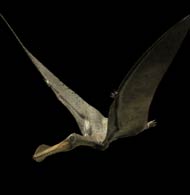 Ornithocheirus was a large pterosaur with a long slender skull and often a bony crest on its snout. It had sharp teeth set in a long tapering jaw designed for catching fish. At the beginning of the Cretaceous period, short-tailed pterosaurs like Ornithocheirus replaced the earlier long-tailed varieties. They also started to grow much larger.
Ornithocheirus had the wing area of a small aeroplane, yet because of its hollow bones, its body probably weighed less than a human. Its wings were made of skin stretched between an enormous elongated finger, and its ankle. They were joined to the rest of its body and its legs. Using rising air currents, or "thermals", Ornithocheirus may have been able to fly hundreds of kilometres without flapping its wings. This could account for the world wide distribution of its fossil remains.
The first fossils of Ornithocheirus were found in the Wealden Formation in Sussex, England in 1827. They were not formally described as Ornithocheirus until 1869. Despite the fact that only partial remains have been discovered, 36 species have been identified from the assortment of over 1000 bones. Most of these have come from the Cambridge Greensand which is a Late Cretaceous rock unit found near Cambridge, England.
|
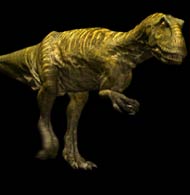 Quetzalcoatlus was a huge pterosaur with a wingspan of up to 13 metres - the largest flying creature of all time. It is the last known pterosaur and survived to the very end of the Cretaceous period. Despite its huge size, its skeleton was lightly built and the whole animal probably weighed no more than 100 kilograms. It was a good soarer - certainly able to cover large distances. Its neck was extremely long, its slender jaws were toothless and its head was topped by a long, bony crest.
Douglas Lawson was the first to find a Quetzalcoatlus fossil, at Big Bend National Park in Texas, USA. Unlike most other pterosaur fossils these remains were not found in marine strata but in the sand and silt of a large river's flood plain. This raised questions about how it lived.
The fact that Quetzalcoatlus had a long neck, and that it can soar has prompted the idea that it lived rather like a vulture and fed on the corpses of dead dinosaurs. But some palaeontologists, noting the long slender jaws suggest that it probed soft ground and pools for molluscs and crustaceans. Others think that it flew low over the warm shallow seas plucking fish from the surface. Lawson named the pterosaur after the Aztec's feathered-serpent god, Quetzalcoatl.
|
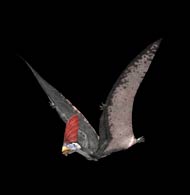 Tapejara was a marine pterosaur - a type of flying reptile. It was typical of later pterosaurs in that it had only a very short tail. It had a remarkable head crest, up to a metre tall. It is possible it used this for display purposes, as a male peacock would use its tail feathers. Rather like a birds beak, the end of its jaw was directed downwards at the front.
Tapejara fossils were found in Brazil. Its name means "The Old Being". This comes from the mythology of the original habitants of Brazil, the Tupi Indians. Most palaentologists consider that pterosaurs are close cousins of the dinosaurs, but the absence of transitional forms makes this uncertain.
|
|
