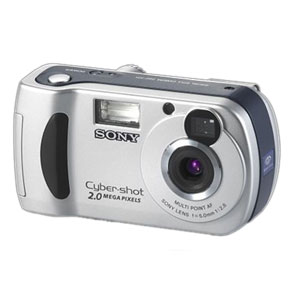
Kodak and Apple sold the first consumer digital cameras in 1994. At present, the digital camera industry is basically divided into four main categories based on image resolution and price.
A) The fully automatic point and shoot cameras with resolution below 1-million pixels and cost below $500, and the megapixel cameras with resolution over a million pixels which cost less than $1000, for example the "Olympus D-460 ZOOM".
B) Prosumer cameras, the megapixel cameras priced between $1000 and $2000, for example the "Olympus C-3030 Zoom".
C) The professional digital cameras, which are the most expensive, cost more than $3000 and based on 35mm and APS SLR cameras, for example the "Nikon D1".
D) Digital video cameras, for example Canon's Optura Pi.
Now, lets begin with the basic logic how a digital camera works. I believe that most of us know the fact that a digital camera does not need any regular film in order to capture images, right? Then how exactly a digital camera works?
Well, a digital camera captures images on a device called electronic light sensor (or CCD (charge-coupled devices)). The CCD is made up of millions of tiny pixels (a pixel is something likes a point). The job of the CCD is to collect light, which comes from the opened shuttle. Then the collected light is converted into electronic data and stored on a memory/storage card (internal or removable), which is the film of a digital camera. Memory cards are reusable.
The most common memory cards including Smart Media, Compact Flash (Type I & II) and Stick memory for instance Sony MemoryStick.
Because of this difference, digital cameras have some advantages that conventional cameras do not have: They give the user the luxury to view images on the digital camera's display instantly and if the user does not like a particular image he or she can delete it instantly and retake again.
The most important part is that, a digital camera allows a user to upload images onto a computer, from the computer the user is then able to edit, store and print images in photographic quality.
Lets put some focuses on the "editing image part" which makes a digital camera so interesting. The user could use the software which included with most digital cameras or image editing software like Adobe Photoshop 6 to adjust brightness, contrast,colour levels, sharpen images and also add some special effects to images that have been taken.
Since images taken by a digital camera are converted into data, it can be used exactly like any other computer files. First it can be sent via email, uploaded to websites and printed through printers.
Another advantage of using a digital camera is that it saves the user a lot of money and time, because he or she no longer have to buy bunch of films and
and pay someone to develop the films later, thanks to the reusability of the memory card and the printability of a digital camera images.
So after reading the above article, do you think you could one day become a skilled photographer? I bet you will. Anyway, there is a lot more to learn before you really became an expect of digital camera. Are you ready to get more? If so, lets go on...
The main factors that affect the quality and size of a digital camera image.
a) Image Compression
b) Image Resolution
a) Image Compression
Image like text are made up with data (which is measured in the unit of bit). The bigger the image the bigger the data will become,and as a result, more spaces or memory it will occupy.
The problem is that most digital cameras only have memory around 8-16 megabytes, while most modern digital cameras can capture an image of size up to 10 megabytes so not many images could be stored in a single memory card.
Because of this problem, the idea of image compression has come into existence. The logic of image compression is to compress images file into smaller sizes, so that more images could be stored in a single memory card.
The user of digital camera can use different level of compression to meet his or her needs. The main trade-off of image compression is the loss of image quality. The most common used compression format is JPEG. Another problem of image compression is that, once an image is compressed, it cannot be restored
back into its original size.
To overcome the problem of loss quality, most digital cameras are using TIFF (Tagged Image File Format)technology to store images. Images stored in this way can be printed in large sizes later by using a printer.
b) Image Resolution
The second factor that affects the quality and size of a digital image is the resolution of the image. Normally, the more pixels a CCD (electronic light sensor) has, the higher the image resolution will become. Higher resolution images can be printed out in lager sizes and better quality than lower resolution images, in other words, the number of pixels a CCD has directly influence the print size a digital camera can produce.
For example, a 1.3 Mega Pixel digital camera produces a screen size image of 1280 x 960 and can print in sizes up to 5 x 7 inches in photo quality but a 4.1 Mega Pixel digital camera produces screen size 2272 x1704 and can print sizes in up to 11 x 14 inches.
Can you see what I mean? But higher resolution images will also taken up more memory.
High-resolution images are good for some editing jobs,for instance cropping (to cut out a section of the image) and combining images. Different level of resolution can be chosen on most modern digital cameras.
As a general rule, images used on websites only need low resolution (for example 640 x 480 pixels (307,000 pixels)) while images to be printed out need higher resolution (>1.3 mega pixels).