|
Welcome to
the DIDIK/Vari-Vue™
Lenticular/Stereographic website - the inventor of the Lenticular
process. Since 1936, when Vari-Vue invented the Lenticular process
and coined the trade name "Lenticular", Vari-Vue has been
the world leader in stereo (3D) and animated printing. For over 60
years, virtually every advancement in the field of Lenticular
technology has been developed by Vari-Vue including specialty
plastics for maximum refractive indexes and mass production, an
enourmous variety of Lenticular lenses (linier lenses) ranging from
from 1 lens per inch to 360 lenses per inch and a variety of varying
focal lengths for each of the lenses, special optical glues which
enhance clarity, have little buble formation and can endure humid,
dry, hot and cold climates. In addition, Vari-Vue developed most of
the high speed Lenticular production equipment, including sheet fed,
continious run equipment as well as "auto-stereo" large
format cameras to which the bulk of all Lenticular images on the
planet was shot with. Starting in the early 1960's, Vari-Vue licensed
much of these advancements to companies on all continents. To this
day, most of the high speed, mass production equipment and techniques
remain trade secrets of Vari-Vue. No other company on this planet has
a better understanding of the technology, know-how of our Lenticular
technology than Vari-Vue or our license holders.
Today, thousands of people world wide collect early Vari-Vue images.
Some of these images sell for thousands of dollars. These photographs
range from the earliest late 1930's images, to stereo images of Elvis
Presley, the Beatles, Rolling Stones, politicians such as Eisenhower,
the socalled "Op-Art" of the 1960's, full sized highway
billboards, conversion tools, 3-D posters, 1939-40 and 1964-65 New
York Worlds Fair items, drinking glasses, record and music album
covers, games, eye glasses, charms, jewelry, greeting cards, point of
sale images and countless other images. Virtually every major
American Company and many, foreign companies had Lenticular images
produced by Vari-Vue in the 1950's through the 1970's. Today, there
has been a resurgence in Lenticular image technology and we continue
to be in the forefront of Lenticular development and new uses for our
Lenticular technology. We mantain the worlds largest Lenticular
collection, which is made available to museums and special shows.
For further information, please refer to the pages below. Thank You.
DIDIK/Vari-Vue
Stereo 3-D Pages
**"Lenticular"
is a trade name of Vari-Vue to describe linier lenses and was coined
by Vari-Vue in 1936.
If
you would like to be placed on our mailing list or if you would like
information on our Lenticular
printing service, blank Lenticular
lenses, Lenticular Guide book or if you are a member of the media and
would like to receive our press kit, please register below:
Registration
Page |

The
second Vari-Vue factory in Yonkers, New York (USA) as seen in this
1962 photograph. Over 200 million Lenticular images per year were
produced at this 50,000 sqft (aproximatley 5,000 sq meter) factory
from 1957 till 1972. In late 1972, Vari-Vue moved to a more modern
facility in Pehlem, New York, where it remained till 1986 when most
of the prodution line and intellectual property was purchase by DIDIK.
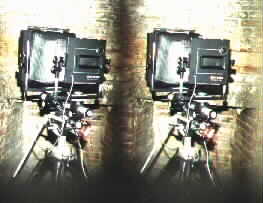
One
of the many varieties of Auto-Stereo cameras designed and built by
Vari-Vue. This particular camera shot most of the famous Lenticular
postcards in the 1950's and 1960's. It is capable of taking an
unlimited number of photographs of the same image, each varying only
slightly from one another.

A
stereo pair is another type of stereo image. This type of image can
be viewed in 3-D by placing a devider between the two images and
looking straight. For more info on viewing, please review the site as
listed in the left column. Stereo Pairs were originally conceived in
1838-- only 9 years after the first photograph was shot (1829) and
two years before Degarue came out with a type of photography that was
later to be known as the Dagarutype.

Vari-Vue
"INTERNATIONAL" logo as adapted in 1948 |