About the Conflict
Achieving its independence from the United Kingdom in 1956, the nation of Sudan occupies an area in north-eastern Africa slightly more than one fourth the size of the US, making it the largest country on the continent in terms of land. Unfortunately, the people of Sudan, who now number more than forty million, are heirs to a long and tragic history, marred by endemic poverty and strife. The most recent conflict to divide Sudan has been playing out in the western region of Darfur since 2003. The roots of the conflict in Darfur are complex, spanning nearly a century of Sudanese history.
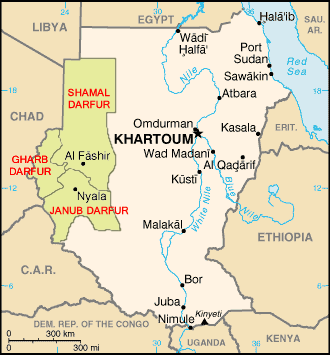 In simplest terms, Darfur has become increasingly divided along ethnic lines. One group encompasses the black Africans, who lead a largely agrarian lifestyle. They are divided among a number of tribes, the largest of which are Zaghawa, Masaaleit, and the Fur, from which the name Darfur is derived. The other main group comprises ethnic Arabs, who are generally nomadic.
In the last twenty-five years, numerous social and economic factors led to a heightening of tensions between these two groups and, more accurately, between the numerous distinct tribes encompassed by them. That the black Africans, who constitute a majority of the six million people in Darfur, were marginalized within the Arab=controlled Sudanese government only served to exacerbate the tensions.
 Meanwhile a separate conflict within Sudan, the so-called "North-South Conflict", was being fought between rebels in Southern Sudan and the Sudanese government, which retained control over the North. Peace talks began several years ago, but many black Darfurians were angry the talks did not properly address their agenda in addition to that of the Southern rebels.
Finally, in early 2003, the Liberation Movement/Army (SLA) and the Justice and Equality Movement (JEM), two rebel groups comprised mainly of black Darfurians, launched attacks on Sudanese government military bases. Full-fledged civil war was under way.
The Sudanese government's response has been stunning in its brutality and its utter disregard for human life and basic human rights. Beginning in mid 2003, with the implicit support of the government, rogue Arab militias known as "Janjaweed" began a systematic campaign of genocide against black Darfurians. Destroying entire black villages at a time, the Janjaweed make no distinction between men, women, and children in their killings. Those who escape death are often raped or have their houses and all their property destroyed. While the government denies affiliation with the militias, Janjaweed raids on black villages are often supported by air strikes from the Sudanese military.
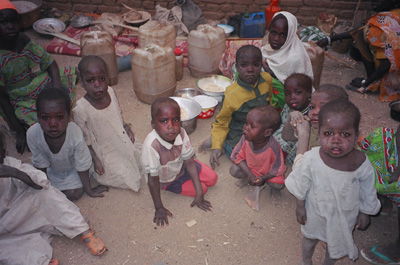
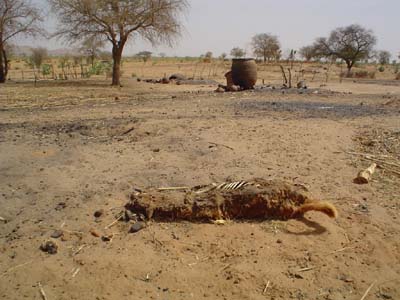 So far, rough estimates put the death toll at 400,000. Many deaths occur not directly from the violence, but as a result of the disease and famine that ravages the 2.5 million people who have been displaced by the conflict. A ceasefire between the rebels and the government was signed in mid 2004, but has been ineffective in stopping the genocide. And so, the killings continue.
