 |
| Diabetes Education 2002 Page 7 |
|
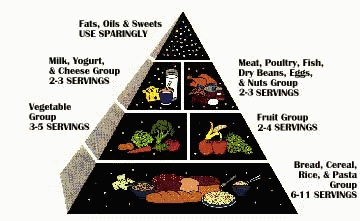
| Food Guide pyramid. Is the last stop in the basics of food use. Using the food guide pyramid as an example of how to break down your daily intake needs. By following examples of the food guide pyramis, you will see that 6- 11 servings of just grains alone makes up your diet. Thisa is a bit much for a diabetic. So we take the low end, of 6 servings of grains, then we see that 2-4 servings of fruits, is fine. we add to that the 6 basic and we are up to 8 servings, now go to milk. We see that some proteins are in the milk group. This gets confusing, but cheese is ameat substiute so thats not countd as a carb. But milk, and yogurt are carbohydrates. This is because they still containe lactose a milk sugar. Where as cheese do not. They are concentrated proteins. So as a rule. use the low end, Also remember that dried or cooked beans are also inthe wrong catagorey. They are not only a protein and fiber but also a carbohydrate. So is corn and peas. So if you want to be exactt, order from this website the diabetics starter kit. It has American Diabetes Dietetic guides. |
| Now we go onto the next idea. and this is the last of the food areas. Cooking. It has been found that fats help a diabetic keep numbers low. The metabolism of fats burn the sugars or extra glucose. Keeping foods tasty is also a keep to keeping control. So use spices to make foods tempting. Use oils especially like olive oil not only margarines,. You can eat everything! even candy! even sugar. granted in limited quantities. But you can simply exchange a slice of bread for a few hershey kisses, A thing about exchanging. Exchanging is a key element in keep ing control. It prevents you from sudden binging and going into ketoacidosis or producing ketones or spiking. Daily treats like the exchanges below actually are good for you, do nto compromise your diet and have been cleared by the ADA. EXCHANGE 1 bread slice or 15 grams exchange: 2 Reeses peanut butter cups or 1/2 hershey bar or 5 vanilla wafers or any piece of fruit excahnging is a key to making your diet a variety! dont be afraid to eat everything.. if you are not sure about teh catagorey or the carb count, eat a small amount, then research, or carry a book around on carb choices until you get into the habeit of knowing the basic food structure! |
 |
 |
|
| Medical Problems Warning! |
| Diabetics have loads of medical problems to face if they are not in control. One o fthe worst that most diabetics are afraid of is the amputation of a foot. whats even more strange is how many diabetics are in denial and often dont want to watch what they eat and then complain when they loose a toe or develop problems. Below we look briefly at some of the complications and what they mean and how to prevent them. |
| FOOT PROBLEMS foot problems occur for a number of reasons. One is lack of c control and improper useage of their medication. Often foot problems are open ulcerations, and exposed flesh. Often the flesh dies. when thsi flesh dies it often stinks. This is called gangrene. Flesh on a diabetics foot becomes dead or easily injured because of neuropathy. That is the lack of sensation. So the diabetic does not know when there is an injury and it becomes worse. Amputation on necrotic or dead tissue is vital. So thats basically how a diabetic looses a toe. To see pictures of this please email me. Neuropathy Neuropathy is the condition where the insulation sheath of the nerve has been destroyed. This is due to the body eating away at the fats and tissues due to glucose overload and ketoine production. ketones are like acetone nail polish remover on a nylon blouse, or paint remover on a cars paint job. Neuropathy prevents the sensation of feeling. This leads to a tingling (due to hyper stimulation of the nerve endings) and a numbness, burning. Neuropathy can strike anywhere on the body. But its most common in the feet and legs. Even the slightest touch is extremely painful, tho heavy contact is not. Nephropathy Nephropathy is kidney disease. As the kidney is one of the two main filters, the exhaustion that occurs from the over stimulation to rid the body of an excess of glucose and ketones leads to two things. One the ketones eats away at the kidney tissue itself \causing holes and dying tissue. this often leads to the removal of a kidney, and teh second is the exhaustion of the kidney to be stimulated. Its over worked, and the hormone that is produced as a signal is often drwoned out So it becomes moot. |
 |
 |
| Copyright 2000-2001 julia sherman D.N. |