Flying To America
The Freshers to America boarding on a trans-atlantic or trans-pacific flight
should be aware of few things, how to prepare your luggage, how to pack and what.
Packing, Luggage
Pack your belongings in two categories: use a small backpack or bag for personal
items what you want to take with you onboard, and the rest can go in the permitted
suitcases.
All airlines departing from India allow passengers to carry onboard a hand luggage,
typically a smaller handbag or a roller bag, and/or a laptop. Depending on the size
of the airplane and the size of the luggage compartment flight personnel might force
you to check in larger carry-on bags. Ladies are permitted to carry on with the
purse/makeup bag. I suggest you to check the respective airlines website before you
proceed to buy the suitcase and pack it for travel.
- Passport and all your papers, you will need these during the check-in process
- Flight tickets and Itenary
- money ( INR & Dollars )
- Baby formula / Milk and baby food in containers if a baby or small child is traveling
- Medications (liquid, gels and/or aerosol)
- Set of Clothes and your daily essential stuff , This will be useful if luggage is lost or delayed
- Employment related documents
- Contact Numbers of Residence/Hotel , Address and driving directions
Dress comfortably for the plane. . Don't be fancy nor dress very elegantly if this is not necessary. Think that you will be in that plane for the next 10-12 hours or more and it will be a hell if your shoes are tight or your pants are not comfortable. Dress as comfortably as you can. Honestly, nobody cares if you wear jeans, even if you travel on the first class.
When buying your ticket, if you are tall I suggest you to ask for an aisle seat instead of a window or a middle seat. Thus you will have the chance to stand up and take a walk if you want to stretch your legs. I personally always ask for an aisle seat. I know, the window seat is more interesting in the first and last 15 minutes of a flight, but in the rest during the flight it's just pain to get out from the window.
About Airports
Airports are devided into several terminals. Often a terminal is so big it's like a small airport in itself. Every
terminal has several gates, sometimes up to 50 or more gates. Most terminals have shops and stores where you can shop,
often a dedicated food place called food court where you can eat. How you can get from one terminal to another varies
from airport to airport. At some airports you just walk, at other ones there are dedicated buses, airport train
(often called concourse) or monorail.
Most airports in the US have nowadays wireless internet, so if you have a laptop or PDA you can go online, surf the
web or check your e-mail. In most cases this is not free, has a fee, typically about $5/hr or $10/day. On.
One of the other crazy things I noticed recently is that more and more planes are boarded (passengers seated)
from front to back. What this means? Usually the "entrance" of a plane is at the front of the plane. Instead of
boarding people at the back of the plane first, many airlines board the front of the plane first, e.g. the first
ten rows first. Then the next 10 rows and so on. The only problem with this is: after you boarded the first 10
rows of people they will block the plane for several minutes and the rest of the passangers have to wait until
these guys settle, and they can not move towards the back of the plane. Wouldn't be easier and more logical to
let in first the passangers who sit in the back of the plane, and filling in the plane from back to front?
Because of this strategy with no common sense the boarding time is a lot longer (at least double compared to
the other way) and people are standing in loooong line waiting to finally get to their seats. Hope this annoying
procedure will change in the future.
Arrival/Departure Record
Sample I-94 Record
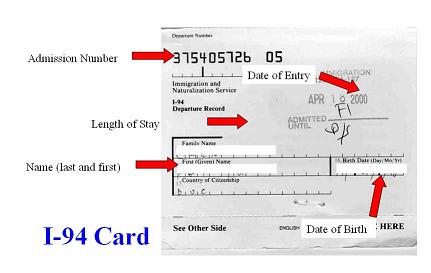
An INS Form I-94 (Arrival-Departure Record) shows the date you arrived in the United States and the "Admitted Until" date, the date when your authorized period of stay expires. You will receive an INS Form I-94 from an INS inspector when arriving in the US at the port of entry. The form has to be completed and presented to the INS inspector who would ask you questions about the purpose of your trip, your stay duration, and your place of residence in the US. When you leave the country, you must provide the I-94 to your airline
