







|
|
|
|
Jeddah is a city of mystery, rich with tradition, history, culture and a unique heritage. It has been mentioned by many travellers in their journals, some describing it as "the city surrounded by walls with beautiful markets and buildings" whilst others describe it as "the small city on the Red Sea".The origins of Jeddah began about 2,500 years ago as a tiny fishing settlement established by the Quada's tribe. Jeddah was then chosen as the main port for the city of Makkah in AD647, by Caliph Osman Ibn Affan.
|
In the 16th Century, the Ottomans built a stone wall around the town, inorder to fortify it against attacks from the Portuguese. Four gates were made on the stone walls. "Bab Sherif" opening towards the South, "Bab Makkah" facing east, "Bab Madinah" in the north wall and a west gate facing the Red Sea. By 1825, under the control of the Ottomans, the town began receiving its first diplomatic representatives from Europe (France and Britain). It then became known as "Bilad al Kanail" - the city of consulates. |
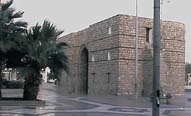 "Bab Madinah" - The North Gate
 |
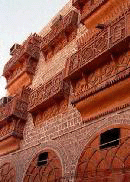 Old Jeddah Building
 |
Jeddah remained a fortified, walled town for centuries of Ottoman influence and was not released from Turkish rule until 1915. The evidence of Turkish influence can be seen in Jeddah's architecture. The buildings of old Jeddah were tall, constructed from coral, limestone, sea shells and timber. The timber was brought by ship from Africa and Indonesia. The balconies and windows were decorated with beautiful wooden facades, known as "rawasheen". These were designed not only to break the sun's glare, but also to take advantage of the cooling sea breeze when the inner windows were opened, during the hot months of the year. Also the wood was carved in such a way that it was easy to look outside while remaining hidden from public view. |
The origin of the city's name poses an interesting dilemma. Juddah (pronounced as Jiddah) in Arabic means Seashore, which is logic enough. But the school of thought which prefers Jaddah which in Arabic means grandmother, is given credence by the traditional location of Eve's tomb within the city. It is believed that when Adam and Eve were expelled from Paradise, Eve came to live in Jeddah and, from time to time, she visited Adam in Makkah or in Mina. After Eve's death, she was buried in Jeddah, where her tomb withstood the ravages of the ages up until only half a century ago when it could still be seen from Bab Madinah, one of the three main gates which surrounded the town up until 1947. Today, it is not possible to see that interesting place since the Saudi Arabian government had the tomb destroyed for the reason that it would instigate perversions in the religion.
 Back to Top