|
House Wine |
|
|
(UPDATE: Make your own wine at your own risk. Since I wrote up these recipes, I've had a chance to sample some of my vintages (I'm still hoping I didn't do irreparable damage to my plumbing), and only the fig wine worked out. I thought to leave the whole lot down near the park with a complimentary corkscrew for the local sans-maison crew, but couldn't bring myself to do it.) I've made three kinds of wine at home, carrot wine, fig wine and apple wine. I'll give you the recipes with a forewarning that I don't know how any of them taste, except for the bit I sipped out of the siphon hose when I was bottling. All fine wines should be allowed to age in a climate controlled atmosphere. So, in lieu of a wine cellar, I bottled everything and put it in a big steamer chest in the living room. Everything I know about winemaking I learned from a book called "How to Make Wine in Your Own Kitchen," by Mettja C. Roate, published 1963. Good luck finding this book. Mine is a paperback from a thrift store, but it's definitely the authoritative book for me. There are a lot of good books on how to make homemade beer, but the ones on winemaking start reading like chemistry textbooks written for snobs. This Roate book goes straight to household ingredients, advises you to "sprinkle yeast on a piece of bread and float it face-down in the wine." She only briefly touches on sterilization, makes no mention of tannins or acidity or pH balances and all that. For her, you take anything in the kitchen that will ferment, add a bunch of raisins and let it sit "in a warm place" for two weeks. She's got recipes for wines made from everything: dandelions, potatos, corn (dried), turnips, rhubarb, peach, berries, etc. (In fact, the guy who just bought my boat mentioned that, as a boy in England, they used to make wine from beef broth or something. Even a dabbler such as I could feel a faint gag reflex thinking about that one. I imagined a kind of fermented soup, poured cold and lumpy into waiting glasses) The recipes seem to work, so far. In the beginning I used special wine yeast and corn sugar, both of which produce better products, but then I just started using cane sugar (make sure it says "cane") and some yeast I found on the shelf, unrefrigerated and way past the expiration date. Whatever. It worked. The trick in most of these wines is the addition of a bunch of raisins. The raisins are what really makes it wine. In fact, I imagine if you had a food processor that could grind up raisins by the pound, you could probably whip out some decent wine in record time. How does it taste? Don't know -- I'm waiting for it to age, I just said. Anyway, here are some recipes I adapted from Roate. |
|

|
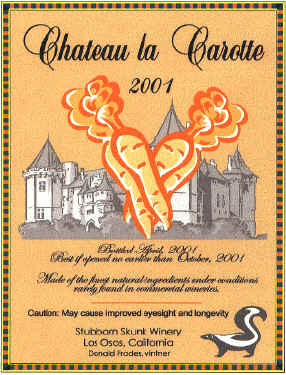
The fine (?) wines I've made, along with their labels. (You can whip up a label pretty fast with Microsoft Publisher. Just use their cheesy clip art and fonts and try to get the size right.) |
|
|---|---|
|
Carrot Wine
Ingredients
|
Fig Wine
Wow -- before bottling this one was kind of a rich deep red with a definite fig overtone. I think it'll probably be like a potent cabernet with hints of a desert oasis and the sweet sweat of the camel rider. This one will be sitting in its "warm place" for a month before bottling. Ingredients:
|
 Before
I bottled this one it tasted kind of like a wine cooler with a bit of
Mountain Dew-like citrus and a kind of carrot sweetness that you probably
wouldn't be able to identify as such. It's a a few shades past golden. (UPDATE: This wine is FOUL!! It left ungodly sediment and was so god-awful I just about took down this recipe. Or at least renamed it "Carrotsene."
Before
I bottled this one it tasted kind of like a wine cooler with a bit of
Mountain Dew-like citrus and a kind of carrot sweetness that you probably
wouldn't be able to identify as such. It's a a few shades past golden. (UPDATE: This wine is FOUL!! It left ungodly sediment and was so god-awful I just about took down this recipe. Or at least renamed it "Carrotsene."