|
|
Mead "... As it is in Valhalla, so may it be in your garage ..." |
|
|
The tasting of the mead: Hand me my broadaxe! |
First of all, I had no idea that so few people knew what mead was, but when I mention I've made it, I'm met with blank stares. The fact is that hardly anyone has actually tasted it, but certainly the name pops up in everything from Jethro Tull songs to Norse myths and (where I probably learned about it first) in Thor comic books and Dungeons and Dragons (the old version with a half-dozen books and way too much graph paper and odd-shaped dice). |
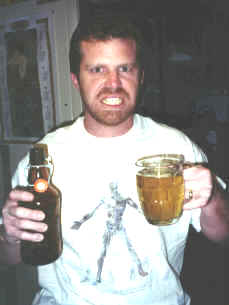
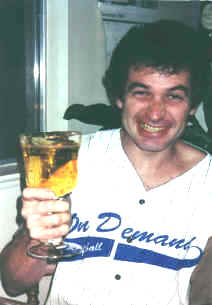
Who the hell is this guy, and what is he doing toasting to Ragnarok? Meet Master Meadmeister Clay from across the street. |
| A
little more background ...
Odin was rumored to have been nursed by a divine goat that produced mead instead of milk. Mead was flowing quite freely in the heavens and earth of the northern Europeans up until the middle ages, when they discovered it was easier to lop down an acre of barley and brew it into beer in a couple of weeks, than to go getting hundreds of beestings by poking around in wild hives, then waiting around forever for their honey-water to ferment, owing to the fact that these people had no concept of yeast, so they just waited for the magic to happen (which it did, thanks to yeast-saturated barrels and various other contaminated vessels, plus the dangerous "airborne yeasts" that homebrew books warn against. Whatever. What a random time that must have been, and one it might behoove us to honor. Mead is not something you sit around and sip. It is also not a beverage you would forcibly imbibe at a party with a funnel, two-dozen frat boys and a yard of plastic tubing. Mead is the story-teller's drink. A bit of mead, acting similar to wine, but better, brings out a sort of sprightly yarn-spinner in the imbiber. My observations tell me that it also leaves you with very spotty -- or blank -- memory the next day, combined with no hangover whatsoever. There are no impurities in the stuff. Not that you should drink this or anything else to excess. Especially not mead. Three bottles will have you banging giant ox bones on the table, creating some kind of hour-long melodic sing-song autobiographical epic, which may include dwarves and frost giants. Please note that among mead-drinking cultures, the Scandinavians left us a huge legacy of epics that feature all kinds of ridiculous ogres, giants, gods, dwarves and whatnot. Thousand upon thousand of pages. Does the fact that they put down a lot of mead have anything to do with their output of fanciful literature? With absolutely no evidence other than the tank of the stuff we whipped up, let me say, unequivocally, YES. At our last New Years Party, one mead-drinking lady guest, who shall remain nameless, ended up dancing solo polkas in our living room and then out in the street, overcome by the honeyed inspiration. Veronika once discovered me singing and dancing to old records in the garage after a routine "quality control" mead-tasting. And after just two or three meads, I once expounded to Ron Davidson in colorful Homeric fashion every subtlety and poetic significance of our expatriate experience ten years ago, and could barely keep up with my own storytelling. (Ron, unfortunately initiated too hastily into meadhood, entered into a merry half-hour laughing spell after one mead and was impelled by the unusual sensations into a kneeling position before the kitchen trash can -- but it was not to be -- mead doesn't do that to a man. Nothing came up and no ill effects were noticed).
|
||
|
Mead is a drink made from fermented honey. It's the oldest known intoxicant to civilization -- pre-dating wine and beer -- owing to its simplicity. Mix up some honey and water and leave it for a while. It can almost occur naturally, which is why almost everyone from the Vikings to African bushmen to the Mayas had some version. I've brewed mead twice -- the first time was kind of random and turned out great. The second time I really planned it out and I'm disappointed. So much for preparation. 1. You can actually buy mead (I got a bottle at World Market) but it's more like novelty wine and just not the same. I was nonplussed. The mead I made, however, was effervescent like champagne, but was served in thick glass chalices. I looked around for a ram's horn or pewter chalice, but no luck. 2. You can get mead recipes all over the place -- on the Internet, out of a lot of homebrewing books, etc. I've got a simple basic one below. Of course you should probably already be familiar with the stuff you need for basic homebrewing, which you can get at any homebrew supplier (at exorbitant prices) or gather up here and there. There's really nothing that specialized, and unless you're the perfectionist engineer type, all you really have to do is make sure things are about as clean as you can get them, and that you follow some real simple concepts of temperature. I've broken every rule of sanitation and storage and still come up with some great stuff. I've also followed the rules and screwed up. If you go to a brewshop and tell them you're making mead, they'll have anything I've listed right on hand. And they'll probably tell you a lot of other stuff about this and that, and how it takes many months. Maybe so, but I just nodded a lot and got what I needed. Anyway, I've boiled the basics down to:
YEAST: Use champagne yeast from a beer/winemaking supply guy. Honey doesn't have the nutrients, I've read, to kick into a fast fermentation like beer, so you probably have to add some "yeast food" to your mix, or else it'll take many months before bottling and many months after. |
||
|
An easy recipe for
|
||
Ingredients for five gallons:
(Incidentally, according to the book, there may be some truth in the sons part, since something about a woman's bodily pH balance around conception that increases the likelihood of sons, and drinking mead (or anything), I guess, does that. Who knows. Just think of the stories you'll tell!
|
||