There are many great science fiction writers--Asimov,
Forward, LeGuin spring readily to my mind. Others would have a different
heirarchy. But few would deny that Arthur C. Clarke belongs somewhere near
the top. In both brilliance of insight and long term productivity, Clarke
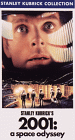
has few peers. The most thoughtful science fiction movie ever came from
the first of Clarke's insightful series on the future, 2001.
One of the earliest enlightening speculations on first contact with aliens
appeared in 1953, when Clarke released Childhood's End.
But in my estimation, Clarke's finest works are in the
Rama series, which I would rate the greatest science fiction series of
all time. Asimov's seminal Foundation series, Adams' hilarious hitchiker's
guides, Forward's pantheon of truly alien aliens all command high respect
and praise. Certainly Clarke's own 2001 series is a truly
great set of works that are better known and more widely revered than his
Rama series. But in my estimation the Rama series outshines all others
on several dimensions.
First of all, it is the most intelligent speculation about
the possible population of aliens throughout the galaxy and their potential
relationship to each other. Secondly, as much as it has to say about the
possible nature of aliens, it has even more to say about a better known
but less understood phenomenon--human nature. It is certainly one of the
most thoughtful endeavors to understand what the long term impact of contact
with aliens would have on human life.
The Rama series grows and flowers as Clarke and later
his collaborator Gentry take decades to ponder who the alien "Ramans" might
be. Each book is markedly more thoughtful and inspiring as the nature of
galactic civilization is slowly but surely revealed. The series starts
with an awesome mystery. In Rendezvous with Rama, a huge
alien spaceship suddenly appears in the solar system, but does not communicate
in any way with humanity. The stunned humans send a team of astronauts
to investigate. While people on the ground speculate about who the Ramans
might be, the astronauts have many adventures as they study carefully the
bizarre structure and environments of the alien craft and work through
their own hypotheses based on meager data and much supposition. However,
at the end of the first book, when the Raman spacecraft departs as abruptly
as it arrived, we know little more about the true character of the Ramans
than at the beginning. Taken alone this antclimax is a bit of a letdown,
but the fun is just starting.
In the second book, Rama II, more
than a half a century has passed with no further contact with the Ramans.
The revelation of the existence of advanced aliens has actually had much
less impact on human society than one might have expected. After the initial
shock, life on earth has gone on largely untouched by the shocking but
brief encounter, as individuals and society are largely unable to know
what to make of their fleeting experience with alien existence. Then just
as before, a second Raman ship approaches Earth, but remains just as mute
as its predecessor. Through this second encounter we still learn little
about the real nature of the Ramans, although much is discovered about
human nature and our readiness to live in a galaxy populated with other
intelligent species and advanced civilizations. However, at the end of
Rama
II several human astronauts choose to stay on the Raman ship as
it heads off at near light speed to an unknown destination in the stars.
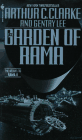
The series really comes to fruition in the third book,
The
Garden of Rama, as the human space travellers return to recruit
human volunteers to live long-term in a Raman-designed multispecies environment.
In fact, I would recommend starting with the third book rather than the
first. The Ramans still do not appear directly but we do meet their
robotic representatives and begin to learn about the structure of galactic
civilization. We are introduced to several interesting alien life forms.
The octospiders, who had been only fleeting observed by human astronauts
in earlier works now become a real material presence. They are a large
insect-like species that was originally genetically engineered by an even
more advanced species and who now base their own society on genetic engineering
of themselves and other species. A few humans also interact with an intelligent
species that metamorphasizes from large, agile insects into a kind of a
sentient organic computer. They live in symbiotic partnership with an intelligent
bird-like species. But as much as we learn about possible alien life
forms, we learn more about human nature.
The vision of galactic civilization which was merely alluded
to in the first two books and only hinted at in the third is finally unveiled
in the final book, Rama Revealed. Clarke and Gentry's
presentation of how humans would react to living with the daily presence
of intelligent aliens is eeriely convincing if not exactly flattering to
humanity.
While the Rama series is Clarke's greatest achievement,
many of his other works also stand head and shoulders above the crowd.
2001
is the most inspiring work of science fiction ever to reach the silver
screen. The subsequent books 2010 (also made into a movie),
2063, and 3001 also contain fascinating speculation
on the development of artificial intelligence and possible fusion of computers,
biotechnology, and the human mind. The original monolith beings
always lurk in the shadows, a stark if generally mute reminder of an awesome
power beyond human comprehension. 2001 is one of the first
series to present a plausible and powerful view of the universe as populated
with beings beyond human comprehension yet somehow involved in the process
of human evolution and development. These works present a convincing
portrayal of how not only scientists, but also ordinary human beings, would
react to daily life in the shadow of an awesome alien presence. I
sometimes feel as if Clarke and Gentry are sending a message from actualy
existing aliens telling all who will hear why humanity has not been admitted
into an already existing galactic federation of civilizations.
But 2001 was not Clarke's first work to
evoke truly alien aliens who interact with humans in the development of
our species. Half a century ago, when science fiction about aliens was
mired in an infancy traumatized by world war and cold war, Childhood's
End used classical religious images to not only present captivating
alien beings but even better, to spin a fascinating yarn with some truly
breath-taking plot twists. Although the passage of 50 years has made some
of its assumptions seem a bit quaint, Childhood's End still
stands as a masterful vision of a human future that is truly open.

Other Pages
My Essays on Contact with Aliens
Aliens, Gods, and Humanity: A Brief Inquiry
Why has there been no contact with Aliens?
Would Aliens be Friendly
or Hostile?
Great Novels (and sometimes videos)
on Contact with Aliens