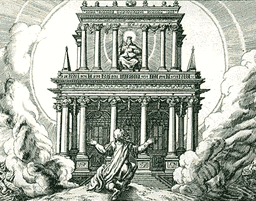
Today aliens capture the popular imagination the way gods and angels did millenia ago. There are in fact many parallels between the way people today think about aliens and the way the ancients thought about gods. Aliens and gods are both conceived of as superbeings. They are thought to have powers and capacities beyond those of mere humans. Gods, especially the later monotheistic gods, lived in the heavens, shaped the physical universe, and ruled over merely mortal humanity. In Carl Sagan's Contact, aliens engineer tunnels of space-time between the stars that allow faster than light travel. In Arthur Clarke's Rama series, advanced aliens monitor the development of innumerable intelligent species in the galaxy. Sagan's alien engineers and Clarke's alien monitors perform functions that classical thought attributed to gods.
Eric von Daniken expressed the parallel between gods and aliens most clearly when he argued that tales of gods coming down from the sky are mythological remembrances of real contact of ancient tribes with alien space travelers. Von Daniken's "chariots of the gods" thesis is highly speculative, but it does highlight the similarities between the way moderns think about aliens and the way the ancients thought about gods and angels.
Contemporary stories of aliens are also similar to classical theology in that they are a projection of human hopes and dreams. What we believe about aliens, like what we believe about gods, tells us a lot about what we believe about ourselves. Tribes that were war-like had war gods. Farming villages had goddesses of fertility and gods of thunder and lightning. Empires that sought to rule vast multicultural territories by enforcing legal codes generated law-giving gods. Similarly, people today who live in a dangerous, unpredictable world that generates paranoia and fear of the hostile "other" are going to get confirmation of their world-view from the hostile aliens and deceitful humans on the X-Files. However, more spiritually developed people with a more benign view of the world they live in are going be open to visions of aliens as spiritual and ethical teachers and partners.
Stories of aliens, like historical religious imagery, show us the limits and potentials of human nature. Starship Troopers, like "Onward Christian Soldiers" or notions of "jihad" (holy war) which drive Islamic terrorists, portray the other as evil and hostile, thus justifying acts of brutality against other human beings. What such images ultimately express is the capacity of humanity for evil and brutality. On the other hand, the movie ET parallels religious ideals of compassion and love of the other. Even more clearly than Jesus' interaction with the foreign Samarian woman at the well, ET portrays the other as something we can relate to with love and trust.
There are, of course, also some differences between stories of gods and stories of aliens. Monotheistic gods generally had dogma. The driving out of the polytheistic gods by the monotheistic religions was largely the triumph of unitary doctrines and dogmas over the ethical ambiguity of polytheistic pantheons. On the other hand, stories of aliens usually precede from a quasi-scientific view of the universe in which material reality is separated from moral doctrine. Most science fiction stories are morality tales, but they rarely rely on a god at the center of the cosmos. Ironically, most contemporary stories of aliens are thus in a sense "humanistic."
As we enter the new millenium, we still worship images of gods that were formed in previous millenia. For more than a thousand years new gods have been rare and new religions have attracted few followers, although new sects worshipping older gods have continued to flourish. The gods worshipped today appeared long before the discovery of other galaxies, space travel, the computer, the telescope, the theory of evolution, or even the concept of modern science.
Today there is much active discussion about cosmology, but it centers on articulation of the Big Bang theory rather than gods who formed the cosmos. Science has produced an image of the universe that is more vast and overwhelming than any historic theological cosmology. But scientific cosmology is without creator gods. The old man with the white beard sitting on a gold throne above earth seems a puny cartoon figure compared to unimaginably huge cosmos 20th century science has revealed.
Yet life has not been completely banished from the new expanded cosmos. The late 20th century abounds with speculation about aliens and alien contact. In fact, one could argue that today most theology is scholastic exhumation of dead ancient texts and that the real active philosophical speculation about the nature of the "life, the universe, and everything" can best be found in science fiction.

Other Pages
My Essays on Contact with Aliens
Why has there been no contact with Aliens?
Would Aliens be Friendly
or Hostile?
Great Novels (and sometimes videos) on Contact with Aliens
The Genius of Arthur C. Clarke