The primary problems we are trying to address are (1) food and income insecurity of impoverished uphill and coastal Aklanon farmers, especially women, most of whom are tenants using harmful and expensive chemical-intensive farming methods on rain-fed land plots of one half hectare or less; and (2) social and economic marginalization of poor farmers and fisher folk, maintained through a non-transparent, unresponsive service system that keep farmers dependent and placid. These problems are documented in our investigations and are corroborated by some government and other studies of local needs and conditions. We are part of a wider movement in Philippine civil society to strive peacefully for a more equitable and sustainable social order in rural provinces.
Our constituents are mainly rural tenant farmers and fisher folk living in remote, rain-fed upland and coastal communities of Panay Island, Western Visayas. A typical household numbers six members and earns an average of US$30 to $35 per month through a mix of agriculture, fishing and "sideline" enterprises (the local median income is US$75 per month). Participants in our programs are 55% women. Most are in their most productive working years (25-55), are native to Panay Island, and speak either Aklanon (in Aklan) or Ilonggo (in Capiz). Their rented lands are too small to qualify for government assistance under current national land reform legislation. In barangay development planning, we also work with a broad cross-section of local residents encompassing all age groups and classes, and with local government officials.
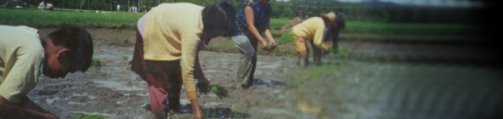
Through training of farmers in sustainable agriculture, we have sought to expand the options and tools available to small-scale tenant farmers to build food security by increasing and diversifying their food production, breaking out of dependency on chemical fertilizers and pesticides, and restoring local land and water resources. Our training has focused on imparting skills, processes and methodologies in organic rice farming, vegetable gardening, soil fertility management, dispersal and use of traditional seed varieties and natural pest management.
Through social mobilization, we have organized farmers (both women and men) and women (in their own groups) to address their problems collectively through people's organizations (P0s). Once organized, these groups have acquired skills to design and implement development projects
of their choosing. For example, organized women in Tabon have learned new skills in maintaining family health, expanded food production and processing, started small businesses, and secured local government support. In other organizing activities, farmers have worked together to increase the local water supply for irrigation, diversify crops, improve organic production of rice and vegetables, and enhance family health and nutrition.
Local governance is a three year old program of Developers that aims to increase people's democratic participation in local government units, particularly barangay councils. This has involved governance training for people's organizations (P0s) and barangay officials, facilitation of local government development planning using participatory methodologies, promoting active participation by P0s in barangay development, and accessing barangay funds for approved projects of farmer's and women's associations.
Our programs have reached 30 barangays covering eight towns of Aklan province. In these areas, we count 25 people's organizations (P0s) as local development partners with new or ongoing development projects in Aklan and Capiz. As of December 1999, roughly 180 women had organized themselves in small associations in connection with our women's empowerment program. As a result, 119 women had made strides forward in their self- esteem, leadership skills, nutrition, savings and income.
Since 1996, about 450 farmers have participated in PO organizing and adopted some mixture of organic farming practices through our sustainable agriculture training program. As a result, in 1999 these farmers had seen modest but sustained increases in rice yields, a return of local bio-diversity, more plentiful and nutritious food for their families, and, most of all, dramatic increases in savings from shedding the use of chemical inputs. Last year we also convened Barangay Development Planning workshop series. These planning workshops were facilitated by our staff but directed and shaped by community members, typically numbering 30 or more. Our host barangays are now implementing their citizens' priorities in development, including sustainable agriculture, livelihood projects run by local farmers' and women's groups, water supply, home nutrition improvement, and monitoring local interventions of the national government line agencies.
At different stages of our partnership with the people in our host communities, we have acted as organizer, trainer, convener, mentor and provider of project-oriented technical and small material assistance. Our overarching objective at every stage has been to promote people's own self advancement and their capacity to access community and government resources despite serious institutional barriers and an embedded culture of passivity.
We are excited about the breakthroughs going on in our host communities. In one community, Tabon, several groups have become highly visible in local development, recognized by the local government unit, productive in animal and food farming, and making first steps in agricultural enterprises. Our organizing work in Tabon started in 1996 based on immediate issues, but soon evolved to a stronger emphasis on leadership, organization and project capacity building for people's self-development. In 1999, three women's organizations banded together to create the Tabon Economic Development Fund (TEDF), a loan pool, to seed women's micro-enterprises included in the barangay five year development plan. TEDF in early 2000 loaned money to over 30 women to acquire new garden tools and grow organic backyard vegetables for family consumption.
Our networks have allowed us to further support the self-development of our host communities. For example, we have signed agreements with the Philippine Departments of Agriculture, Health, and Agrarian Reform to cooperate in farmer training and agricultural development in Aklan Province. We signed an agreement to coordinate development planning and project screening for women in several neighborhoods in the town of Makato. We are an active member of Barangay Bayan, a national consortium of Filipino NG0s focused on increasing democratic people's participation in local governance, and in the Southeast Asian Conference on Sustainable Agriculture, an Asian regional network of sustainable agriculture trainers. Our current and past funding partners include the Mennonite Central Committee (USA), Oxfam UK, Christian World Service (New Zealand), Swiss Catholic Lenten Fund, and Asian Partnership for Human Development.
The internal culture of Developers Foundation is grounded in a core motivation to empower rural people who are anonymous and invisible to people in power, yet are courageousand ready to make real changes in their lives through collaboration and the determined pursuit of objectives which they value. The benefits of our work with rural people are reciprocal. We draw inspiration from the people in remote, isolated communities whose patience and perseverence in the face of hardship are truly extraordinary. We seek to further the cause of these people, who by quiet example of courage, hope, persistence and creativity have shown us what development is really about.
 �
�