 _._._._._._._._._._
Much time and money is being spent on mapping the human genome. This certainly will yield a treasure trove of information. But there are tens of thousands of genomes (other creatures) that also store untold treasures. Current methods are very slow. The following is a description of a decoding technology that might be up to the task.
I give you (a drum roll please) - GENOBLINKER:
_._._._._._._._._._Imagine if you will, a humble ribosome chugging down a local message RNA (mRNA). Closer inspection shows something odd about this one. It's somewhat longer then most and emitting photons. What at first appears to be a constant glow, a high speed optical receiver determines to be an intermittent flashing of four frequencies; red, yellow, green, and blue (make up your own frequencies).
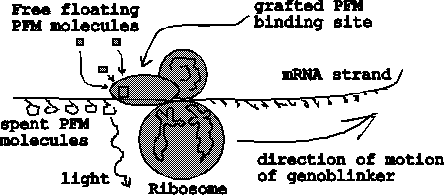
As a base, adenine (for example), on the mRNA , exits from the traditional side of the ribosome, it passes through a new grafted section. This section allows pre-fluorescent molecules (PFM) from solution to bind to the exiting base. The binding of the base and the PFM triggers the energy stored in the PFM to be released as a single flash of light.
There are four types of PFM in solution. One for each of the four bases: adenine, cytosine, guanine, and uracil. Call them PFMa, PFMc, PFMg, and PFMu. Previously, four independent chemical batches were mixed up that created these molecules in a high state of latent energy.
Just as a blasting cap is at a high state of energy and releases that energy when touched with a small electric spark; these molecules emit a flash of light when bonded to the base that each is designed for.
When PFMa bonds with adenine, it emits a red burst. When PFMc bonds with cytosine, it emits a yellow burst. When PFMg bonds with guanine, it emits a green burst. When PFMu bonds with uracil, it emits a blue burst. (make up your own frequencies).
Any heat generated by the emission is localized in the PFM, and is carried away from the genoblinker with the departure of the PFM from the area.
These PFM molecules were transported from their batches of origin and dumped into the observation dish.
The observation dish contains mRNA strands that were transcribed from the DNA under study (using old technology). The dish contains one genoblinker and the usual cellular solutions to support its existence as a ribosome. An abundance of the four PFM molecules are present. A population of genoblinkers may be necessary to insure that at least one will find the mRNA strand in a reasonable time. Clearly no more than one genoblinker may be transmitting at a time.
The genoblinker will decode all the mRNA once and not be able to reprocess any. This is because the PFM molecules have been bonded to the mRNA and hence prevent the reentry of the mRNA into the traditional entrance of the ribosome.
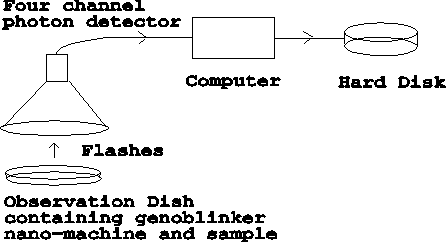
The external "macro-machine" is straight forward and can be built with present off-the-shelf components. The four channel photon detector is simply a device that will receive the flashes from the genoblinker and convert them to "on-off" signals that the computer will store on the hard drive.
There would be four detectors, each one sensitive to a different one of the four frequencies emitted by the genoblinker. When the computer receives an "on" signal it knows which base should be written down (on the hard drive) by virtue of which channel the signal came from.
You may well ask, why bother to soup up a ribosome to make a genoblinker?
The answer is, that it's always easier to modify something that is close to what you want, than to make a brand new one from scratch. Consider what a ribosome does already.
We want it to do these functions, but in addition, blink while it works!
A mapping technology based on genoblinkers would allow small labs throughout the world to contribute to human progress in genetics. A mom and pop lab could order a vial of genoblinkers, PFM molecules, and a photon detector (from a large lab) and be in business. A small outpost in the Amazon would be possible.
A genoblinker has information, of the genetic code, flowing up from the small world of molecules, to the macro world of everyday life, through a communications link of light.
The next obvious question to ask is, can we reverse the direction, and send genetic code from the computer down to a "genobuilder" ?
Someday we will have a neat design for an entire creature on the hard drive. It would be nothing to flash a sequence of four frequencies down into a dish. The hard part would be to create a genobuilder that would receive the signals and build a DNA molecule (or an RNA precursor), base by base.
Once the genome is constructed out of molecules, growing the creature would be easy.
As of this writing, I haven't a clue of what a genobuilder would look like.
© January 8,2000 William Day (email:[email protected])
All
rights reserved. Licensing inquiries invited.
