1/25/2000- It's a few weeks later now, and I get the feeling that souping up a ribosome as a genoblinker, may be like using a Rolls Royce to carry manure. It could be done, but it's not very elegant.
During protein synthesis is not the only time PFM molecules could be bonded to bases (with resulting light emission); bases are also exposed during both replication and transcription.
It may be that replication would be a better time for blinking.
Consider what happens during normal replication. An unzipper enzyme splits the two spines of DNA open and reveals the internal bases. Nucleotides, in solution, then bond with their appropriate bases to begin a new DNA helix.
Well you may say, it's obvious that all you need do is to have no nucleotides floating about, and instead have PFM molecules in solution. As the bases are exposed, the PFM molecules would bind and flash out the desired code.
But not so fast. (If anything can go wrong, it will go wrong). If the unzipper should expose adenine(1), cytosine(2), guanine(3), and thymine(4) in rapid sequence; it may be, from random chance, that the mating PFM molecules may appear, in the area, in the order 3,2,1,4; bind, and fire off the wrong code sequence. In natural replication, a lock step binding, one after the other, may not be necessary. As long as the right base pairs are mated, all's well. In genoblinking, sequentially binding (and firing) is required.
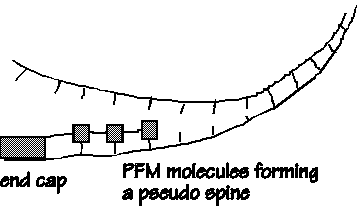
Therefore it may be necessary to form a spine structure like the following:
Here the idea is that a PFM molecule would be made that would not be bound sufficiently to an exposed base, without a bond also to the previous PFM molecule. This would force a sequential binding (and firing) to occur. It would appear that a starter molecule (end cap) would be needed to be developed as well.
I would imagine that this revised approach would be significantly easier than refitting a ribosome to do blinking.