B.F. Skinner
(1904-1990)
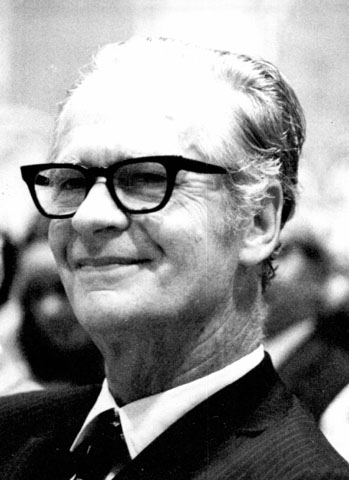
B.F. Skinner (1904-1990)
|
|
" We take advice, heed warnings, observe rules, and obey laws, and our behavior then comes under the control of consequences which would otherwise not be effective."
~~~
"The real problem is not whether machines think but whether men do."

-
American psychologist
- Undergraduate degree in English from Hamilton College
-
Enrolled in Harvard Psychology Department at age 24
-
Encouraged to experiment in both Psychology and Physiology Departments
- Taught at University of Minnesota, Indiana University and Harvard University
- 1938 ~ Published The Behavior of Organisms, one of his most significant works
- 1948 ~ Published Walden Two, his vision of Utopia based upon his theories for operant
conditioning
- Died of leukemia in 1990
Skinner is particularly known for his work in the area of behaviorism. Through his work in this science, he became interested in how behavior could be shaped and controlled with reinforcement. His work was often controversial and often misunderstood. For some time, an unfounded rumor circulated that he had used his second daughter as a subject in her own "box".
It is important to note that operant conditioning is not learning by trial and error. The premise of operant conditioning is that subjects, or students, can be taught by providing immediate reinforcements for correctly learned information, skills or behavior. The desired responses will build on each until the student has developed the whole, desired outcome. Each smaller acquisition will add onto the next and the student will receive continual, immediate, positive feedback when success has been made at the level, thus encouraging the student to continue learning.
Skinner also strongly emphasized the use of positive reinforcement rather than negative reinforcement. He contended that negative reinforcement can bring about a particular desired behavior, while developing other unwanted ones. For example, students who are punished when they do not study may study, but they may also stay away from school (truancy), vandalize school property, attack teachers, or stubbornly do nothing.
Operant conditioning has led to the contribution of many developments in education:
(1) instructional
objectives
(2) programmed instruction
(and its offshoot, computer-assisted instruction)
(3) mastery learning
(4) contingency contracts
(5) applied behavior
analysis
1. By understanding operant conditioning, teachers can develop instructional objectives that will focus on behavioral objectives, which will be observable, measurable with an explanation of the conditions under which the behavior should be exhibited and the criterion for judging the acceptable performance of the behavior. Teachers can easier develop objectives that will lead from simple memorization to evaluation (Bloom's taxonomy).
2. With programmed instruction, goals of instruction are specified at outset, the student is required to make a response in each frame instruction begins with info the student already knows; new info is broken up into small pieces, and instruction proceeds through a gradual presentation of increasingly more difficult pieces, with the terminal behavior gradually shaped, and because of the gradual shaping process, it's highly probable that the student will give correct answers to the questions asked; each correct answer is reinforced immediately with feedback that it is correct
3. Mastery learning is developed in such a way that the student must learn on lesson beofer moving on to the next. Lessons are developed as units of a small amount of material, sequenced so that each basic concept is foundation to later units. Before going on, students get feedback and reinforcement that they have "mastered" the content by taking and passing a test and activities are developed to provide extra help for students not exhibiting mastery on the first try.
4. Contingency contracts are agreements between teacher and student that explain the required outcomes and consequences for the student. Essentially this is goal setting with outcomes for the student.
5. Applied behavior analysis entails modifying the environment and conditions that have led to a student exhibiting inappropriate behavior so as to illicit desired behavior.
In education, Skinner's most interesting contribution has been the development of the teaching machine and programmed learning. The idea is for the student to progress at his/her own rate in small stages until a body of knowledge has been mastered. The student is told the correctness of the answers right away so to see where mistakes have been made. Hopefully, the student will learn from the mistakes immediately. In the past, this has been used to a small degree in the development of text books.
The content in programmed instruction is arranged in small chunks and organized in a simple to complex sequence. The learner progresses by responding correctly, receiving feedback, and moving forward. If the response is incorrect, the learner repeats instruction until there are no mistakes. This allows the learner to set his own pace. The instruction is linear with no paths diverging from the directed instruction.
This has also become a foundational concept for educational software. In such educational software programs as the Reader Rabbit series and Jumpstart series, students are encouraged to complete a number of challenges. As each challenge, or question, is completed, the student is able to move onto the next level. Each level becomes more and more challenging and advancement (reward) is dependent upon student learning the new knowledge or skills needed to move on (modification).
In some ways, technology has had more of a influence on how educators use the principles of operant conditioning than the other way around. Basic principles of operant conditioning have been adopted to technology, such as preventing small chunks of information, requiring mastery of one level to allow for moving forward and providing immediate feedback on progress. Technology, specifically improvement in the use of computer, has allowed for complex branching of content, record of student response, graphics and speech, drill and practice, problem solving, and tutorials. However, the basic principles of operant conditioning still guide the development and use of technology in education.
Skinner proposed that subjects (students) could not move to the next level of learning unless they had completely mastered the previous level. He also required students to 'overtly' compose responses that would show mastery of the skill or knowledge presented. He did not rely on multiple choice answers. This made it both difficult and tedious for those subjects who did not show mastery on the first attempt.
Although programmed instruction is effective in achieving certain learning outcomes, it is sometimes characterized as boring because of the monotony, repetition, and small steps towards mastery. As computers have become more powerful and programming more complex, some of these concerns have been addressed. Computer programs are faster and more interesting, graphics and sound have made computer assisted learning
There has also been criticism from those who believe that operant conditioning takes away from the individuals freedom. By consciously attempting to modify the way an individual thinks or behaves, we are imposing our own will upon the the individual.
Computers are being used more and more in the classroom. They are more powerful, cheaper and more utilized than ever before. Operant conditioning will certainly continue to have a significant influence on technology in education. As computers become faster and programming becomes more complex, technology influenced by Skinner's theories, will play greater roles in the classroom. Schools of education continue to improve their standards for educating teachers on the use of technology in their profession. More and more new teachers are being trained on how to use the computer as a personal assistant, as well as a teaching tool. Senior teachers are becoming more comfortable and more competent using the computer.
Teachers can use telecommunication, such as the Internet to help them develop behavioral objectives. Teachers are becoming more aware of how programmed instruction works and more software programs are being developed that utilize the concepts of operant conditioning and programmed instruction. Program designers and software companies are becoming more aware of how much students can learn using technology. Skinner's ideas will continue to be put to use well into the future, even if those who use them, do not understand the concepts or the educational philosophy behind them.
http://teachnet.edb.utexas.edu/~lynda_abbott/Opinnov.html
http://www.bfskinner.org - A web site created by the BF Skinner Organization, includes an article by Skinner's eldest daughter, Julie Vargas.
Contact - [email protected]