An Interview with BF Skinner
It seems to me that most of the confusion and criticism toward the use of operant conditioning with children has stemmed from a misunderstanding of the basic fundamentals of the theory. This interview was conducted with open-ended questions, in an attempt to clear up some of these misunderstandings. A few of these questions appear here. The interview led to the development of a web page on Skinner and his work. ~ D. Gaudet
Please check it out here: http://www.geocities.com/derekgaudet/bfskinner.htm
I: Welcome Dr. Skinner, it is a great pleasure to have this opportunity to talk to you.
BF: Thank you for having me here, it's an honor to see that there is still interest from the public in my theories.
I: Can you tell us a little about yourself and what led you to your work in operant conditioning?
BF: Well, I was born in Pennsylvania in 1904 and eventually received a degree in English. I truly wanted to be a writer, but found I had nothing to say so I went back to school. I completed my doctorate in psychology from Harvard in 1931. My father was a lawyer and my mother was a housewife. As a youth, I was never severely disciplined by my parents, but I did develop a healthy respect for law and authority. I realized that much of what I had learned as a youth came from conditioning. I had never been beaten, yet I had developed this respect I mention. I finally understood that it was the constant efforts of my parents to reinforce my good behavior that had encouraged me to continue to exhibit good behavior. I read a great deal and was very interested in the work of Pavlov and Watson and this interest gave me the encouragement to pursue my studies in psychology. In Harvard, I worked well with my mentor, Dr. William Crozier. It was there that I began looking at the way in which behavior is affected by conditions.
I: To the layman, you are best known for your work with training rats to run around a maze while you played with rewards and punishments. Was your work more than that?
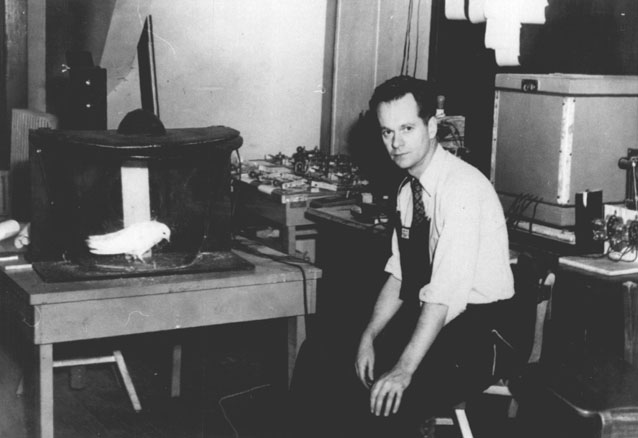
BF: Oh yes, I actually began my studies in psychology and physiology. I was pretty much left on my own and found it very interesting to study the behavior of rats. I was interested to see if their behavior could be modified and what methods would be the most effective. I wasn't convinced that they were learning through trial and error, but rather they were learning by being rewarded with success. It seemed to be much more complex than simple reflex.
I: How do you respond to criticism from educators such as Alfie Kohn who suggest that, "even when children are 'successfully' reinforced or consequenced into compliance, they will likely feel no commitment to what they are doing, no deep understanding of the act and its rationale, no sense of themselves as the kind of people who would want to act this way in the future. They have been led to concentrate on the consequences of their actions to themselves, and someone with this frame of reference bears little resemblance to the kind of person we dream of seeing each of our students become"?
BF: Essentially, operant conditioning is another tool that teachers can use to modify the behavior of their students. One can agree that it is manipulating the child and the child performs solely for the reward or to avoid the punishment. However, the bottom line is that the students are behaving in a way that makes it possible for the teacher to teach in the class. Imagine, a classroom where the teacher is dedicating 50% of his or her time to trying to "motivate" one child. What is happening for the other children? I would propose modifying the behavior of the one discipline problem to enable the teacher to get on with the job of teaching the class.
As far as developing deep understanding and rationale, well , our moral code is more than what is taught in school. The child learns from verbal reinforcement from society, from adults, from peers and so on. When a child learns something correctly and is told it is correct, that affirmation is a conditioning factor. When they take that knowledge and proceed to the next level of learning, we witness operant conditioning. Freedom is simply the concept of feeling free. I personally do not condone punishment, but admit that punishment, or the fear of punishment can condition a subject to behave in a desired way. It is much better to use positive reinforcement than negative.
I: Can you explain more on how an understanding of operant conditioning and programmed instruction can help teachers become better educators?
BF: Understanding these concepts can help teachers in many ways. Mr. Gaudet, in your recent article on operant conditioning and programmed learning you detail five very good contributions that these concepts have made to the field of education. Assisting teachers in understanding and writing behavioral objectives, furthering the development of programmed instruction, encouraging mastery learning, introducing contingency contracts and allowing for applied behavior analysis in developing plans for behavior modification have all become essential factors in education. I would refer readers to this article.
I: In regards to technology, how do you see the utilization of operant conditioning and programmed learning for the future?
BF: Many e-learning providers are using Internet technology to implement basic educational techniques that are derived from programmed learning models. Software for children such as the Reader Rabbit and the Jump Start series have been developed using programmed learning theory. I have noticed that technology has developed at a tremendous rate and this is for the benefit of mankind. Early programmed learning models simply developed memorization of facts, rather than mastery of skills. When I first developed the concept, I had no idea how far technology could go.
Instructional design has moved beyond programmed learning to cognitive learning theory, which views learning as an active, creative endeavor. Learning theory has progressed even further toward a constructivist model, which holds that active learning occurs best when it addresses real-life complexity in a natural context.
It would be a mistake to adhere to an orthodox use of behaviorism in schools today. The world is different, technology is better, and children think differently than they did 40 years ago, or even ten years ago. It is time to take what works best from the many theories available to use and create the best possible situation for the students of today. I am very pleased to see that my early theories have aided the evolution of learning with the use of technology to the point where the highest orders of learning can be addressed, assessed and developed. I hope that educators continue to look into what works best for children.
In the words of Louis Armstrong: "What a wonderful world."
I: I: Dr. Skinner, thank you very much for this interview. I think that we have covered a great deal here. Hopefully our readers will now better understand that operant conditioning. It is helpful to reconsider this as a tool that teachers can use to better understand their students, how students can learn and what can affect their learning processes. I think that there is still a great deal that can be accomplished by incorporating many of your ideas into the use of technology as we continue to study how we can use technology to enhance the learning experience of our students in the modern, technological world.
Conducted by D. Gaudet, in the office of S. Lucas, University of Alabama,
September 17, 2002.
Please note - this interview was not real, it was done as part of a project for a course at the University of Alabama. BF Skinner has been dead since 1990.
Even Skinner couldn't be conditioned to come back and give an interview.
Some sources for technology
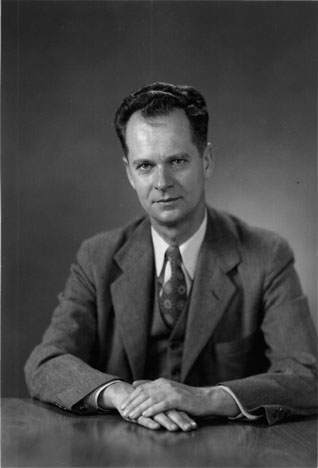
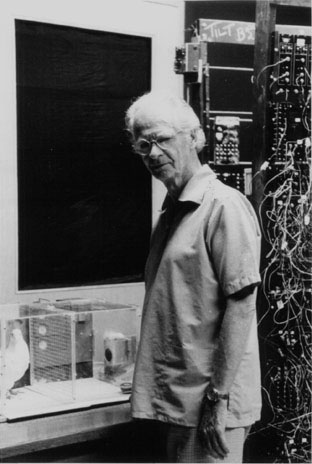
Pictures of BF Skinner, courtesy of Skinner Foundation: http://www.bfskinner.org
For a good article on the development and use of technology in programmed learning: http://www.learningcircuits.org/2001/feb2001/sevilla.html
A helpful handbook for technology and teaching can be found at: http://tltc.shu.edu/handbook/chapter2/Index.htm
Some good ideas on computer based technology and learning: http://www.ncrel.org/tplan/cbtl/phase1.htm
And a word of warning: http://www.december.com/cmc/mag/1994/jul/tech.html